
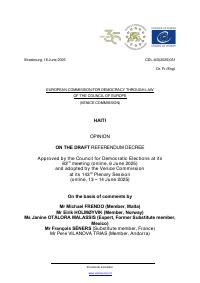
CDL-AD(2025)031: Opinion on the draft referendum decree
- The draft decree details the voting procedure but omits much of what the 2024 opinions asked for.
- The fundamental principles of electoral law cannot be fully guaranteed in the present Haitian context, and voters cannot freely express their wishes in areas controlled by armed groups.
- Asks that gang members be barred at minimum from the electoral administration, and that observers be given the same security guarantee as voters and polling staff.
- Asks that the decree itself carry the secrecy of the vote and the arrangements for displaced persons, including polling stations in displacement sites.
- Objects that appeals against CEP decisions would be heard by a body containing CEP members.
- Notes the referendum date was still unknown when the opinion was adopted.
The Venice Commission's opinion on Haiti's draft referendum decree, requested by letter of 6 May 2025 from Patrick Saint-Hilaire, President of the Provisional Electoral Council. The draft was circulated as CDL-REF(2025)028, and a Commission delegation held online meetings with the CEP on 28 May 2025. It is the first of the three opinions the CEP asked for itself; the two 2024 opinions were requested by the OAS.
The opinion sets the draft against what it calls one of the deepest political and institutional crises in Haiti's modern history: no legislative elections since 2019 and government by unelected authorities, which the Commission says has profoundly undermined the constitutional and democratic framework of the State, on top of dysfunctions already inherent in the 1987 Constitution.
It repeats that a minimum level of security must be re-established before any vote, and observes that developments in recent months point to further deterioration. The Commission finds that the fundamental principles of electoral law, under Article 25 of the International Covenant on Civil and Political Rights, Article 23 of the American Convention on Human Rights, Article 3 of the First Additional Protocol to the European Convention on Human Rights, the Code of Good Practice in Electoral Matters and the revised Code of Good Practice for Referendums, cannot be fully guaranteed in the current Haitian context, and that the freedom of voters to express their wishes cannot be achieved in areas controlled by armed groups.
On the text itself, the Commission finds that the draft mainly details the voting procedure and leaves out much of what its earlier opinions asked for. Its fourteen key recommendations, lettered A to N, ask the decree to set out the broad outlines of the security framework, to clarify how far the 2021 electoral decree applies to this referendum, to guarantee the vote of displaced persons including through polling stations in displacement sites, and to provide at least the essential arrangements for voters abroad.
The remaining recommendations concern the conduct of the vote and the handling of complaints: writing the secrecy of the vote into the decree, providing for a lower electoral administration of balanced composition whose members cannot be freely revoked, developing campaign rules to international standards, limiting public campaign funding without encouraging parties with no real basis, keeping appeals against CEP decisions away from a body containing CEP members, allowing only citizens to lodge appeals directly, lengthening the deadlines for appeals and decisions, empowering the Referendum Litigation Office to annul a ballot where an irregularity may have affected the outcome, reviewing the criminal provisions against necessity and proportionality, and clarifying the scope of the referendum code of conduct.
The referendum date was still unknown when the opinion was adopted, at the 143rd Plenary Session on 13-14 June 2025.
How to cite
Venice Commission (Council of Europe), CDL-AD(2025)031: Opinion on the draft referendum decree, https://www.venice.coe.int/webforms/documents/default.aspx?pdffile=CDL-AD(2025)031-e
- Rights holder
- Council of Europe (Venice Commission)