Republic of Haiti
Document Library
4,677 documents 213,367 pages
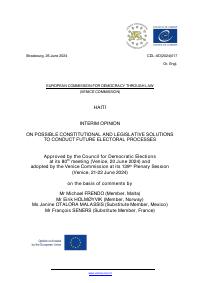
CDL-AD(2024)017: Interim Opinion on constitutional and legislative solutions for future electoral processes

CDL-AD(2024)017: Interim Opinion on constitutional and legislative solutions for future electoral processes

Venice Commission (Council of Europe) 2024-06 15 pages
Summary — The Venice Commission's first opinion on Haiti's electoral framework, requested by OAS Secretary General Luis Almagro on 4 March 2024. It is interim because the Commission had not yet been able to meet Haitian representatives. It sets out the issues to be settled before any vote, from voter registration and equal access to the ballot across the territory to the composition of the electoral administration and the resolution of electoral disputes.
Key Findings
Full Description

The Venice Commission's first opinion on Haiti's electoral framework. It was requested by letter of 4 March 2024 from Luis Almagro, Secretary General of the Organization of American States, who asked the Commission to analyse the legislative framework for Haiti's elections alongside the recommendations of past OAS electoral observation missions, and to help identify legislative solutions for future electoral processes.

The Commission is explicit about the limits of its role. The choice among those solutions belongs to the authorities and the people of Haiti; its own task is to supply the analysis, the international standards and the comparative experience on which an informed decision can rest. The opinion is interim because, with no stable institutions in place and a meeting with the Transitional Presidential Council still pending, the Commission published without having heard the Haitian side.

Its recommendations set the agenda the two later opinions build on: that every Haitian national be able to take part, that voters be properly registered, that access to the vote be equal across the territory, and that restrictions on the right to be elected be limited to criminal convictions. On the machinery, it asks for a lower electoral administration balanced in composition whose members cannot be removed at will, faster and transparent transmission of results, an appeal that does not return to the body being appealed against, and full access for domestic and international observers at every stage.

On representation it asks for limited public campaign financing that does not reward parties with no real basis, equal access to public media, and effective measures for women and young people as both candidates and voters. Haiti's last Parliament held four women among 149 members.

Adopted at the Commission's 139th Plenary Session on 21-22 June 2024, after approval by the Council for Democratic Elections on 20 June, on the basis of comments by Michael Frendo, Eirik Holmøyvik, Janine Otálora Malassis and François Séners.

Sectors
Geography
Time Coverage
2024 — 2024
Entities
Commission européenne pour la démocratie par le droit (Commission de Venise)Conseil de l'EuropeOrganization of American States (OAS)Conseil Électoral Provisoire (CEP)
Full Document Text

Extracted text from the original document for search indexing.

Strasbourg, 26 June 2024 CDL-AD(2024)017 Or. Engl. EUROPEAN COMMISSION FOR DEMOCRACY THROUGH LAW (VENICE COMMISSION) HAITI INTERIM OPINION ON POSSIBLE CONSTITUTIONAL AND LEGISLATIVE SOLUTIONS TO CONDUCT FUTURE ELECTORAL PROCESSES Approved by the Council for Democratic Elections at its 80th meeting (Venice, 20 June 2024) and adopted by the Venice Commission at its 139th Plenary Session (Venice, 21-22 June 2024) on the basis of comments by Mr Michael FRENDO (Member, Malta) Mr Eirik HOLMØYVIK (Member, Norway) Ms Janine OTALORA MALASSIS (Substitute Member, Mexico) Mr François SENERS (Substitute Member, France) www.venice.coe.int CDL-AD(2024)017 -2- Opinion No. 1193/2024 Table of Contents I. Introduction ................................................................................................................... 3 II. Background and constitutional framework ..................................................................... 3 III. Analysis ......................................................................................................................... 5 A. Constitutional issues.................................................................................................. 5 B. Applicable legislation ................................................................................................. 6 C. Issues to be addressed ............................................................................................. 7 1. Right to vote and to be elected ........................................................................ 7 a. Access to citizenship........................................................................................ 7 b. Restrictions to the right to vote and to be elected ............................................. 8 c. Voter registration ............................................................................................. 9 d. Out-of-country voting ....................................................................................... 9 2. Electoral administration .................................................................................... 9 3. Voting and counting ....................................................................................... 10 4. Complaints and appeals ................................................................................ 10 5. Election observation....................................................................................... 11 6. Election campaign and campaign finance, media .......................................... 12 7. Electoral system ............................................................................................ 13 IV. Conclusion .............................................................................................................. 14 CDL-AD(2024)017 I. -3- Opinion No. 1193/2024 Introduction 1. By letter of 4 March 2024, Mr Luis Almagro, Secretary General of the Organization of American States (OAS) requested the Venice Commission to “analyze the legislative framework for Haiti’s elections, along with the relevant recommendations of past OAS Electoral Observation Missions and help identify legislative solutions that could serve as a basis for conducting the next and future electoral processes in Haiti.” 2. Mr Michael Frendo, Mr Eirik Holmøyvik, Ms Janine Otálora Malassis and Mr François Séners acted as rapporteurs for this opinion. 3. On 13-15 May 2024, a delegation of the Commission composed of Mr Frendo, Mr Holmøyvik (online), Ms Otálora Malassis and Mr Séners, accompanied by Ms Simona Granata-Menghini, Secretary of the Venice Commission, and Mr Pierre Garrone from the Secretariat, held meetings at the seat of the Organization of American States (OAS) in Washington DC. The delegation met with current and former Haitian officials, including former electoral officials; members of Haitian civil society; the OAS Assistant Secretary General Mr Nestor Mendez; several Permanent Representatives to the OAS; several Haitian and non-Haitian experts; and senior officials of the OAS. The Commission is grateful to the secretariat of the Organization of American States for the excellent organisation of this visit. 4. Due to the lack of stable institutions in Haiti and pending the possibility of a meeting with the Transitional Presidential Council, it was decided to proceed with an interim Opinion at this stage. 5. This Interim Opinion is intended at presenting an overview of the essential issues to be addressed in order to proceed with the organisation of future elections. It does not intend to be directive but aims at assisting the Haitian authorities in taking balanced and informed decisions. 6. This Opinion was drafted on the basis of comments by the rapporteurs and the results of the meetings on 13-15 May 2024. It was approved by the Council for Democratic Elections at its 80th meeting (Venice, 20 June 2024). It was examined at the joint meeting of the Sub-Commissions on Democratic Institutions and on Latin America on 20 June 2024 and, following an exchange of views with Mr Francisco Guerrero, Secretary for Strengthening Democracy, Organization of American States, it was adopted by the Venice Commission at its 139th Plenary Session (Venice, 21-22 June 2024). II. Background and constitutional framework 7. The current Constitution of Haiti was adopted in 1987 following a constitutional referendum. Its preamble sets out to create “a stable and strong State, capable to protect the values, traditions, sovereignty, independence and national vision”. Parliament is composed of two chambers, the Chamber of Deputies and the Senate. The Chamber of Deputies is directly elected in its entirety by the citizens every four years (Article 92-3). The Senate is directly elected by the citizens. The senators’ mandate is six years. One third of the Senate is renewed every two years. The Plenary Session is responsible inter alia of the formation of the Permanent Electoral Council (Article 192); its quorum is the majority of each chamber. 8. The executive power is exercised by the President of the Republic and by the Government (Article 133). The President is directly elected by the people for a term of five years (Article 1341) which cannot be extended and can be renewed only once, no earlier than 5 years after the end of the first mandate (Article 134-3); the President is responsible for the respect and the execution of the Constitution and for the stability of the institutions, and ensures the smooth functioning of the state powers and the continuity of the state (Article 136). S/he guarantees the independence and the territorial integrity of the state (Article 138). The Government is composed of the Prime Minister and the ministers and state secretaries; it is responsible for the state policy CDL-AD(2024)017 -4- Opinion No. 1193/2024 and is responsible before Parliament (Article 156) for both the acts of the President of the Republic which they countersign and of the acts of the ministers. The Prime minister is chosen by the President among the members of the party which has the parliamentary majority, or, if there is no such majority, in consultation with the Presidents of the two chambers of Parliament. The President’s choice of Prime Minister needs to be ratified by Parliament (Article 137). The Government must then obtain the confidence of Parliament on its general policy (Article 158). Either Chamber of Parliament may vote a motion of no confidence in a minister (Article 172), which leads to the latter’s dismissal (Article 172). The President may dismiss the Prime Minister and receives her or his resignation. The President presides over the meetings of the Council of Ministers. 9. The Constitution also provides for a Permanent Electoral Council (PEC) which is mandated to organise and “control in all independence” the electoral operations on all the territory of Haiti until the proclamation of the electoral results (Article 191-1). The PEC prepares the draft electoral law, which it submits to the executive for the necessary follow up (article 191.1) and ensures the updating of the electoral lists (Article 191-2). Article 192, as amended in 2012, provides that the PEC is composed of nine members: 3 chosen by the Superior Council of the Judiciary, three by the National Assembly (with a 2/3 majority in each chamber) and 3 by the Executive. The PEC members are elected for a non-renewable term of nine years (Article 194). One third of the PEC is renewed every three years (Article 194-1). The PEC is also competent to rule on every dispute arisen in the context of the elections and on the application or violation of the electoral legislation, subject to further legal proceedings being brought against the responsible persons before the competent courts (Article 197). 10. Since 1987 no permanent electoral legislation has been adopted. Nor could a Permanent Electoral Council be created. 19 Provisional Electoral Councils were successively set up.1 Each set of elections was therefore organised on the basis of provisional (ad hoc) legislation. This legislation was adopted in the form of a statute, except in 2015 when a statute could not be adopted, and elections were organised on the basis of a presidential decree. 11. The last parliamentary elections took place in 2015 and the last presidential elections in 2016. Since then, the mandates of parliamentarians have come to an end and Parliament has ceased its functions. The post of President has been vacant since the murder of President Jovenel Moïse in 2021. 12. On 3 April 2024, a political agreement for a peaceful and orderly transition was signed by a number of political stakeholders including Prime Minister Ariel Henry, representatives of political parties and organisations, as well of civil society and of religious organisations. This agreement provides inter alia for the creation of a Transitional Presidential Council composed of nine members; of a Government directed by a Prime Minister as well as of a Supervisory Body of Governmental Action (Organe de Contrôle de l’Action Gouvernementale). It also provides that, during its first operation, the Transitional Presidential Council will appoint a Provisional Electoral Council composed of nine members, representing nine sectors (religious communities, academia, civil society, trade unions). 13. The Transitional Presidential Council was appointed by decree of the Council of Ministers dated 12 April 2024. It was given a non-renewable mandate until 7 February 2026. Mr Garry Conille was appointed as Prime Minister on 28 May 2024. A new Government was formed on 11 June 2024. 14. For what concerns electoral matters, this interim Opinion will be mainly based on the following standards: 1 P. de Bard, In Haiti, as elsewhere, Elections alone are not the answer. CDL-AD(2024)017 -5- Opinion No. 1193/2024 - United Nations, universal standards: • International Covenant on Civil and Political Rights (ICCPR), Article 25(b) (right to vote and to be elected); • CCPR General Comment No. 25: Article 25 (Participation in Public Affairs and the Right to Vote), The Right to Participate in Public Affairs, Voting Rights and the Right of Equal Access to Public Service; • Universal Declaration of Human Rights, Article 21; • Declaration of Global Principles for non-partisan election observation and monitoring by citizen organizations and Code of Conduct for non-partisan citizen election observers and monitors, CDL-AD(2012)018. - Organization of American States: • American Convention on Human Rights, Article 23(b) (right to vote and to be elected); • American Declaration of the Rights and Duties of Man, Article XX; • Inter-American Democratic Charter, Article 1 (right to democracy); • Electoral good practices guide for strengthening electoral processes (2021); • Second manual for OAS election observation missions (2024). - Council of Europe: • First Additional Protocol to the European Convention on Human Rights, Article 3 (Right to Free Elections); • Venice Commission, Code of Good Practice in Electoral Matters, CDL-AD(2002)023rev2cor. III. Analysis A. Constitutional issues 15. The Venice Commission notes that the 1987 Constitution contains provisions which may lead – and have indeed led - to the paralysis of the state institutions. As was explained to the Commission, elections should be organised every 18 months. If, on account of some dysfunction, elections cannot be held for more than four years, a vicious circle is triggered which spirals down to crisis and paralysis: with no functioning PEC, and no permanent electoral law, further elections cannot be organised; without elections, Parliament ceases to exist, the President cannot be elected, and the PEC cannot be formed. There is no provision in the Constitution allowing for continuation of the institutions pending new elections in case of delays or dysfunctions. As a consequence, once this spiral has been triggered and the mandate of the state institutions has expired, there cannot be any constitutional solution to the crisis; only an extraconstitutional solution may be envisaged. Under conditions of emergency, when it is impossible to comply with the Constitution, it is well-established that resort to the de facto doctrine and the principle of state necessity may be appropriate in exceptional circumstances, in order to preserve society and to protect the principle of the rule of law.2 Haiti has reached this stage. 16. While the Haitian authorities’ immediate concern is, once security is assured, to organise presidential and parliamentary elections, which necessitates some degree of derogation from the constitutional rules, the question arises as to if, how and to what extent the Constitution needs changing before the new elections are held. This is a choice the authorities need to make soon. In the Commission’s view, in order to avoid that the future institutions be subject to the same instability and threat of crisis as nowadays, the rules providing for partial renewal of the Senate and the PEC without a mechanism ensuring their continuation pending such renewal, and the 2 See Supreme Court of Canada re Manitoba Language Rights, (1985) 1 Supreme Court Law Reports 721 at pp. 747 to 768, which canvasses the jurisprudence of other courts on these questions. CDL-AD(2024)017 -6- Opinion No. 1193/2024 provision that an electoral law is prepared by the PEC for each electoral cycle, should be amended before the new elections are held. 17. As to the procedure to be followed, the Venice Commission notes that the current Constitution (title XIII) provides for a very lengthy amendment procedure, requiring supermajorities of both chambers sitting jointly (Article 284-1) and two presidential mandates (Article 284-2). Amending the Constitution through referendum is formally prohibited (Article 284-3). The Venice Commission cannot but acknowledge that amending the Constitution through the constitutional procedure cannot be envisaged in Haiti before the state institutions are reestablished, with due regard to the situation of necessity in Haiti. 18. If it is accepted that a constitutional amendment is necessary before the new elections and that it is therefore to be carried out through an extraconstitutional procedure, it should be acknowledged that such amendment would have a very limited democratic legitimacy, being prepared by a body, the Transitional Presidential Council, which has not been elected by the people of Haiti. The question of the extent of the constitutional amendment therefore arises. Extensive constitutional amendments have been discussed in Haiti in the last decade and at least two sets of amendments (in fact, new constitutions) were prepared. Several interlocutors met in Washington strongly argued in favour of an extensive constitutional reform to be carried out prior to the new elections. 19. It was argued by several interlocutors met in Washington that the people of Haiti is currently facing extreme hardship and, once security is restored and elections may be held, would not necessarily consider a lengthy procedure of constitutional amendment to be a priority and would rather expect and demand that a functional State focus on providing basic public goods to its citizens. A certain balance between the needs of legality and democratic legitimacy of the constitutional amendments on the one hand, and priority to effective governance on the other hand will need to be found. The Venice Commission stresses that it will be for the Haitian transitional authorities to decide if constitutional amendments should be prepared, and how extensive they should be. The Venice Commission considers that the people of Haiti should be consulted to the maximum extent possible and that the feedback from the past constitutional amendment consultations should be used for the preparation of the future amendments, given that, at this stage, the security situation and the time pressure would not allow to hold constitutional consultations. In the Venice Commission’s view, therefore, if it is decided to amend the Constitution prior to the new elections, it would be advisable, in the interest of democratic legitimacy, for a referendum to be organised in order for the people of Haiti to endorse, and “own”, these future constitutional changes. B. Applicable legislation 20. The Venice Commission has consistently advocated for the need to ensure stability of electoral law.3 As stated in the explanatory report to the Code of Good Practice in Electoral Matters, “[s]tability of the law is crucial to credibility of the electoral process, which is itself vital to consolidating democracy. Rules which change frequently – and especially rules which are complicated – may confuse voters. Above all, voters may conclude, rightly or wrongly, that electoral law is simply a tool in the hands of the powerful, and that their own votes have little weight in deciding the results of elections. The problem is not so much changing voting systems – they can always be changed for the better – but rather changing them frequently or just before (within one year of) elections. Even when no manipulation is intended, changes will seem to be dictated by immediate party-political interests.”4 In the current situation, with no 3 On stability of electoral law, see Venice Commission, Code of Good Practice in Electoral Matters, CDLAD(2002)023rev2-cor, II.2.b; Interpretative declaration on the stability of the electoral law, CDL-AD(2005)043; Revised interpretative declaration on the stability of electoral law, CDL-AD(2024)027. 4 Venice Commission, Code of Good Practice in Electoral Matters, CDL-AD(2024027). Venice Commission, Code of Good Practice in Electoral Matters, CDL-AD(2002)023rev2-cor, II.2.b, §§ 63, 65. CDL-AD(2024)017 -7- Opinion No. 1193/2024 elected institution in office, the issue of stability does not arise as such. However, it seems appropriate to take the legislation applied to the latest recent elections as a point of departure. This is particularly true for the law to be applied to a constitutional referendum to be organised before any elections and/or to the first elections to take place in the absence of any democratically elected institutions. 21. In case the Constitution is modified, electoral law will of course have to be adapted to the revised constitutional framework. Depending on how extensive the future constitutional amendments may be, this adaptation may first concern the way of electing constitutional bodies, including the electoral system. Such issues cannot be addressed in abstracto but the whole constitutional and legal context will have to be considered, including the nature of the political institutions and their interrelations, and in particular the determination of the bodies which are directly or indirectly elected, the division of powers and the presidential or parliamentary nature of the system. 22. The first vote will take place under the Political Agreement, which provides for the composition of the Transitional Electoral Council but is silent about the rest of the electoral administration. 23. When new institutions are elected, they will have to consider, on the basis of the experience of the first elections after the transition and in particular of election observation reports, whether the legislative framework is appropriate or requires amending, well before the next elections, in order to adopt a perennial electoral legislation, which should ensure stability of electoral law and thus legal certainty and confidence in the electoral process. 24. The Venice Commission wishes to stress that while the extraordinary circumstances prevailing in Haiti may justify some derogation from the existing Constitution and legislation, the general constitutional and international principles of democratic elections should be guaranteed to the maximum extent possible. 25. Further, the Venice Commission stresses once again that a balance will have to be found between legality and democratic legitimacy on the one hand, and a pragmatic approach to ensure effectiveness on the other hand. C. Issues to be addressed 26. In the next sub-chapter, the Venice Commission will address the essential aspects of electoral law which will have to be addressed in the rules to be applied to the next elections, and/or in future perennial electoral legislation. It will put the emphasis on the issues which were raised in recent electoral observation reports. In the limited time available, only a selection of issues will be addressed; other issues may require consideration. 27. Before entering into the various aspects of the electoral process, the Venice Commission would like to put emphasis on two essential pre-conditions for holding the elections: electoral capacity and election security, including first and foremost personal security of the voters and physical security of premises and material. 1. Right to vote and to be elected a. Access to citizenship 28. The issue of difficulties to access Haitian citizenship has been raised during the discussions in Washington DC. The 1987 Constitution (Article 11) provides that “[a]ny person born of a Haitian father or Haitian mother who are themselves native-born Haitians and have never renounced their nationality” is Haitian. This means that one of the grandparents should have the Haitian CDL-AD(2024)017 -8- Opinion No. 1193/2024 citizenship. Apart from evidential requirements which are difficult to respect in a country where the reliability of civil status may be problematic, such a rule goes beyond what is required in most states for the acquisition of citizenship through ius sanguinis. Moreover, it may be reminded that, in the Americas, ius soli often applies. In addition, immigration to Haiti is limited. The Venice Commission recommends that access to Haitian citizenship – and thus to the right to be vote and to be elected - be not impeded by too restrictive rules. 29. General international law does not forbid a country to provide for the loss of its citizenship by people who acquire another one. However, as long as they have (keep) Haitian citizenship, double nationals are Haitian citizens and should be given the right to vote and, in principle, the right to be elected.5 30. At any rate, those who have already been recognised as Haitian nationals should be in a position to take part in the electoral process and in particular in the next elections. b. Restrictions to the right to vote and to be elected 31. According to international standards, restrictions to the right to vote and to be elected can be based on a criminal conviction for a serious offence.6 The Venice Commission considers that, if the exclusion of offenders from elected bodies does not happen by the simple functioning of the electoral mechanisms, legislative intervention becomes necessary and the exclusion of sentenced offenders should be envisaged, including when the judgement has been issued by courts abroad.7 32. Overall insecurity is a major impediment to the holding of free elections and is largely due to the action of gangs which control an important part of the territory. When security is reestablished, the members of these gangs having committed crimes should be put on trial, but it is unlikely that (final) convictions may take place before the elections. In this regard, the Venice Commission recommends considering whether the political rights should be suspended for citizens awaiting trial for serious crimes. 33. Concerning restrictions other than those based on criminal convictions, the 1987 Constitution (amended in 2012)8 limits the right to be elected to Parliament to persons who have resided at least two (2) consecutive years preceding the date of the elections in the electoral circumscription to be represented; and are owners of real assets in the circumscription or exercise a profession or an industry there. These conditions are very strict and not easy to prove. The system of discharge from being a manager of public funds as a condition for eligibility (Article 91(6), 96(6), 135(f) of the Constitution) also goes against international standards, in principle as well as in its implementation, which was suspect of politicisation. 34. The Venice Commission therefore recommends: - Before the next elections, ensuring that all Haitian nationals be in a position to take part in the electoral process; limiting the restrictions to the right to be elected to cases of criminal convictions, while considering whether the political rights should be suspended for citizens awaiting trial for serious crimes; - After the next elections: reconsidering the rules on access to and loss of Haitian citizenship and the restrictions to the rights of double nationals. 5 Cf. European Court of Human Rights, Tǎnase and Chirtoacǎ v. Moldova, 7/08, 18 November 2008. 6 Venice Commission, Code of Good Practice in Electoral Matters, CDL-AD(2002)023rev2-cor, I.1.1.d. 7 Venice Commission, Report on exclusion of offenders from Parliament, CDL-AD(2015)036cor, §§ 174-175. 8 Article 91, 96. CDL-AD(2024)017 -9- Opinion No. 1193/2024 c. Voter registration 35. As repeatedly recommended by election observation missions, the process of registration of voters should be improved. To ensure confidence in the process, and in particular in the reliability of the CNIs (cartes nationales d’identité), the ONI (Office national d’identification) should be given sufficient means and its activity should be narrowly coordinated with that of the electoral administration: the transmission of data should be simple and automatic. As underlined by the election observers at the occasion of the last elections, the registration process should take place sufficiently in advance of elections. It will likely be necessary to carry out a full process of registration of voters before the next elections. After that, electoral registers must be made permanent,9 which will make them more reliable through permanent co-operation with ONI. d. Out-of-country voting 36. While there is a general trend to introduce out-of-country voting, there is no international standard which imposes it. In a country with a very important diaspora, this is an essential issue and also a major challenge, especially concerning voter registration and the organisation of the voting operations. Ensuring the holding of elections in-country in conformity with international standards should be a priority, before envisaging out-of-country voting, taking into consideration the significant number of Haitians who have left the country and who are in an irregular situation in the country in which they stay: in this situation the elaboration of a reliable electoral list will pose serious problems. 2. Electoral administration 37. According to the Venice Commission’s Code of Good Practice in Electoral Matters, “[i]ndependent, impartial election commissions must be set up at all levels, from the national level to polling station level. The central electoral commission must be permanent in nature.”10 These are essential requirements for ensuring the conformity of the electoral process with international standards. However, a Permanent Electoral Council was never established in Haiti. 38. No standard solution may be recommended concerning the composition of a central electoral commission. The best choice must be made on the basis of previous experience and local circumstances. Haitian and international stakeholders made it clear that they did not find a political composition of the electoral administration – that is the appointment of its members by political parties – to be a good solution. The Venice Commission however underlines that socalled “professional” election management bodies do not always have the necessary level of professionalism, independence, and impartiality. A balanced political composition of the electoral administration may therefore also ensure that it takes balanced decisions.11 39. The Venice Commission recalls in this context that “[t]he composition of the central electoral commission is certainly important, but no more so than its mode of operation.”12 The most important decisions should be made, if possible, by consensus, otherwise by a qualified majority.13 40. Permanence of the central electoral commission also means permanence of its staff, which must have specialised skills and be trained, as should electoral commissions at all levels.14 9 Venice Commission, Code of Good Practice in Electoral Matters, CDL-AD(2002)023rev-cor, I.1.2.i. 10 Venice Commission, Code of Good Practice in Electoral Matters, CDL-AD(2002)023rev-cor, II.3.1.b-c. 11 The Venice Commission’s recommendations on Central Electoral Commissions can be found in the Compilation of Venice Commission opinions and reports concerning Central Electoral Management Bodies, CDL-PI(2024)005. On their composition, see II.1. 12 Ibid., § 79. 13 Ibid., I.3.1.h and § 80. 14 Ibid., I.3.1.g and § 83. CDL-AD(2024)017 - 10 - Opinion No. 1193/2024 41. While the Political Agreement states (Articles 33ff) that a Transitional Electoral Council will organise the next elections, in the Venice Commission’s view the creation of a Permanent Electoral Council should be an immediate priority after these elections. 42. The Political Agreement does not deal with the lower electoral administration. The composition of the latter should therefore be decided before the next elections and its composition should be made as balanced as possible. 43. Last-minute replacement of members of the electoral administration is a problem which appeared in a number of countries, including Haiti. It affects the independence as well as the capacities of the electoral administration. The Venice Commission cannot but repeat its recommendation that “the bodies appointing members of electoral commissions must not be free to dismiss them at will”, and stresses that this recommendation should be followed for the next elections as well as for future ones.15 3. Voting and counting 44. The first condition for ensuring proper voting procedures is accessibility of polling stations. This means that the time necessary for voters to access them must be short, even if they must join them on foot. According to information received from stakeholders during the visit to Washington, voter turnout and even interest for elections was limited outside the main cities. The Venice Commission recommends addressing as an urgent issue before the next elections the ways to ensure better access to the voting process in the countryside, including by providing for more polling stations. 45. Security of the vote must also be ensured to the extent required for confidence in the electoral process. This is a challenge in the present situation in Haiti, which applies not only to the voting process itself but also to the transportation of the material. For the next elections, international involvement may be necessary at the request of the Haitian authorities. 46. The announcement of results was delayed in particular in the 2015 and 2016 elections. This is a major obstacle to full confidence in the electoral process. The Venice Commission recommends addressing the ways to speed up the process, for example by facilitating the transmission of results. The Venice Commission also recalls recommendations made by election observers to reinforce the transparency of the electoral process. These issues will have to be addressed before the next elections. 4. Complaints and appeals 47. As stated in the explanatory report to the Code of Good Practice in Electoral Matters, “[i]f the electoral law provisions are to be more than just words on a page, failure to comply with the electoral law must be open to challenge before an appeal body. This applies in particular to the election results: individual citizens may challenge them on the grounds of irregularities in the voting procedures. It also applies to decisions taken before the elections, especially in connection with the right to vote, electoral registers and standing for election, the validity of candidatures, compliance with the rules governing the electoral campaign and access to the media or to party funding.”16 48. In its consolidated recommendations following the 2015 electoral observation mission and the 2016 electoral expertise mission, the European Union stated that “the main recommendation 15 Ibid., I.3.1.f. 16 Venice Commission, Code of Good Practice in Electoral Matters, CDL-AD(2002)023rev2-cor, § 92. For more details on the issue, see Venice Commission, Report on election dispute resolution, CDL-AD(2020)025. CDL-AD(2024)017 - 11 - Opinion No. 1193/2024 of the EU electoral missions concerned the separation between the CEP [Conseil électoral provisoire] (electoral operations) and the bodies in charge of litigation, based on the principle that the CEP could not be both judge and party”. 49. The legislation of many countries provides for appeals to electoral commissions in first instance. International standards recognise this as an alternative to appeals to a court. In countries where there are no special electoral courts, this is a way to ensure that a specialised body deals with the case. However, international standards provide for a final appeal to a court.17 50. The main issue with the CEP dealing with appeals is that it decided in last instance, even on appeals on its own decisions. (Provisional) Electoral Councils were judge and party since in principle no appeal was possible against their decisions. This led to the recommendation mentioned above. The Venice Commission recalls that each country has the choice between providing for first instance appeals to a court or an electoral commission if final appeals to a court are possible. However, complaints inside the electoral administration should be made to a higher electoral body, not to the very instance which has taken the decision. Regardless of the model chosen, it should guarantee an effective examination of appeals, which according to international standards would require the appeals body to be impartial in relation to the parties.18 51. Courts dealing with electoral appeals should have the appropriate skills to address electoral matters. This does not mean that electoral courts should be created outside the present judicial system. Other options are possible, including an electoral court composed of judges from other courts and specialised in electoral law. 52. The Venice Commission has not examined the Haitian judicial system and will therefore not make suggestions about the possibility to use the existing courts to decide on electoral matters or about the necessity to create a new judicial body. For the next elections, if judges with the appropriate skills cannot be found, a pragmatic solution according to which the Transitional Electoral Council decides disputes as the last instance can be envisaged. First instance decisions should be taken as much as possible by lower levels of the electoral administration to ensure that cases are decided by two instances. 5. Election observation 53. Election observation is a guarantee against electoral irregularities. Therefore, both national – partisan and non-partisan - and international observers should be given the widest possible opportunity to participate in an election observation exercise during the whole electoral process, starting from the registration of voters and ending with the settlement of disputes.19 54. During the meetings in Washington, claims were made that observation was not professional and was politicised. 55. While a priori restrictions to the right to observe elections would not be acceptable, training should be offered or even - for later elections - imposed to observers when accredited. This will help ensuring their professionalism. 56. It is common (good) practice to have partisan observers representing political parties. While international standards provide for a duty of impartiality – and of non-interference in the electoral 17 Venice Commission, Code of Good Practice in Electoral Matters, CDL-AD(2002)023rev-cor, II.3.3.a and § 93. 18 Venice Commission, Code of Good Practice in Electoral Matters, CDL-AD(2002)023rev-cor, II.3.3. European Court of Human Rights, Mugemangango v. Belgium [GC], no. 310/15, 10 July 2020. 19 Venice Commission, Code of Good Practice in Electoral Matters, CDL-AD(2002)023rev-cor, II.3.2; Guidelines on an internationally recognised status of election observers, CDL-AD(2009)059. CDL-AD(2024)017 - 12 - Opinion No. 1193/2024 process –,20 it may happen that the latter is not respected. Broadly accepting partisan observers as well as non-partisan and international ones without discrimination should however lead to a balance between the reports, making it possible to identify the irregularities and the ways for improvement.21 6. Election campaign and campaign finance, media 57. The legislation on media and on political parties will not be addressed here as such. However, the main principles applying to it will be recalled. 58. The principles of equality of opportunity and of freedom of voters to form an opinion imply “a neutral attitude by state authorities, in particular with regard to: i. the election campaign; ii. coverage by the media, in particular by the publicly owned media; iii. public funding of parties and campaigns.”22 59. Transparency is an essential standard applying to all areas of the legislation on political parties,23 and in particular to political financing.24 “Weak party and campaign financing and transparency rules are the most problematic and constitute a particularly high-risk area for corruption when it comes to the involvement of third parties in the sphere of political activities”.25 Transparency applies in particular to reporting, which should remain public for an appropriate amount of time, to allow for proper public scrutiny.26 60. The very high number of political parties appears as linked, at least partially, to the system of public financing. It should be noted that limiting public financing to those parties which obtain a certain percentage of votes does not go against international standards, as long as the threshold is not unreasonably high.27 The limitation of beneficiaries of public financing could thus be a way to avoid a proliferation of parties weighing excessively on the state budget. 61. International standards, and in particular the principle of equal treatment before the law with regard to the media, refer “not only to the airtime given to parties and candidates, but also to the timing and location of such space.”28 62. Moreover, “[d]epending on the subject matter, equality may be strict or proportional. If it is strict, political parties are treated on an equal footing irrespective of their current parliamentary strength or support among the electorate. If it is proportional, political parties must be treated according to the results achieved in the election.” 29 Due to the difficulty to take previous results as a basis and at the same time the risk of proliferation of parties without a real basis, intermediate solutions could be looked for. For example, the emphasis could be on strict equality for access to public media and on proportional equality with a threshold for public funding. 20 Venice Commission, Guidelines on an internationally recognised status of election observers, CDLAD(2009)059, III.2.3. 21 Cf. the Declaration of Global Principles for non-partisan election observation and monitoring by citizen organizations and Code of Conduct for non-partisan citizen election observers and monitors, CDL-AD(2012)018, in particular § 17 on elements of the electoral process that should be evaluated. 22 Venice Commission, Code of Good Practice in Electoral Matters, CDL-AD(2002)023rev-cor, I.2.3.a; see also I.3.1.a. 23 Venice Commission and ODIHR, Joint Guidelines on Political Party Regulation, 2 nd edition, CDL-AD(2020)032, passim. 24 Ibid., §§ 204ff. 25 Ibid., § 219. 26 Ibid., § 263. 27 Ibid., § 242. 28 Ibid., § 200. 29 Venice Commission, Code of Good Practice in Electoral Matters, CDL-AD(2002)023rev-cor, II.2.3.b. CDL-AD(2024)017 - 13 - Opinion No. 1193/2024 63. The issue of the limits for private contributions30 and spending31 should also be addressed. 64. Concerning the timing, it does not appear realistic to address in detail the financing of political parties before the next elections. Priority could be given to ensuring limited public financing of the electoral campaigns (rather than of the parties themselves) without providing incentives to the creation of parties without any real basis. As to media law, the Venice Commission recommends giving priority to ensuring equal access to public media. 7. Electoral system 65. A two-round majority system was applied to the elections of the President of the Republic and to both Chambers of Parliament,32 and a first-past-the-post system with closed lists to municipal elections.33 The issue of a change of the system was raised neither in the documents submitted to the Venice Commission nor in the discussions in Washington. 66. The risk of inequalities of representation (electoral geometry) is particularly high in systems with one-member constituencies. Clear rules should be adopted to ensure a “clear and balanced distribution of seats among constituencies on the basis of one of the following criteria: population, number of resident nationals (including minors), number of registered voters, and possibly the number of people actually voting. The permissible departure from the norm should not be more than 10 % and should certainly not exceed 15 % except in special circumstances (protection a concentrated entity, sparsely populated administrative entity) the distribution of seats must be reviewed at least every ten years, preferably outside election periods.”34 The choice of the criterion for allocating seats (such as population or number of registered voters) should be based on the data which are most reliable. 67. The Constitution provides for one seat per municipality for the Chamber of Deputies (and a maximum of three for large build-up areas) (Article 90) and three Senators per Department (Article 94-1). This may lead to important inequalities of representation, at odds with international standards on equal voting power which apply at least to the lower – or only - Chamber. 68. Imposing redistricting before the next elections could delay them. The previous allocation of seats could therefore be maintained for just one election. –The Venice Commission recommends providing as soon as possible for rules on redistricting, ensuring equal voting power and a regular revision of the allocation of seats. 69. Gender-balanced representation (gender parity), in elected bodies appears more and more as an international standard.35 In Council of Europe States, “balanced participation of women and men is taken to mean that the representation of either women or men in any decisionmaking body in political or public life should not fall below 40%”.36 The Haitian authorities should consider the introduction of rules encouraging such parity, which will be the easiest at local level 30 Venice Commission and ODIHR, Joint Guidelines on Political Party Regulation, 2 nd edition, CDL-AD(2020)032, §§ 207ff. 31 Ibid.¸§§ 246ff. 32 Article 90-1 (Chamber of Deputies), Article 94-2 (Senate), Article 134 (President of the Republic) of the Constitution. 33 2015 Décret electoral, Articles 59, 63. 34 Venice Commission, Code of Good Practice in Electoral Matters, CDL-AD(2002)023rev-cor, I.2.2.ii, Iv-v. 35 See for example the ongoing elaboration of the CEDAW general recommendation No 40. on the equal and inclusive representation of women in decision-making systems; Council of Europe, Recommendation Rec(2003)3 of the Committee of Ministers to member states on balanced participation of women and men in political and public decision making and Reykjavik Summit of the Council of Europe – United around our values, Reykjavik Declaration, point 10. 36 Appendix to Rec(2003)3. See also CM(2009)68, Declaration: Making gender equality a reality. CDL-AD(2024)017 - 14 - Opinion No. 1193/2024 where the vote takes place in multi-member constituencies.37 Participation of young persons in democratic life and decision-making processes is also a priority.38 This is even truer in a country like Haiti with a low average age and where the new institutions will need to take crucial choices for the country’s future; it is therefore of the utmost importance that the various sectors of the population be represented as much as possible. More participation of women and young people as voters, but also as candidates and members of elected bodies, was raised as a priority by the interlocutors met in Washington. IV. Conclusion 70. By letter of 4 March 2024, Mr Luis Almagro, Secretary General of the Organization of American States (OAS) requested the Venice Commission to “analyse the legislative framework for Haiti’s elections, along with the relevant recommendations of past OAS Electoral Observation Missions and help identify legislative solutions that could serve as a basis for conducting the next and future electoral processes in Haiti”. While the choice of these solutions belongs to the authorities and the people of Haiti, the Venice Commission’s task is to assist them by providing an analysis of the issues which need to be addressed along with the international standards and comparative experience of other countries which may help take informed and balanced decisions. 71. Due to the lack of stable institutions in Haiti and pending the possibility of a meeting with the Transitional Presidential Council, the Venice Commission has prepared an interim Opinion at this stage. 72. While the immediate concern of the Haitian authorities is to organise presidential and parliamentary elections, which implies some degree of derogation from the constitutional rules, the question arises as to if, how and to what extent the Constitution needs changing before the next elections are held. This choice belongs to the Haitian authorities. In the Commission’s view, in order to avoid that the future institutions be subject to the same instability and threat of crisis as nowadays, the rules providing for partial renewal of the Senate and the PEC without a mechanism ensuring their continuation pending such renewal, and the provision that an electoral law is prepared by the PEC for each electoral cycle should be amended before the next elections are held. 73. As, in the Venice Commission’s opinion, amending the Constitution through the constitutional procedure cannot be envisaged in Haiti before the state institutions are reestablished, a certain balance between opposing needs – legality and democratic legitimacy of the constitutional amendments and priority to effective governance – will need to be found. The preparation of the constitutional amendments by the Transitional Presidential Council, if it decided to do so, should be inspired by previous constitutional amendment processes; further, the approval of the amendments by referendum should be envisaged, even if this procedure has no basis in the present Constitution. 74. In the current situation, with no elected institution in office, the issue of stability of electoral law does not arise as such. However, it seems appropriate to take the legislation applied to the latest elections as a point of departure for the next elections. 75. Security and capacity to carrying elections are two essential pre-conditions for holding elections. 37 On possible ways to ensure gender parity, see Venice Commission, Declaration on Women’s Participation in Elections, CDL-AD(2006)020; Report on the Impact of Electoral Systems on Women's Representation in Politics, CDL-AD(2009)029. 38 See Reykjavik Declaration, point 8. CDL-AD(2024)017 - 15 - Opinion No. 1193/2024 76. To ensure as much as possible respect for the right to free elections, the Venice Commission recommends addressing the following issues as a matter of priority before the next elections: - - - Ensuring that all Haitian nationals be in a position to take part in the electoral process; Ensuring the proper registration of voters; Ensuring equal access to the voting process all over the territory; Limiting the restrictions to the right to be elected to cases of criminal convictions, while considering whether the political rights of citizens should be suspended for citizens awaiting trial for serious crimes; Providing for a balanced composition of the lower electoral administration with no possibility to dismiss its members at will; Speeding up the process of transmission and announcement of results and ensuring its transparency; If the introduction of a judicial appeal is not possible, suppressing – or at least limiting as much as possible - the cases when the Transitional Electoral Council decides on appeals against its own decisions; Ensuring full access of domestic (partisan and non-partisan) and international observers to all stages of the electoral process; ensuring the training of domestic election observers; Ensuring limited public financing of the electoral campaign without providing incentives to the creation of parties without any real basis; Ensuring equal access to public media; Providing for effective measures towards representation and participation of women and youth both as candidates and voters. 77. After the next elections, the Venice Commission recommends designing a legislative framework which will ensure full respect of the right to free elections, and in particular: - Reconsidering the rules on access to and loss of Haitian citizenship and the restrictions to the rights of double nationals; Establishing permanent electoral registers; Establishing an independent and impartial Permanent Electoral Council; Revising the system of complaints and appeals to make a final appeal to a court possible; Revising the legislation on political parties and media in conformity with international standards; Providing for rules on redistricting ensuring equal voting power and a regular revision of the allocation of seats; Ensuring effective legislative measures towards gender parity and proper representation of the youth. 78. The Venice Commission remains at the disposal of the Haitian authorities and of the Organization of American States for further assistance in this matter.

How to cite

Venice Commission (Council of Europe), CDL-AD(2024)017: Interim Opinion on constitutional and legislative solutions for future electoral processes, https://www.venice.coe.int/webforms/documents/default.aspx?pdffile=CDL-AD(2024)017-e

Rights holder
Council of Europe (Venice Commission)