Full Document Text
Extracted text from the original document for search indexing.
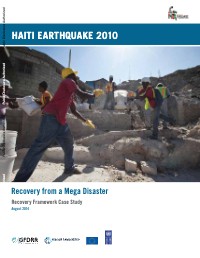
Recovery from a Mega Disaster
HAITI EARTHQUAKE 2010
August 2014
Recovery Framework Case Study
Public Disclosure Authorized
Public Disclosure Authorized
Public Disclosure Authorized
Public Disclosure Authorized
Conference Version
INTRODUCTION TO THE CASE STUDIES SERIES
The World Bank’s Global Facility for Disaster Reduction and Recovery (GFDRR), the United Nations De-
velopment Program (UNDP) and the European Union (EU) are working on a guide for developing disaster
recovery frameworks (DRF). This guide aims to help governments and partners plan for resilient post
disaster recovery while contributing to longer term sustainable development. It is based on practices
gleaned from country experiences in disaster recovery around the world. Hence, the development of the
DRF Guide entailed the development of country-level case studies as well as thematic case studies on
disaster recovery.
These case studies have been designed to collect and analyze information on: i) disaster recovery standards
and principles adapted by countries for specific disasters; ii) planning efforts for making such recovery ef-
ficient, equitable and resilient; iii) policies, institutions and capacities to implement and monitor disaster
recovery; and iv) ways and means for translating the gains of resilient recovery into longer-term risk reduc-
tion and resilient development.
The methodology for developing the case studies consisted of five steps:
1. Desk review of available documentation and literature regarding the specific disaster
and recovery.
2. Field visit to complete and validate findings from the first step, including a workshop with govern-
ment officials and other partners who have been involved in the recovery process; and in-depth
interviews with key partners in central and local government, international organizations
(multilateral and non-governmental), and civil society.
3. Preparation of the study to be part of the GFDRR country case study series.
4. Review of document by the afore-mentioned partner organizations, their country offices, peers
and partner agencies.
5. Validation of final case study document through an in-country workshop.
Importantly, these case studies aim to learn from, and not evaluate, country reconstruction initiatives. Practices
learned from each country’s experience would inform the contents of the guide for developing a DRF. Additionally,
the case studies examine the planning processes and not the implementation details of recovery experiences. As
such, they do not seek to offer a comprehensive account of the post-disaster recovery program, but instead provide
details and insight into the decision-making processes for reconstruction policies and programs.
Following the earthquake of January 2010, the Government of Haiti appealed to the international community
for support in assessing total damage and loss, as well as in post disaster reconstruction and recovery.
The case study of Haiti focuses on the policies and practices of recovery from that time until the pres-
ent. This document summarizes only the key findings from the case study. The complete document will be
published following the validation workshop with the Government of Haiti, scheduled for October 2014.
Disclaimer: This document is the product of work performed by GFDRR staff, based on information provided by GFDRR's partners. The findings,
analysis and conclusions expressed in this document do not necessarily reflect the views of any individual partner organization of GFDRR, including,
for example, the World Bank, the Executive Directors of the World Bank, UNDP, the European Union, or the governments they represent. Although
GFDRR makes reasonable efforts to ensure all the information presented in this document is correct, its accuracy and integrity cannot be guaran-
teed. Use of any data or information from this document is at the user's own risk and under no circumstances shall GFDRR or any of its partners be
liable for any loss, damage, liability or expense incurred or suffered which is claimed to result from reliance on the data contained in this document.
2 Haiti Earthquake 2010 | Recovery from a Mega Disaster
RECOVERY CONTEXT
Country context drives the disaster recovery and reconstruction process. In Haiti, chronic poverty,
rapid urbanization, and a complicated political history created a confluence of needs on the ground that
shaped the recovery and reconstruction process. The recovery process unfolded alongside rapid massive
urban migration and an explosion of informal settlements, creating additional challenges for addressing the
twin goals of disaster recovery and long-term development.
The blow to a nation’s capital and seat of government meant that civil servants, institutional memory,
office buildings, and means of working were lost in an instant, a scenario for which no one was pre-
pared. The Government’s previous emergency preparedness activities had largely focused on responding to
frequent hurricanes and flooding, rather than mega disasters and earthquakes. Political leaders, unfamiliar
with the nascent Disaster Risk Management System, quickly established new teams to advise on response
and recovery. President Préval turned to trusted advisers and established ad hoc advisory councils to assist
him to address pressing issues like fatality management and debris, rather than the coordination groups
envisioned in the newly created National Disaster Management Plan. Prime Minister Bellerive set up a Crisis
Cell to help manage and inform the recovery planning process at a strategic level.
FROM POST-DISASTER ASSESSMENT TO RECOVERY
PROGRAMMING STAGE
The Prime Minister took the lead in coordinating both the international community and Haitian minis-
tries through the PDNA process. The PDNA was carried out under the supervision of the High Level Man -
agement Team led by the Prime Minister and included several international members. Haitian government
officials led each PDNA theme, supported by over 200 international experts. Conducting and coordinating
the assessment took tremendous effort by all involved. According to some views, the government might
have been able to lead and coordinate the PDNA more effectively if all international experts providing
support knew Haiti’s country context and had the language and cultural skills to conduct efficient assess-
ments – even if it meant having fewer people involved in the assessment process.
The short timeline for delivering the PDNA hindered broad stakeholder consultations, affecting the
legitimacy of its action plan in the eyes of many Haitians. In the short run, this influenced the Prime Min -
ister to develop a parallel Action Plan for National Recovery and Development of Haiti with a small team of
government officials and international consultants that used existing national strategies to address PDNA
Country Case Study Series | Guide for Disaster Recovery Frameworks | August 2014 3
damage and loss information. This document, rather than the PDNA, became the principal report sent to the
New York pledging conference to mobilize funding from donors. In the long-run, the abbreviated consulta-
tive process meant those not directly involved in the PDNA would not consider the PDNA to be the guiding
document for recovery and reconstruction planning. Whereas the PDNA identified the actions needed for
recovery within ten years, the Action Plan stated that the country would use the 2010 earthquake as an
opportunity to rebuild Haiti into an emerging economy by 2030.
The Strategic Plan for the Development of Haiti (“Strategic Development Plan”) was also published in
March 2010 to expand on the long-term perspective of the Action Plan. A continuation of the work that
the Ministry of Planning and External Cooperation (MPCE) had started before the earthquake, it argues that
it is vital for structuring initiatives, for convening stakeholders around a common strategy, and for improved
coordination among the various development initiatives in Haiti. The strength of this vision is the recogni-
tion of the equally important roles of the State and the Haitian Citizen and that political and personal will is
necessary in order to achieve positive transformative change in Haiti.
GETTING MOVING
As assessments, actions plans, and strategies were readied for the March 2010 pledging conference,
the central issue to resolve who and how to lead the recovery process resulted in five intertwined
processes led by various actors: (1) a joint Haitian-International Community led recovery commission;
(2) national government-led initiatives; (3) locally-led initiatives; (4) NGO led; and (5) private sector led.
At the time of the disaster, there was no agency within the government with the mandate to lead
disaster recovery and reconstruction, which led both to the idea that such an agency should exist,
and that until its establishment, an interim body was needed. The Interim Haiti Recovery Commission
(IHRC) was launched and co-chaired by Prime Minister Bellerive and UN Special Envoy Clinton, with the
hope of aiding the mobilization of financial and technical resources. With a mandate of 18 months, it was
not intended to be a funding body or a procurement operational agency, but more of a high-level forum
for donor coordination as well as an action-oriented mechanism carried out by the work of its board
members. The Haiti Reconstruction Fund was initially designed to complement the IHRC, but with a lon-
ger lifespan and mission. Similar to IHRC, it is governed in partnership between the government and the
international community.
Early in the recovery process, many government leaders also found themselves overwhelmed with all
the international assistance that descended on Haiti, making it difficult to chart their own course for
recovery and lead as they would have liked. Some views were that leaders were always in meetings with
donors or international organizations, which was a barrier to having the time and space to carry out the
strategic planning needed to better lead the recovery and reconstruction. One of the most common obser-
vations was that the government did not feel empowered enough to say “no” to offers of assistance that did
not fully accord with the direction ministries wanted to take or the solutions Haitian’s thought best.
Government offices with responsibility for interagency coordination tried to coordinate activities
across agencies, and serve as a platform for donor coordination. The Prime Minister’s Cabinet meetings
was the primary forum for collaborating on the multi-sectoral and complex challenges posed by recovery
and reconstruction. Governmental ministries charged with specific sectors worked with the international
community, particularly the United Nations cluster system in order to address their needs.
4 Haiti Earthquake 2010 | Recovery from a Mega Disaster
Each major town impacted by the disaster had its unique approach to managing and planning the
recovery, in a process largely detached from national-level initiatives. The Post Disaster Needs As -
sessment and other guiding plans and documents were scant on community-specific information. Due to
the centralized nature of the government, very few recovery and reconstruction funds flowed directly to
local governments. Local leaders did their best to address their constituents needs, establishing recovery
and reconstruction processes that ranged from using technical assistance platforms among several cities
(in Palmes) to using the UN cluster system to organize the resources of the multiple organizations that
arrived to assist.
The number of non-governmental organizations (NGOs) active in Haiti skyrocketed after the disas-
ter, making it the country with the highest number of NGOs per capita in the world, and creating
new coordination challenges for all involved. In addition to the government’s own NGO coordination
platform, multiple international organizations tried fostering coordination among NGOs, as well as with
the UN cluster system, which proved to be a good tool for networking, sharing experiences, resources,
and convening for advocacy to the local or national government. IHRC also had varied relations with
NGOs and sector based coordination through its different leaders and relationships with relevant minis-
tries. Progress varied, based on NGO ability to launch from planning to activities.
Most recovery occurred in the private sector, through small businesses, major employers, individuals,
and homeowners doing their best to return to their everyday lives. The private sector took new and in -
novative steps for organizing itself to better support recovery and reconstruction. The Haitian Government
also tried to support restoration of the private sector: The Chamber of Commerce worked on improving the
legal framework; the Ministry of Commerce and Industry established a procurement process that supported
buying goods and services as locally as possible. It also established a ‘micro port,’ or a center of services
for producers and entrepreneurs, and was additionally active in promoting mobile banking, which enabled
people to buy from local markets.
GETTING DOING
Tremendous efforts were made to implement international best practices. After the 2010 earthquake,
the Government requested a total of $3.86 billion through the Action Plan to support the recovery efforts
for 2010 and 2011. Fifty-five donors responded by pledging $5.60 billion for those two years.
Up to 2012, Donors channeled 16% of the total funds disbursed through the multi-donor HRF. Accord -
ing to the HRF website, “all approved projects are in line with the priorities set out in the Government’s
Action Plan for National Recovery and Development of Haiti,” with a portfolio that is diverse, both sectorally
and geographically, reflecting the multidimensional nature of the reconstruction and recovery effort.
Multiple government agencies and international organizations worked together to develop a variety
of action plans and strategies to address the needs of affected communities. These strategies shared
common elements, such as similar guiding principles and the focus on building back better. Strategic in
nature, these documents lacked concrete budgets and timelines for implementing recovery activities and
projects across sectors. The proponents and primary users of the action plans and strategies were typically
the groups and people involved in their design.
For recovery and reconstruction, locally-led efforts to plan and coordinate recovery activities typical-
ly occurred independently of the national-level efforts of government ministries and their partners.
Instead, communities typically worked directly with local NGOs and other international organizations to
facilitate acquiring and delivering resources to their local communities. The delegate of Jacmel, for example,
Country Case Study Series | Guide for Disaster Recovery Frameworks | August 2014 5
assisted by other government officials and foreign partners, drafted sectorial plans for the commune. These
local committees are deemed by some to be successes in the recovery process although others might argue
that their response was largely improvised. Nevertheless, without an official participatory planning process
at a national level, local government leaders found it challenging to officially transmit their communities’
needs and priorities to government agencies and international organizations.
With thousands of broadly ranged NGOS on the ground, the way each one contributed to the recovery
and reconstruction depended largely on the type of NGO it was. Haitian NGOs, with decades of expe -
rience serving communities, contributed a significant amount of financial resources to Haitian recovery,
often in parallel to the larger, international organizations and national-level coordination systems in place.
For the private sector, the lack of government regulation and oversight also meant that companies
faced few constraints in implementing projects. A large telecommunications firm, for example, was
able to rebuild schools and health facilities faster than their government counterparts. The absence of
government-sanctioned building norms created opportunities for companies like a engineering firm
to fill that void, and help companies rebuild to safe standards. Such lack of government regulations
allowed these companies to disburse money when and how they deemed fit and to freely work with their
government counterparts to agree upon and execute their priorities. The private sector played a strong
role particularly at the local level, specifically on water supply, electricity restoration, reconstruction
and debris removal.
Most planning for recovery was done on a project-by-project basis rather than a programmatic or
holistic approach. Consultation and collaboration tended to take place at the sector or project level among
actors within the UN Cluster system, civil society, private sector, and local municipalities. The clusters
provided good networking forums, but long-term work did not benefit, given the constant turnover of par-
ticipants. This also resulted in a lack of holistic vision and implementation, which was additionally affected
by the lack of national government oversight to the recovery process among the various stakeholders.
Funding from international donors and NGOs came in a variety of forms that was difficult to track.
These included: (i) new funding from international bi- and multi-lateral donors mobilized as the result of
the earthquake; (ii) bi-lateral project funding that was already negotiated with the government prior to the
earthquake and reprogrammed for reconstruction purposes (some of which was re-committed as part of
the UN pledging process, but was not new funding); (iii) budget support to the Haitian government through
the HRF or directly; and (iv) NGO and private sector funding. Because various donor mechanisms are used,
the funding amounts, methods, uses and management are almost virtually impossible to track. Additionally,
they are often not included in the national budget of Haiti.
Despite limited budgetary resources, the Government allocated funds for disaster recovery in 2010
and 2011. For capital investment projects, the principal source of government funding was the PetroCaribe
Agreement, with $380 million USD pledged to firms for infrastructure-related projects, 73% of which had
been spent within the first two years after the earthquake. The government also received direct budget
support through the HRF and other donors, which is the government’s preferred modality for financing the
recovery and reconstruction, as it increases its ability to plan and implement projects.
Over $9 billion USD has been disbursed for relief and reconstruction efforts, as of 2014: $6 billion
from bilateral government donors and an estimated $3 billion from private contributions. As of 2012,
approximately 55% of recovery aid was directly given to multilateral agencies, international non-state ser-
vice providers, and non-specified recipients, compared to 12% that was channeled directly to the govern-
ment using national systems. According to the Office of the Special Envoy for Haiti (OSE), an additional
33% of recovery aid is reported to have supported the private sector, which could have included the gov-
ernment, project implementation units and non-state service providers.
6 Haiti Earthquake 2010 | Recovery from a Mega Disaster
Since 2010, the Module de Gestion de
l'Aide Externe (External Aid Management
Module, MGAE) within the MPCE has re-
corded all humanitarian data available in
the UN OCHA Financial Tracking System
that records the majority of NGO direct
funding. The MGAE is a web portal that
shares an interactive database of project
funding and in-kind contributions from the
international community, with the purpose
of increasing transparency of foreign aid;
improving the planning, management, moni-
toring, and evaluation of external assistance;
and informing the Haitian budgetary process.
Two and half years after the earthquake,
and 18 months after IHRC closed, the gov-
ernment stepped up the Cooperation for
Foreign Development Aid (CAED) to coor-
dinate reconstruction financing. Housed
under the MPCE, CAED is a dialogue platform
chaired by Prime Minister Lamonthe. At its in-
auguration, Prime Minister Laurent Lamothe
stated that this dialogue platform “restores
to Haiti its sovereignty in aid management
and especially its priorities.” The CAED held
its first meeting in May 2013, where leaders
discussed their reconstruction priorities for
the next three years.
ACHIEVEMENTS SINCE 2010
Despite the vast devastation and impact of the 2010 earthquake, the immense amount of effort and
resources coming from the national and local levels, as well as from around the world, in the past four
years have had a positive impact on Haiti’s long-term recovery. The reconstruction of physical infra -
structure is one of the most notable improvements, with 186 miles of roads newly paved, the rise of busi-
ness centers, 46 new health centers, 7 new hospitals, sports arenas, airports, schools, and neighborhood
housing, along with a large number of rehabilitated buildings that had been affected by the quake. 90% of
Haiti’s displaced population has been moved out of camps and into houses. Incidences of cholera have been
reduced by 50%. Haiti’s GDP has increased by 4%, while inflation decreased from 8% to 4.5%. Foreign
businesses have shown interest in investing in various areas of Haiti’s private sector, including tourism.
Through its experiences and lessons learned in the past four years, Haiti has seen improvements in
its own governance systems. The creation of new entities, such as UCLBP, HRF, and CAED, has facilitated
the government’s ability to address recovery and development needs, both on a sector level and a national
level. All of the efforts to improving governance systems have resulted in better donor coordination, better
OVERALL KEY LESSONS LEARNED
The international community delivered aid as planned
by their own priorities and agenda, while undermining
Haiti’s development goals. Aid should adapt to the coun-
try context, rather than lament the country context.
Government’s recovery plan should be multi-sec-
toral and actionable enough to assign responsi-
bilities and mandates to both government and
non-governmental partners.
International community needs to devise strategies
and analytical tools for ensuring that humanitarian
aid also contributes to country’s long-term develop-
ment plans.
Government should define early on what “country-driv-
en” and “country-ownership” means to them so that
donors and partners can properly support them.
In countries without a strong culture of information
sharing, additional effort will need to be invested in
incentivizing this behavior change
In countries still focused on building strong govern-
ment institutions, recovery and reconstruction should
be used to bolster existing planning and coordination
mechanisms, rather than create new ones.
Country Case Study Series | Guide for Disaster Recovery Frameworks | August 2014 7
information sharing, better land and urban planning, and clearer processes for resolving land title issues
that had created challenges in the recovery process but are now more approachable. One of the best exam-
ples of how recovery programming has contributed to the establishment of new development practices is
how the Government made a firm policy commitment to slum upgrading, through the successful implemen-
tation of 16 neighborhoods / 6 camps program. This reflects the government’s ability to scale up and adapt
the original program model, working in collaboration with international and local partners.
8 Haiti Earthquake 2010 | Recovery from a Mega Disaster
RESOURCES
About the MGAE, Module de Gestion de l’Aide Externe webpage https://haiti.ampsite.net/en/about-mgae-0
Action Plan for National Recovery and Development of Haiti, Government of the Republic of Haiti, p. 8, March 2010
Has Aid Changed? Channelling Assistance to Haiti before and after the Earthquake. Office of the Special Envoy for
Haiti, June 2011
HRF Annual Progress Report 2011/2012 “From Mobilizing Resources to Achieving Results”
Haiti-Reconstruction: Official Statement of the Government on the Implementation of CAED. Haiti Libre. November
30, 2012. http://www.haitilibre.com/en/news-7285-haiti-reconstruction-official-statement-of-the-government-on-
the-implemenation-of-caed.html
Katz, Andrew. Four Years Later, Haiti’s Troubled Recovery Haunts Its Future. Time Magazine. January 12, 2014.
http://world.time.com/2014/01/12/four-years-later-haitis-troubled-recovery-haunts-its-future/
Klevorick, Caitlin. 4 Years Later: Haiti’s Progress Not Always Visible to the Naked Eye. Huffington Post. January 15,
2014. http://www.huffingtonpost.com/caitlin-klevorick/4-years-later-haitis-prog_b_4592848.html
Phelps, P. Analyzing the Haiti Post-earthquake Shelter and Housing Response: What was done and what was learned?
July 8, 2013
Ramachandran, Vijaya and Sneha Raghavan. Haiti Quake: Four Years Later, We Still Don’t Know Where the Money
Has Gone. Center for Global Development. January 7, 2014 http://www.cgdev.org/blog/haiti-quake-four-years-later-
we-still-dont-know-where-money-has-gone
Interview with Claire Pierre, Health Sector Lead for the IHRC, October 18, 2013
Interview with Thomas Pitaud, Technical Specialist for United Nations Development Programme. The World Bank,
October 17, 2013
Interview with Jacmel authorities, Hotel Cap Lamandou, Jacmel, Haiti, January 31, 2014
Interview with Joel Boutroue, UN DSRSG, Port au Prince, Haiti, February 3, 2014
Interview with Kit Miyamoto, Port au Prince, Haiti
Interview with Michel Matera, Senior Disaster Risk Management Specialist, The World Bank, August 29, 2013
Interview with Sara Coppler, International Disaster Response Specialist, Habitat for Humanity International,
October 22, 2013
Country Case Study Series | Guide for Disaster Recovery Frameworks | August 2014 9