
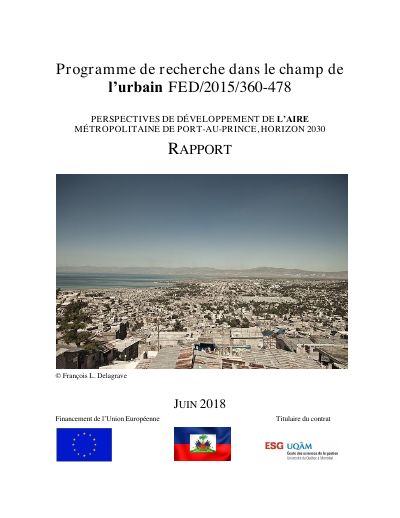
Development Outlook for the Port-au-Prince Metropolitan Area to 2030
- The enlarged metropolitan area probably reached 4 million inhabitants in 2018 and will add 1 million by 2030, or 40 percent of the country's population, up from 25 percent twenty years earlier.
- The metropolis needs 15,000 to 18,000 new housing units a year from 2018 to 2030, while 2,000 to 3,000 units a year are upgraded or rehabilitated.
- About 80 percent of metropolitan residents live in precarious neighborhoods in 2018.
- 1 percent of jobs in the metropolitan area were in the informal sector in 2012, and the informal economy is estimated at about 50 percent of national GDP.
- Canaan, 18 km north of Port-au-Prince, houses more than 250,000 people who settled informally.
- Public services cannot keep pace with growth, and private and collective initiatives supply most of them.
- Most of the 48 experts interviewed picked the pessimistic scenario for 2030.
- The intercommunality of the Palmes region and neighborhood water committees are given as governance models.
In 2016 the European Union delegation in Haiti retained the Université du Québec à Montréal (UQAM) and partner universities (Université de Montréal, Université catholique de Louvain, Université Quisqueya, Université d'État d'Haïti and the Centre de techniques de planification et d'économie appliquée), with independent researchers, to give the Union analysis for its future interventions in the Port-au-Prince metropolitan area up to 2030. The work lasted close to two years, drew on 48 in-depth interviews with professionals, researchers, elected officials, senior civil servants and business people, and produced this report in June 2018. The perimeter is the enlarged metropolitan area, the built-up zone from Léogâne to the limits of Cabaret.
The report finds that the enlarged area probably reached 4 million inhabitants in 2018 and will add 1 million by 2030, or 40 percent of the country's population, up from 25 percent twenty years earlier. Growth comes from migration and from natural increase, and the recent expansion is in three zones: the northeast (Croix-des-Bouquets, Thomazeau, Ganthier, Cabaret), the west (Gressier, Léogâne) and the southeast (Pétion-Ville, Kenscoff). The metropolitan area needs 15,000 to 18,000 new housing units a year from 2018 to 2030, while 2,000 to 3,000 units a year are upgraded or rehabilitated, and about 80 percent of residents live in precarious neighborhoods. The chapter on Canaan describes a settlement 18 km north of the city that houses more than 250,000 people who settled informally after the 2010 earthquake.
On the economy, the report cites an IHSI-DIAL survey in which 77.1 percent of jobs in the metropolitan area in 2012 were in the informal sector, and estimates the informal economy at about 50 percent of national GDP. It judges that public services for water, sanitation, electricity, transport, education and health cannot keep pace with growth and that private and collective initiatives will keep supplying most of them. Asked to choose among three scenarios for 2030, most of the 48 experts picked the pessimistic one.
The governance chapters describe an institutional vacuum and unclear roles among the actors of the metropolis. They point to the intercommunality of the Palmes region (Gressier, Léogâne, Petit-Goâve, Grand-Goâve) and to neighborhood water committees as working models, and suggest a light permanent metropolitan structure, a review of social housing policy, and acceptance of informality as a condition for planning.
How to cite
European Union; Université du Québec à Montréal (UQAM), 2018, Development Outlook for the Port-au-Prince Metropolitan Area to 2030, accessed via HaitiDocs, https://www.haitidocs.org/doc/ue-2018-perspectives-aire-metropolitaine-pap-2030
- Rights holder
- European Union|Université du Québec à Montréal (UQAM)