
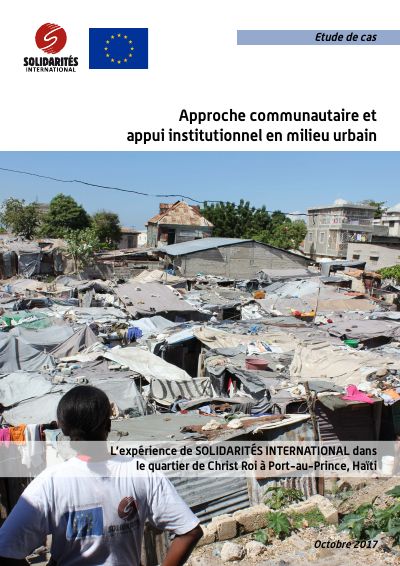
Case Study: Community Approach and Institutional Support in an Urban Setting, the Experience of Solidarités International in the Christ Roi Neighborhood
- Solidarités International ran emergency water and sanitation work for 60,000 people at 52 sites from 2010 before turning to neighborhood-level projects.
- The PARAQ total was EUR 74.5 million, of which EUR 55.8 million from the European Union, for 8 operators in 10 vulnerable neighborhoods.
- At Bristout-Bobin, working through a central committee gave an unrepresentative view of the community and led to disputes, so the approach was changed at Christ Roi.
- At Christ Roi, 111 reference residents took part in the planning workshops, were paid as experts of their neighborhood, and were open to all residents instead of a community platform.
- The community team had one head and four mobilizers and validated all communication between SI and the field.
- The study presents the tripartite organization of operator, residents and public institutions as the condition for ending the project without major tension.
The case study starts from the post-earthquake context. From 2010 Solidarités International (SI) ran emergency water and sanitation work for 60,000 people at 52 sites of the metropolitan area, then began a pilot program to support displaced households returning to their neighborhoods of origin in Bristout and Bobin. The PARAQ total of EUR 74.5 million, of which EUR 55.8 million from the European Union, financed 8 operators in 10 vulnerable neighborhoods of the capital and Petit-Goâve.
The first part treats the community approach as a reversal of the usual NGO view: residents are social actors, where the usual view casts them as victims. It draws lessons from Bristout-Bobin, where working through a central committee of site committees gave an unrepresentative view of the community, led to misunderstandings and disputes over cash-for-work selection, and kept the partnership at the stage of consultation. At Christ Roi SI instead set up a team of one head and four mobilizers placed at the center of the project, opened a neighborhood office, and opened the planning to all residents; 111 people called reference residents took part in the workshops for the planning scheme and were paid as experts of their neighborhood.
The second part describes a strong and formal link with institutions: roles set in protocols with the public works ministry and the municipality, institutional support as a pillar of project governance, and the affirmation of the State's role, for instance in land and compensation matters. The conclusion presents a tripartite organization of operator, residents and institutions as what allowed the project to end without major tension.
How to cite
Solidarités International (SI), 2017, Case Study: Community Approach and Institutional Support in an Urban Setting, the Experience of Solidarités International in the Christ Roi Neighborhood, accessed via HaitiDocs, https://www.haitidocs.org/doc/si-2017-christ-roi-etude-de-cas-approche-communautaire
- Rights holder
- Solidarités International (SI)