
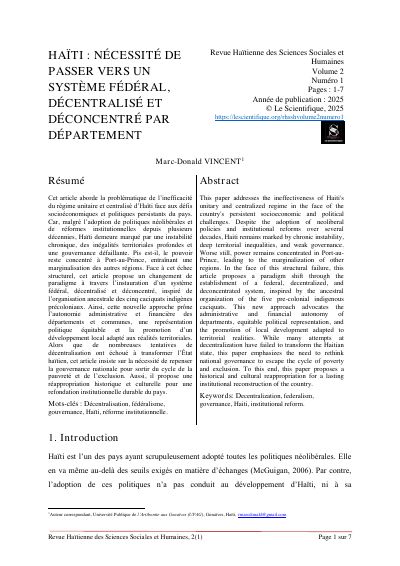
Haiti: The Need to Move Toward a Federal, Decentralized and Deconcentrated System by Department
- The author argues that the unitary, centralized regime has not answered chronic instability, territorial inequality and weak governance.
- The article finds historical roots for a federal system in the five pre-colonial caciquats and in the post-1806 division between north and south.
- In the proposed model each of the ten departments would have a separate budget, assembly and development policy and would pay at least 15 percent of its gross revenue to the central state.
- Each department would send 2 or 3 senators to a federal Senate and have a departmental vice-president.
- One elected executive mayor would replace the three mayors per commune, and the CASEC would be abolished.
The article argues that Haiti's unitary and centralized regime has not answered persistent instability, deep territorial inequality and weak governance, with power concentrated in Port-au-Prince and other regions marginalized. It finds the historical basis for a federal system in the five pre-colonial indigenous caciquats of the island and in the division between the north under Henri Christophe and the south under Alexandre Pétion after 1806.
The author proposes a federal model that respects the ten departments. Each department would have separate institutions, budget, development policy and assembly, and would send at least 15 percent of its gross revenue to the central state. Each would send 2 or 3 senators to a federal Senate and have a departmental vice-president. The three mayors per commune would give way to one elected executive mayor, and the communal section administrative councils (CASEC) would be abolished. The author presents this as a modern reappropriation of Haitian history and calls it a structural necessity.
How to cite
Le Scientifique, 2025, Haiti: The Need to Move Toward a Federal, Decentralized and Deconcentrated System by Department, https://lescientifique.org/wp-content/uploads/2025/05/Haiti-Necessite-de-passer-vers-un-systeme-federal-decentralise-et-deconcentre-par-departement.pdf
- Rights holder
- Le Scientifique