
Climate Attribution of Hurricane Matthew in Haiti: Toward an Understanding of Climate Change Impacts in Small Island Developing States
- Hurricane Matthew struck southwestern Haiti on October 4, 2016 and was among the most destructive hurricanes of the decade in the region.
- The study applies the four-step event attribution framework of Clarke and others (2023).
- Extrapolated probability ratios indicate a 1.5- to 2-fold increase for high winds and up to a 3-fold increase for extreme rainfall.
- Warmer sea surface temperatures, more atmospheric moisture and sea level rise probably amplified the storm.
- The storm's damage cannot be separated from poverty, weak institutions and environmental degradation in Haiti.
- The author recommends integrating climate attribution into adaptation policy, risk governance and loss and damage mechanisms.
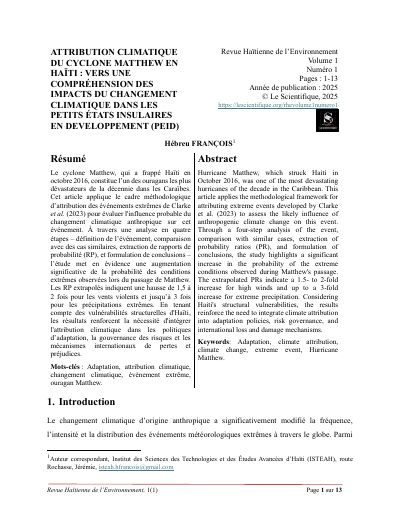
The study uses the framework of Clarke and others (2023) to judge how far human-caused climate change influenced Hurricane Matthew, which struck southwestern Haiti on October 4, 2016. The four steps are defining the event, comparing similar cases, extracting probability ratios from earlier studies, and drawing conclusions.
The extrapolated ratios indicate a 1.5- to 2-fold increase in the probability of high winds and up to a 3-fold increase for extreme rainfall. The author adds that warmer sea surface temperatures, more atmospheric moisture and sea level rise probably amplified the storm, and that its effects cannot be separated from Haiti's poverty, weak institutions and environmental degradation. He recommends using attribution in adaptation policy, risk governance and international loss and damage mechanisms.
How to cite
Le Scientifique, 2025, Climate Attribution of Hurricane Matthew in Haiti: Toward an Understanding of Climate Change Impacts in Small Island Developing States, https://lescientifique.org/wp-content/uploads/2025/08/Attribution-climatique-du-cyclone-Matthew-en-Haiti-vers-une-comprehension-des-impacts-du-changement-climatique-dans-les-Petits-Etats-insulaires-en-developpement-PEID.pdf
- Rights holder
- Le Scientifique