
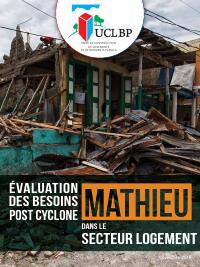
Post-Cyclone Matthew Needs Assessment: Housing Sector
- Counts more than 103,900 dwellings destroyed, 111,475 partially and seriously damaged, and 21,972 flooded.
- Records 2,066,908 people directly and indirectly affected, and 224 temporary shelters.
- Works through housing typology, dwelling size and density, and construction type before stating recovery needs, so the need is expressed against the housing that exists rather than a standard unit.
- Treats human and social impact within the sector as its own section, which is where the distinction between destroyed and seriously damaged matters, since a household in the second category may still be occupying the building.
The housing volume of the post-Matthew needs assessment, prepared by the public housing and buildings construction unit. It counts the stock rather than valuing it first, which is what makes the scale legible: more than 103,900 dwellings destroyed, 111,475 partially and seriously damaged, and 21,972 flooded, against 2,066,908 people directly and indirectly affected and 224 temporary shelters.
The volume works through housing typology, dwelling size and density, and construction type before setting out recovery objectives, so the reconstruction need is expressed against the kind of housing that actually exists in the affected departments rather than against a standard unit. It also treats the human and social impact within the sector as its own section, which is where the difference between a destroyed and a seriously damaged dwelling stops being an accounting distinction: a household in the second category may still be occupying the building.
How to cite
Housing and Public Buildings Construction Unit (UCLBP), 2016, Post-Cyclone Matthew Needs Assessment: Housing Sector, accessed via HaitiDocs, https://www.haitidocs.org/doc/pdna-matthew-2016-secteur-logement