
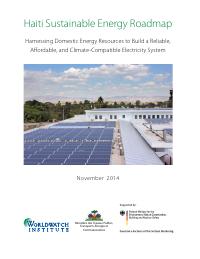
Haiti Sustainable Energy Roadmap
- States that a transition to a 90 percent renewable energy system is a realistic option, not an aspirational one, and quantifies it against business as usual by 2030 at 1,870 new jobs and some 22 million tonnes of CO2-equivalent emissions saved.
- Estimates peak demand exceeding 1 GW by 2030, so significant new capacity must be added on any pathway, which turns the question from whether to build into what to build.
- Builds four scenarios rather than one plan, at 52, 56, 85 and 90 percent renewable shares, with oil accounting for 20 percent of generation in the 85 percent scenario.
- Answers the intermittency objection with grid analysis: up to 95 percent of wind energy generated could be delivered successfully to the grid, and specific operating measures would raise acceptable wind by 14 percent while lowering costs.
- Concentrates the 2030 renewable build in two technologies amounting to 93 percent of total renewable capacity, with hydropower at 15 percent against 85 percent for the other.
- Treats waste as generation capacity, with Port-au-Prince producing about 1,600 tonnes of municipal solid waste a day and Cap-Haïtien's stream able to fuel a plant of more than 1 MW.
- Prices distributed options separately, including solar at USD 30 per kW suited to off-grid applications, and notes that transmission losses of 66 percent mean 3 kWh at the plant for 1 kWh delivered.
A roadmap to 2030 for building Haiti an electricity system from domestic energy resources, published in November 2014. It is built as scenarios rather than a single plan, and the scenarios are what make it usable: renewable shares of 52 percent, 56 percent, 85 percent and a stated realistic option of 90 percent, each with its own generation mix and cost.
The headline finding is that the ambitious option is not the impossible one. A transition to a 90 percent renewable system is described as a realistic option, and the roadmap quantifies its benefits against business as usual by 2030: 1,870 new jobs and some 22 million tonnes of CO2-equivalent emissions saved. Peak demand is estimated to exceed 1 GW by 2030, so Haiti has to add significant new capacity regardless of which pathway it chooses, which is the argument for choosing deliberately.
The technical analysis addresses the objection usually raised against variable renewables. Grid studies found that up to 95 percent of wind energy generated could be delivered successfully to the grid, and that specific operating measures would raise the amount of wind the grid can accept by 14 percent while lowering costs. Two technologies dominate the 2030 renewable capacity at 93 percent of the total, with hydropower at 15 percent of one mix against 85 percent for another resource, and the roadmap also prices distributed options, including solar suited to off-grid applications at USD 30 per kW on one measure. Waste is treated as a resource: Port-au-Prince generates about 1,600 tonnes of municipal solid waste a day and Cap-Haïtien's stream could fuel a plant of more than 1 MW.
How to cite
Ministère des Travaux Publics, Transports, Énergie et Communications (MTPTEC); Worldwatch Institute, 2014, Haiti Sustainable Energy Roadmap, https://www.international-climate-initiative.com/legacy/Dokumente/2014/141130_Sustainable_Energy_Roadmap_Haiti.pdf