
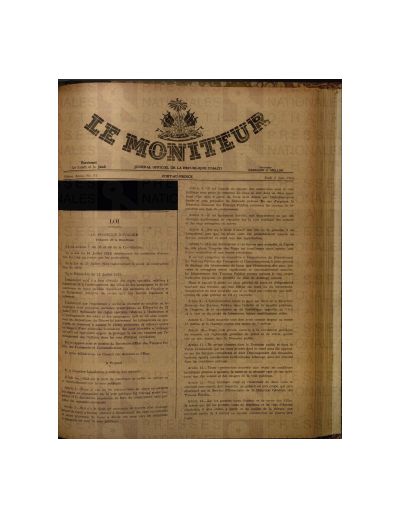
Law of 29 May 1963 Establishing Special Rules on Housing and the Development of Towns and Countryside
- A free strip of at least two metres must be left between the carriageway and the boundaries of adjoining land.
- Pavement construction costs fall 50 percent on the owners, on estimates and plans prepared by the Department of Public Works, Transport and Communications.
- Article 15 requires boundaries to be maintained hedges or low walls whose height the local administration fixes.
- The corpus holds the CIAT syntheses that describe a framework built from instruments like this one, and not the instruments.
The law of 29 May 1963 establishing special rules on housing and on the development of towns and countryside, reproduced from Le Moniteur.
It is a setback-and-servitude statute, and its articles read as such. Pavements are to be laid along the roads it covers wherever judged necessary, and for that a free strip of at least two metres must be left between the carriageway and the boundaries of adjoining land. The cost of building those pavements falls 50 percent on the owners, on estimates and plans prepared by the Department of Public Works, Transport and Communications. Article 15 requires boundaries along these roads to be either properly maintained hedges or low walls whose height the local administration fixes on advice.
The corpus holds the CIAT's synthesis of urbanism law in force and its Cahiers d'urbanisme, which describe a framework assembled from instruments like this one. This is one of those instruments, and the rule that a landowner surrenders two metres and half the cost of a pavement is the kind of provision a land-tenure or urban-upgrading discussion turns on.
How to cite
Legislative Body of Haiti, Law of 29 May 1963 Establishing Special Rules on Housing and the Development of Towns and Countryside, https://www.sgcm.gouv.ht/
- Rights holder
- Government of Haiti