
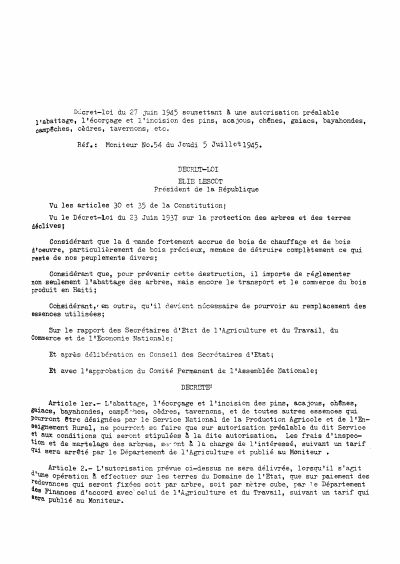
Decree-law of 27 June 1945 subjecting the felling, barking and tapping of named tree species to prior authorisation
- Prior authorisation is required to fell, bark or tap the named species, and any others the agricultural service designates.
- Inspection and marking costs fall on the applicant under a published tariff.
- On state land, royalties are due per tree or per cubic metre under a tariff set by finance and agriculture jointly.
- The regime covers felling, transport and trade.
The decree-law of 27 June 1945, published in Le Moniteur No. 54 of 5 July 1945 under Élie Lescot.
The preamble states that sharply increased demand for fuelwood and timber, particularly precious woods, threatens to destroy what remains of the country's stands, and that preventing this requires regulating the felling, transport and trade of wood produced in Haiti, and providing for replacement of the species used. Article 1 subjects felling, barking and tapping of the named species, and any others the Service National de la Production Agricole et de l'Enseignement Rural designates, to prior authorisation from that service on the conditions it sets, with the cost of inspection and marking charged to the applicant under a tariff published in Le Moniteur. Article 2 adds, for operations on state land, royalties fixed per tree or per cubic metre by the finance department in agreement with agriculture, under a published tariff. Article 3 extends the regime to transport.
The regime is a licence-and-royalty system covering the whole chain from stump to market, and the species list is the working definition of Haiti's commercial timber.
How to cite
Presidency of the Republic of Haiti (PRH), Decree-law of 27 June 1945 subjecting the felling, barking and tapping of named tree species to prior authorisation, https://www.fao.org/faolex/country-profiles/general-profile/en/?iso3=HTI
- Rights holder
- Government of Haiti