
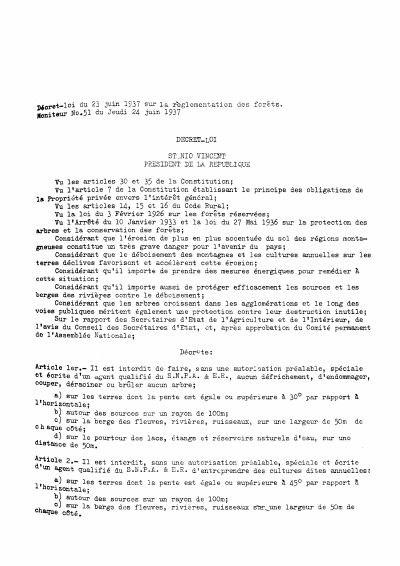
Decree-law of 23 June 1937 on forest regulation
- Written authorisation is required to cut on slopes of 30 degrees or more.
- Buffers: 100 metres around a spring, 50 metres on each bank of a watercourse, 50 metres around lakes and reservoirs.
- Annual cropping on those lands needs the same authorisation.
- Trees in built-up areas and along public roads are protected.
- These thresholds are repeated by Haitian environmental instruments to this day.
The decree-law of 23 June 1937, published in Le Moniteur No. 51 of 24 June 1937 under Sténio Vincent.
The preamble names erosion on mountain soils as a very grave danger for the country's future, and annual cropping on sloping land as what accelerates it. Article 1 forbids clearing, damaging, cutting, uprooting or burning any tree without prior written authorisation from a qualified agent of the Service National de la Production Agricole et de l'Enseignement Rural, on four defined classes of land: slopes of 30 degrees or more, a 100-metre radius around springs, a 50-metre strip on each bank of rivers and streams, and a 50-metre band around lakes, ponds and natural reservoirs. Article 2 applies the same authorisation requirement to annual crops on those lands. It also protects trees in built-up areas and along public roads.
Haitian environmental instruments have repeated these numbers for ninety years, and a watershed restoration programme or a hillside agriculture project is measured against them. The corpus holds the 1958 soil erosion and forestry law, the 1972 reforestation fund and the 1995 environment code, all of which build on this text.
How to cite
Presidency of the Republic of Haiti (PRH), Decree-law of 23 June 1937 on forest regulation, https://www.fao.org/faolex/country-profiles/general-profile/en/?iso3=HTI
- Rights holder
- Government of Haiti