
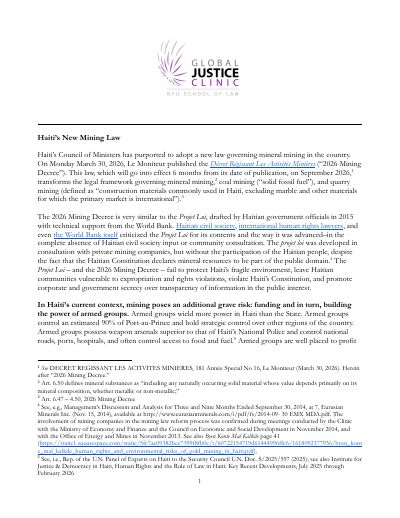
Haiti's New Mining Law
- The 2026 Mining Decree is very similar to a 2015 draft law prepared with World Bank technical support, and it has no maximum term for a mining agreement.
- It creates a National Mining Authority and no longer requires parliamentary approval of exploitation permits, as the 1976 decree did.
- Article 115 keeps reports, documents and data from work under a mining title confidential for 10 years, and the decree does not require companies to disclose revenues or payments to the State.
- The NMA has 30 days to appraise an exploration permit application and 90 days for an exploitation permit, and the Ministry of the Environment has 180 days to respond to an environmental study, after which non-objection is presumed.
- Article 3 calls mining an activity of public utility and Article 165 lets companies seek expropriation, while the decree is silent on the rights of people displaced by mining.
- The brief concludes that this is not an appropriate time to encourage mining investment, given the absence of representative government and the territorial control of gangs.
The brief says the 2026 Mining Decree, published in Le Moniteur on March 30, 2026 and due to take effect six months later, is very similar to a 2015 draft law prepared with World Bank technical support that civil society, human rights lawyers and the World Bank itself had criticized. It notes four differences from that draft: no maximum term for a mining agreement, slightly stronger language on expropriation, a new clause allowing royalties to be amended by decree, and no Fund for the Promotion and Development of Mineral Resources. It states that the decree creates a National Mining Authority and no longer requires parliamentary approval of exploitation permits, as the 1976 decree did.
The brief lists the decree's weaknesses on transparency, the environment and community rights. It points to a 10-year confidentiality period for reports and data under mining titles, review deadlines of 30 to 180 days that it calls unrealistic, a presumption of non-objection to environmental studies when the Ministry of the Environment does not respond, and silence on people displaced by mining. It argues that the decree conflicts with the 1987 Constitution on the right to property, information and participation. It concludes that Haiti lacks representative government and that gangs control much of the country, so this is not an appropriate time to encourage mining investment.
How to cite
Global Justice Clinic, 2026, Haiti's New Mining Law, https://en.ayitikanpemin.org/s/Preliminary-Draft_Analysis-of-2026-Mining-Decree_Global-Justice-Clinicdocx.pdf
- Rights holder
- Global Justice Clinic