
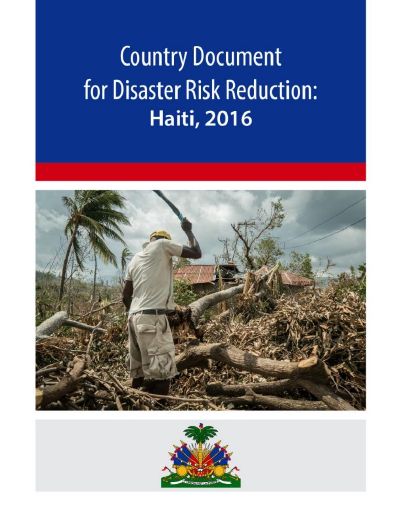
Haiti Country Document 2016-2020: Disaster Risk Reduction
- Haiti is placed fifth in the world for disaster risk exposure, with about 98 percent of the population facing at least two hazards. The figure is the document's single most quoted line.
- The cost of individual events is given as a share of GDP, which makes them comparable: 120 percent for the 2010 earthquake, 15 percent for the 2008 cyclone season, 7 percent for Jeanne in 2004 and 7 percent for Matthew.
- Matthew's damage is reported against agricultural GDP as well as total GDP, at 31 percent, which locates the loss in the sector that absorbed it.
- The priority axes are mapped to the Sendai Framework, so the national plan can be read against the international standard it reports into.
The Document Pays is the reference assessment a country prepares under the European Union's DIPECHO programme to state, in one place, what it is exposed to and what its institutions can do about it. This edition covers Haiti from 2016 to 2020 and was written by the Directorate of Civil Protection with the UN Office for Disaster Risk Reduction, with ECHO funding.
The hazard profile is the part most often quoted. Haiti is ranked the fifth most exposed country in the world to disaster risk, with about 98 percent of the population exposed to at least two natural hazards, and more than a hundred disasters recorded between 1900 and 2016: roughly 40 cyclones, more than 50 floods, seven droughts, a cholera epidemic and two further infectious epidemics. The document places the country both in the North Atlantic hurricane belt and on a seismically active zone, and sets the June to November cyclone season against the record of Hazel in 1954, Flora in 1963 and Matthew in 2016.
The economic accounting is specific. The 2010 earthquake killed more than 220,000 people, injured 300,000, left 1.5 million homeless and displaced 1.3 million, destroying 105,000 buildings and damaging 208,000, with losses put at around 120 percent of GDP. Matthew cost 38 billion gourdes, 7 percent of GDP and 31 percent of agricultural GDP. The four cyclones of 2008 and Jeanne in 2004 contracted GDP by 15 and 7 percent.
The second half turns to institutions: the legal and institutional framework of the SNGRD, the state of disaster risk reduction, the development context, and a workshop-based risk analysis. It closes on priority axes, each mapped to the Sendai Framework, covering the operational capacity of the SNGRD, public education and awareness, coordination and leadership in emergencies, and the legal and institutional framework itself.
How to cite
Direction de la Protection Civile (DPC); United Nations Office for Disaster Risk Reduction (UNDRR), 2017, Haiti Country Document 2016-2020: Disaster Risk Reduction, https://www.aecid.ht/fr/documents
- Rights holder
- Direction de la Protection Civile (DPC)|United Nations Office for Disaster Risk Reduction (UNDRR)