
MINUJUSTH - Report of the Secretary-General on the United Nations Mission for Justice Support in Haiti (S/2019/198), 1 March 2019
- The strategic assessment mission, conducted September 2018 to February 2019, concluded that Haiti's security and governance problems require political solutions and long-term development gains. A peacekeeping presence was not the answer to them.
- The Secretary-General assesses that the national police will be able to assume full responsibility for security and protection by 15 October 2019, the end of the two-year exit strategy, unless the Government's capacity to respond to the crisis comes under mounting challenge.
- He recommends a small strategic advisory office led by a Special Representative, alongside the country team and supported by a triple-hatted Deputy Special Representative, Resident Coordinator and Humanitarian Coordinator, for one year from 16 October 2019.
- He records that the Haitian leadership supports a special political mission with an advisory mandate covering political reform, elections, justice, corrections, police development, community violence reduction and human rights.
- He recommends phasing out the MINUJUSTH mandate over its final six months with a proper handover of security responsibilities.
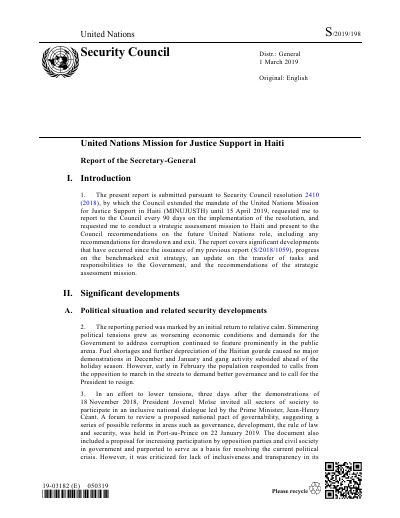
Submitted under resolution 2410 (2018), this is the report that carried the strategic assessment mission's recommendations to the Council, and it is where the end of peacekeeping in Haiti was proposed.
The assessment ran from September 2018 to February 2019 and concluded amid renewed demonstrations, which the Secretary-General says reconfirmed its findings. Its central judgement is that the security and governance problems Haiti faces call for political solutions and long-term development gains. He records being encouraged by the development of the national police, whose performance during the demonstrations he describes as widely acknowledged as professional and effective, and assesses that the force will be able to assume full responsibility for the security and protection of Haiti by 15 October 2019, at the end of the two-year exit strategy the Council foresaw, unless the Government's capacity to respond to the crisis comes under mounting challenge.
What he proposes in its place is deliberately small. He records that the Haitian leadership supports a special political mission with an advisory mandate covering political reform, elections, justice, corrections, police development, community violence reduction and human rights, and recommends the Council establish it as a strategic advisory office led by a Special Representative, working alongside the technical capacities of the country team and supported by a Deputy Special Representative who would also be Resident Coordinator and Humanitarian Coordinator, for one year from 16 October 2019. Drawing on earlier transitions in Haiti and elsewhere, he recommends phasing out the MINUJUSTH mandate over its final six months with a proper handover of security responsibilities.
The report also covers progress on the benchmarked exit strategy and the transfer of tasks to the Government. Read against resolution 2466 (2019), which extended MINUJUSTH for a final six months, and the letter S/2019/387 that designed the successor, it is the first of the three documents that closed peacekeeping in Haiti and opened BINUH.
How to cite
MINUJUSTH - Report of the Secretary-General on the United Nations Mission for Justice Support in Haiti (S/2019/198), 1 March 2019, https://docs.un.org/en/S/2019/198
- Rights holder
- United Nations