
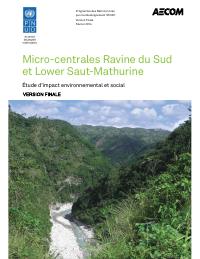
Ravine du Sud and Lower Saut-Mathurine Micro Hydro Plants: Environmental and Social Impact Assessment
Summary: The final environmental and social impact assessment for two micro hydro plants at Ravine du Sud and Lower Saut-Mathurine, prepared by AECOM for UNDP and dated February 2014. It covers the physical, biological and human environments, including aquatic fauna and agro-economic conditions.
Key Findings
- Records about 10 percent of the Haitian population with access to electricity, and often for only a few hours.
- Puts around 80 percent of the country's energy needs as met from local resources: 55 percent firewood, 16 percent charcoal and 5 percent hydro.
- Thermal generation accounts for about 70 percent of production, against installed capacity of 61 MW of which Péligre on the Artibonite is the largest plant.
- Estimates undeveloped hydroelectric potential at more than 150 MW, of which 85 percent or 127 MW sits in four large plants of 22 to 45 MW and 15 percent or 23 MW in 27 small plants of 0.10 to 2.57 MW.
- Notes demand forecast to grow by 5,000 kW every five years, which is the frame the two micro plants are assessed against.
Full Description
Haiti's renewable generation debate is mostly conducted at the level of national targets, so a full site-level impact assessment of two specific hydro schemes is unusually concrete. UNDP published it in three parts; the corpus holds them merged into the single 446-page document they form. Read with the PHARES mini-grid material and the EDH tariff series for the wider electricity picture.
How to cite
AECOM; United Nations Development Programme (UNDP), 2014, Ravine du Sud and Lower Saut-Mathurine Micro Hydro Plants: Environmental and Social Impact Assessment, https://www.undp.org/fr/haiti/publications/lhydro-electricite-micro-centrales-ravine-du-sud-et-lower-saut-mathurine-etude-dimpact-environnemental-et-social