
Draft law organising work in three eight-hour shifts
- The bill organises work in three eight-hour shifts and authorises night work and mixed day-and-night shifts.
- It repeals article 122 of the labour code.
- Overtime pay and Sunday and public holiday provisions are preserved.
- Shift law bears on the unit cost of apparel exports, since an assembly plant's capital cost is the same at eight hours as at twenty-four.
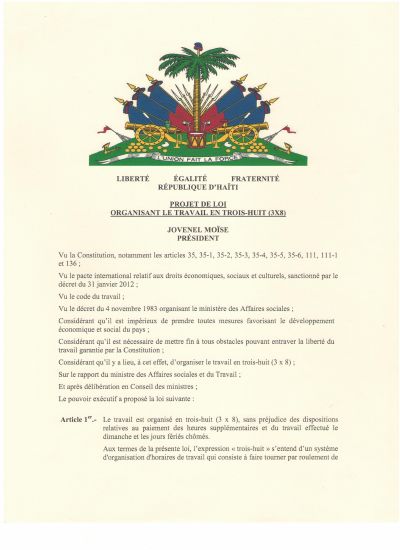
A draft law organising work in three eight-hour shifts, signed by Jovenel Moïse.
Article 1 organises work in three-eights, without prejudice to the provisions on overtime pay and on work performed on Sundays and public holidays, and defines the term. Article 2 authorises night work and the mixed day, meaning a shift combining daytime and night hours. Article 3 repeals article 122 of the labour code. Article 4 repeals contrary laws, decree-laws and decrees, with execution by the minister of social affairs and labour.
The preamble cites constitutional articles 35 and 35-1 to 35-6 and 111, the International Covenant on Economic, Social and Cultural Rights sanctioned by the decree of 31 January 2012, the labour code and the decree of 4 November 1983 organising the Ministry of Social Affairs, and it states the motive as removing obstacles to the freedom of work and favouring economic and social development.
The capital cost of an assembly plant is fixed whether it runs eight hours or twenty-four, so shift law bears directly on the unit cost of Haitian apparel exports and on the number of jobs a given investment supports. The corpus holds the minimum wage series, the HOPE and HELP preference documentation and the industrial park studies that turn on this question.
How to cite
Presidency of the Republic of Haiti (PRH), 2017, Draft law organising work in three eight-hour shifts, https://www.sgcm.gouv.ht/
- Rights holder
- Government of Haiti