
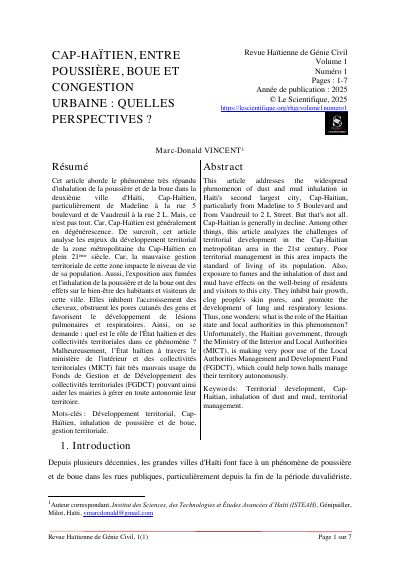
Cap-Haïtien Between Dust, Mud and Urban Congestion: What Prospects?
- The article attributes dry-season dust and rainy-season mud mainly to roads in poor condition, deficient water management and deforestation that favors erosion.
- It states that dust and mud inhalation affects the health of residents and visitors.
- Cap-Haïtien covers 53.50 square kilometers, the third smallest commune among the 19 communes of the Nord department, and receives people displaced from Port-au-Prince.
- The town hall relies on contributions from the city center only, although it has the power to tax all three communal sections.
- The author proposes 18 actions, including completing the Limonade landfill, relocating the Petite-Anse slaughterhouse, road paving and drainage, and hiring municipal staff.
The article examines territorial management in the metropolitan area of Cap-Haïtien, the second city of Haiti. It attributes the dry-season dust and rainy-season mud mainly to roads in poor condition, deficient water management and deforestation that favors erosion, and it states that inhaling dust and mud affects the health of residents and visitors.
The author describes a commune of 53.50 square kilometers that receives people displaced from Port-au-Prince while the central government has taken no decision to equip the city. The article says the town hall has taxing powers but relies on contributions from the city center only, and that public works, the national solid waste service and other bodies are not active in the city. It proposes 18 actions, among them completing the Limonade landfill, relocating the Petite-Anse slaughterhouse, paving and draining roads, opening roads to relieve national routes 1 and 3, collecting local taxes in all three communal sections and hiring municipal staff.
How to cite
Le Scientifique, 2025, Cap-Haïtien Between Dust, Mud and Urban Congestion: What Prospects?, https://lescientifique.org/wp-content/uploads/2025/03/Cap-Haitien-entre-poussiere-boue-et-congestion-urbaine-quelles-perspectives.pdf
- Rights holder
- Le Scientifique