
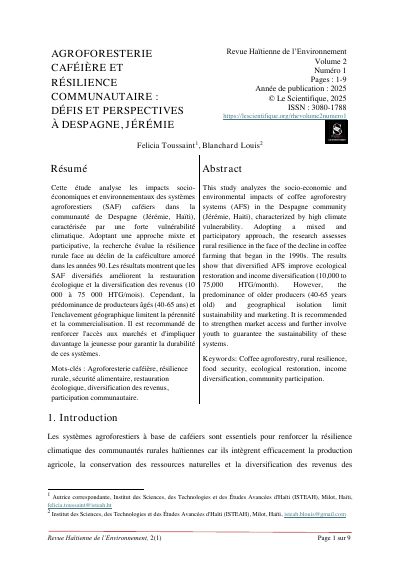
Coffee agroforestry and community resilience: challenges and prospects in Despagne, Jérémie
- Coffee in Despagne is grown in traditional creole gardens, and the authors say production declined from the 1990s with climate events, tree loss, coffee rust and aging plantations.
- Plots lie between 870 and 1,075 m (mean 973 m) and are small (1,300 to 5,063 m2) because of land fragmentation.
- 95% of plots are under moderate shade, and 85% have a tree layer, 80% a shrub layer and 60% a herbaceous layer.
- Producers report better soil recovery, soil moisture and income diversification, with monthly incomes of HTG 10,000 to 75,000.
- The main producers are 40 to 65 years old and young people are little involved.
- All farmers interviewed name market access, limited by isolation, as the main obstacle.
The authors, from the Institut des Sciences, des Technologies et des Études Avancées d'Haïti (ISTEAH), study the community of Despagne, in the 2nd communal section Haute Voldrogue of Jérémie. Coffee there has been grown in traditional creole gardens with fruit and forest shade trees, and the authors write that production declined from the 1990s with cyclones, floods, landslides, irregular rainfall, loss of tree cover, coffee rust and aging plantations. They describe the work of the Fondation Nouvelle Grand'Anse (FNGA) in reviving coffee on the northern slope of Macaya Park.
The study is a case study using a mixed approach: a structured survey of producers, open-ended answers, direct observation and institutional documents, with coordinates taken in eight Haute Voldrogue communities. Plots lie between 870 and 1,075 m (mean 973 m) and range from 1,300 to 5,063 m2, which the authors link to land fragmentation. Ninety-five percent of plots are under moderate shade. The vertical structure shows a tree layer in 85 percent of cases, a shrub layer in 80 percent and a herbaceous layer in 60 percent. Bananas, yellow yam, sweet potato, giraumon, vegetables and fruit and forest trees are combined with the Cathymore, Typica and Castillo coffee varieties. Producers perceive better soil recovery, soil moisture and income diversification. The paper does not state the number of producers surveyed.
Monthly farm incomes range from HTG 10,000 to 75,000, a spread the authors attribute to unequal land access. The producers who lead the system are mostly 40 to 65 years old, with weak involvement of young people. All farmers interviewed named market access as a major obstacle because of isolation. The authors recommend market access infrastructure, broad training in sustainable practices, documentation of the system's effects on farm families, and stronger combination of local knowledge with the approach.
From the document
Text extracted from the original document. It may contain character recognition errors.
How to cite
Le Scientifique, 2025, Coffee agroforestry and community resilience: challenges and prospects in Despagne, Jérémie, https://lescientifique.org/wp-content/uploads/2026/02/Agroforesterie-cafeiere-et-resilience-communautaire-Defis-et-perspectives-a-Despagne-Jeremie.pdf
- Rights holder
- Revue Haïtienne de l'Environnement (Le Scientifique)