
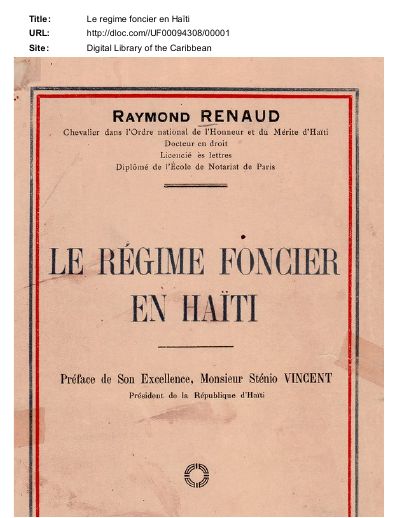
The Land Tenure System in Haiti
- Sténio Vincent's preface says this is the first time Haitian property and mortgage law has been treated with scientific unity.
- The preface doubts that the Torrens system alone would give Haiti secure titles, because customary land practices make land registration a political act.
- Vincent lists informal unions, undivided inheritances, irregular transmission of family names and long possession of state land as features of Haitian land relations.
- The preface cites a government initiative to grant ownership of up to five hectares to state tenants whose lease dates back ten years and who have paid dues regularly.
- The author states that the Haitian land system, modeled on French law, ignores local conditions and responds poorly to the country's needs.
- The author announces a critical study followed by a reorganization plan that proposes land registers and a cadastre for Haiti.
This record is based on the first 30 pages of the file; the rest of the book was not read for it. The book is a law thesis. In the preface, President Sténio Vincent writes that the author gave the first coherent treatment of Haitian property and mortgage law. He doubts that the Torrens system alone would secure titles in Haiti, citing the customary land practices of the countryside. He lists features of Haitian land relations: informal unions (plaçage), undivided inheritances, irregular transmission of family names, long possession of state land by tenants and holders, and a trend toward small property since 1804.
The preface also mentions the family rural property law and a government initiative to grant ownership of up to five hectares to any state tenant whose lease dates back ten years and who has paid dues regularly. In the foreword the author says he sailed for Haiti on October 1, 1933 and stayed more than two months. The introduction states that the Haitian land system, modeled on French law, ignores local conditions and responds poorly to the country's needs, and announces a critical study followed by a reorganization plan in 12 chapters, from the geography and history of Haiti to the peasantry, the agrarian question, current land law, foreign land registration and cadastre rules, and the land tax.
How to cite
Raymond Renaud, 1934, The Land Tenure System in Haiti, http://dloc.com/UF00094308/00001
- Rights holder
- Raymond Renaud