
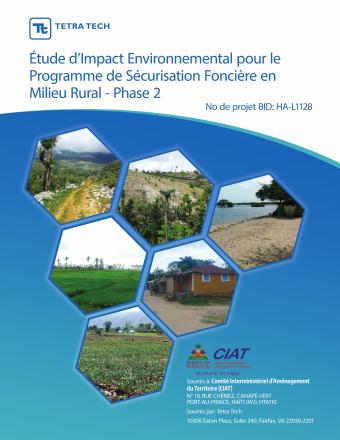
Rural Land Security Programme Phase 2 (HA-L1128): Environmental Impact Study
- The fullest safeguards instrument in this CIAT set, at 146 pages, by Tetra Tech for the CIAT, dated 17 April 2017.
- Secure tenure can either encourage soil conservation and planting or enable clearance and sale, depending on setting.
- With the social impact study it covers both risk axes of titling: who formalization disadvantages, and what the resulting land-use change does.
Land regularization changes what people do with land, and that has environmental consequences: secure tenure can encourage investment in soil conservation and tree planting, or it can enable clearance and sale for development, depending on the setting. This study assesses those consequences for the second phase of Haiti's Rural Land Security Programme, IDB operation HA-L1128. It was prepared by Tetra Tech, Inc. for the CIAT and is dated 17 April 2017, and at 146 pages it is the most substantial safeguards instrument in this collection. Read with the program's social impact study of the same year, the pair covers the two risk axes a titling program carries: who may be disadvantaged by formalization, and what the resulting change in land use does to the environment. Both were conditions of the financing rather than academic assessments, which is why they exist in this level of detail.
How to cite
Inter-American Development Bank (IDB); Government of Haiti; Interministerial Committee for Territorial Planning (CIAT), 2017, Rural Land Security Programme Phase 2 (HA-L1128): Environmental Impact Study, http://ciat.gouv.ht/sites/default/files/docs/Etude%20d%27Impact%20Environnemental%20pour%20le%20Programme%20de%20S%C3%A9curisation%20Fonci%C3%A8re%20en%20Milieu%20Rural%20-%20Phase%202.pdf