
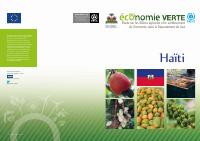
Green Economy Study for the Sud Department
- Selects three value chains in the Sud department as the ones to prioritize for a green economy, honey, castor and cocoa, sets out the criteria behind the choice, and ties the investment plans to Haiti's Intended Nationally Determined Contribution.
- Sizes the castor opportunity on a yield gap rather than on demand alone: Haiti gets about 250 kg a hectare against 3,000 kg elsewhere, national production is around 1,300 tonnes from at least 10,000 seed producers, and 4,125 hectares are identified across communes including Aquin.
- Notes that world castor supply is growing at 1 percent against 3 percent for demand, with a projected supply deficit of 25 percent, which is what makes the yield gap worth closing.
- Finds honey a net import position at small absolute scale: about 9,000 hives and roughly 1,000 beekeepers of whom only 10 percent use modern hives, averaging 5 hives each, against exports of 33,000 US dollars in 2013 and imports of about 100,000, with an imported liter costing 30 percent more than the local one.
- Records cocoa sold almost entirely unfermented, 96 percent against 4 percent fermented and 2 percent as artisanal chocolate, which is where the value is lost, and prices entry into the chain at 4,600 dollars a hectare.
- Sets the sector against a long decline, agriculture's share of GDP falling from 32 percent in the early 1980s to 25 percent in 2014, in a department holding 9 percent of the national population over 2,654 square kilometers where 75 percent of people are food insecure and lending rates run from 24 to 60 percent.
- Observes that the flagship action aimed at large private firms receives only 5 percent of the National Agricultural Investment Program's forecast budget of 170 million dollars, and that the CPDN targets include planting 137,500 hectares of forest, protecting 10,500 hectares of national forest parks and 19,500 hectares of mangrove, and restoring at least 60,000 hectares of agroforestry.
Published by the United Nations Environment Programme in 2016 with support from the European Union, this study examines green economy prospects for the Sud department. Its copyright page grants free reproduction for educational and non-profit purposes provided the source is acknowledged, which is worth noting for reuse. Published in the year Hurricane Matthew struck the Sud directly in October, it describes the department's environmental and economic prospects immediately before the event that reset them - the same relationship the MARNDR Grand'Anse diagnosis of the same year has to that department.
How to cite
United Nations Environment Programme (UNEP); European Union, 2016, Green Economy Study for the Sud Department, https://agripubhaiti.org/wp-content/uploads/2025/03/Etude-Economie-Verte-Sud.pdf