
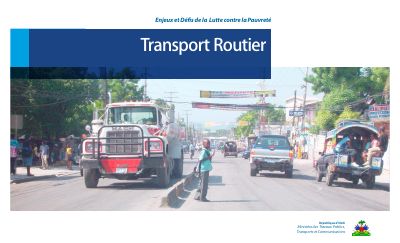
Stakes and Challenges of Poverty Reduction: Road Transport
- The road network is about 3,400 km (650 to 700 km national, 1,500 km departmental, 1,200 km communal) and less than 20 percent of it is paved.
- Half of the network, 1,700 km, is in very poor condition and only about 350 km, close to 10 percent, is in satisfactory condition, up from 3 percent in 2004.
- The network has lost nearly a third of its length since 1991, and the absence of maintenance is named as the main cause of its deterioration.
- About two thirds of the population is rural, and more than half of that population has no access to any transport service.
- The construction and maintenance market is small: two medium-size Haitian firms have the capacity for rehabilitation works.
- Three objectives guide the strategy: poverty reduction and crisis prevention, balanced development through well-maintained infrastructure, and integration in Caribbean and international trade, with actions scheduled to June 2008, December 2009 and after January 2010.
The Ministry of Public Works, Transport and Communications (MTPTC) wrote this strategy as the newly elected government set the revitalization of transport among its first priorities. The first part describes the state of the sector: the MTPTC counted about 720 civil servants, 155 of them managers, in November 2006; the road maintenance fund (FER) was created by a law of July 24, 2003 and receives a levy of one gourde per gallon of fuel; and donors and NGOs act through many execution units that the document says weaken the State's planning role.
On roads, the document describes a network of about 3,400 km: 650 to 700 km of national roads, about 1,500 km of departmental roads and about 1,200 km of communal roads, less than 20 percent of it paved. It records that the network has lost nearly a third of its length since 1991 and gives its condition as 350 km good, 350 km average, 1,000 km poor and 1,700 km very poor. Roads in satisfactory condition rose to about 350 km, close to 10 percent of the network, from 3 percent in 2004, and the government program was expected to rehabilitate more than 600 km more. The text adds that about two thirds of the population is rural and that more than half of that rural population has no transport service. It also reviews ports, airports and the urban transport market.
The second part sets three objectives: contribute to poverty reduction and crisis prevention, promote sustainable, balanced and fair development through suitable and well-maintained infrastructure, and favor Haiti's integration in Caribbean and international trade. The third part covers implementation: a shared strategy, better maintenance management through the FER, mobilizing financing, private sector participation and strengthening the MTPTC. Annex 1 gives a calendar of actions for the short term (to June 2008), medium term (July 2008 to December 2009) and long term (after January 2010).
How to cite
Ministry of Public Works, Transport and Communications (MTPTC), 2006, Stakes and Challenges of Poverty Reduction: Road Transport, accessed via HaitiDocs, https://www.haitidocs.org/doc/mtptc-2006-transport-routier-enjeux-pauvrete
- Rights holder
- Ministère des Travaux Publics, Transports et Communications (MTPTC)