
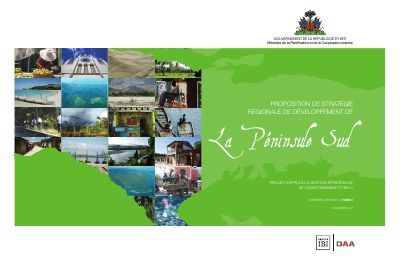
The Southern Peninsula: Proposed Regional Development Strategy, Volume II
- The strategy is a first version for consultation, aligned with the PARDH and the 2007-2010 national poverty reduction strategy, and the final version is meant to bind the State, civil society and partners around clear objectives.
- Seven long-term orientations and five development objectives frame the strategy, including reducing the concentration of activity in Port-au-Prince and balancing the occupation of the territory.
- The organization of the territory rests on regional development poles, local development poles at the arrondissement capitals, and communal and communal-section seats.
- Four Grands Chantiers (territorial, economic, social and institutional refoundation) group programs numbered 1.1 to 4.6, from the transport network and electrification to the administration of justice and security.
- The annex tables list road projects between Miragoâne, Anse-à-Veau, Baradères, Pestel and Corail and the rehabilitation of the Jérémie to Les Irois road, with locations but no costs.
- The implementation plan (section 7) is a one-sentence stub to be written after consultations, so the document gives no financing, costs or timetable.
Volume II of deliverable 4 of the MPCE project supporting the strategic management of public investment, prepared by Groupe IBI/DAA and dated December 2010. The document presents itself as a first version of the regional development strategy for the Southern Peninsula, built on the diagnostic in Volume I, on the Action Plan for the Recovery and Development of Haiti (PARDH) and on the 2007-2010 national growth and poverty reduction strategy paper (DSNCRP). It says the content will change as consultations proceed, and that the final version should become an instrument of planning, programming and management that mobilizes the State, civil society and international partners.
The strategy sets seven long-term orientations and five development objectives: structure the organization of the territory, develop, diversify and modernize the economy, protect and restore the environment, set up social and cultural service networks, and set up a framework for managing development and land use. It proposes a pyramid of regional development poles, local development poles centered on the arrondissement capitals, and communal and communal-section seats, and names zones suited to agricultural poles (the Cayes plain, the Baconnois plain, the Beaumont coffee area and the Dame-Marie and Anse d'Hainault cocoa hinterland), tourism poles and industrial poles (Les Cayes, Jérémie and Miragoâne).
The four Grands Chantiers follow the national recovery plan: territorial refoundation (programs 1.1 to 1.8, from the transport network to urban renovation), economic refoundation (2.1 to 2.6, from agriculture and fishing to labor-intensive works), social refoundation (3.1 to 3.6, from higher education to social solidarity) and institutional refoundation (4.1 to 4.6, from the legal framework to justice and security). Annex tables list the projects by result and location, for example the construction of road links between Miragoâne, Petite-Rivière-de-Nippes, Anse-à-Veau, Baradères, Pestel and Corail, and the rehabilitation of the Jérémie, Moron, Dame-Marie and Les Irois road. The tables contain no costs, and the implementation plan in section 7 is a placeholder.
How to cite
Ministry of Planning and External Cooperation (MPCE); Groupe IBI/DAA Inc., 2010, The Southern Peninsula: Proposed Regional Development Strategy, Volume II, http://mpce.gouv.ht/peninsulesudb.pdf
- Rights holder
- Ministère de la Planification et de la Coopération Externe (MPCE)|Groupe IBI/DAA Inc.