
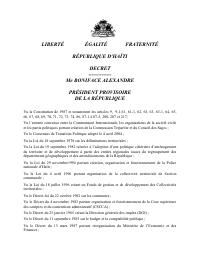
Decree Establishing the General Framework of Decentralization and the Organization and Functioning of Haiti's Territorial Collectivities
- Promulgated February 1, 2006 by transitional president Boniface Alexandre.
- Establishes the general legal framework for decentralization and the three tiers of territorial collectivity: communal section, commune, department.
- Assigns the communal section the role of first-level proximity public service provider, and the commune the role of harmonizing communal-section interests.
- Forms a four-decree package with companion decrees on the section communale, commune, and department, all dated the same day.
- Still the framework decree underpinning Haiti's decentralization architecture at the time of this ingest.
This decree, promulgated on February 1, 2006 by transitional president Boniface Alexandre acting on the report of the Minister of the Interior and after deliberation in the Council of Ministers (the legislature being inoperative at the time), establishes the framework decree that underpins Haiti's decentralization architecture. Article 1 states its purpose as fixing the general framework of decentralization and the organization and functioning of Haiti's territorial collectivities, with a view to the adequate provision of public services, local development and participatory democracy.
Book I sets out general orientations and the basic principles of decentralization: the right of territorial collectivities to self-administer and manage their affairs, respect for national unity and territorial integrity, the pairing of decentralization with adequate deconcentration of state services, and the assignment of proximity public services to the collectivity closest to the population, with higher-level collectivities or the central government stepping in when a service cannot be assured locally. Article 6 assigns respective vocations to each collectivity: the communal section as the first level of grouping, mobilization and citizen participation and direct provision of proximity public services; the commune as the level that prioritizes and harmonizes the collective interests of the communal sections it groups; and (per later articles) the department as the level coordinating and harmonizing communal development plans.
Subsequent books address the legal personality, administrative and financial autonomy, organs, resources, supervisory (tutelle) mechanisms, and the coordination structures between central and territorial administration. This decree, together with three companion decrees on the section communale, the commune and the department (all also dated February 1, 2006 and held in this same batch), forms the legal core of Haiti's decentralization framework still in force. The corpus text is the native PDF text (not OCR).
How to cite
Ministry of the Interior and Local Government (MICT), 2006, Decree Establishing the General Framework of Decentralization and the Organization and Functioning of Haiti's Territorial Collectivities, https://www.mict.gouv.ht/wp-content/uploads/2016/04/Decret-Portant-Cadre-General-de-la-Decentralisation-Organisation-et-Fonctionnment-des-Collectivites-Territoriales-Haitiennes.pdf