
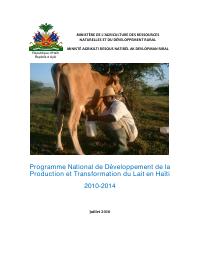
National Programme for the Development of Milk Production and Processing in Haiti
- Identifies the gap the programme exists to close: national milk production of 45,000 tonnes against demand of 130,000 tonnes and an assessed production potential of 145,000 tonnes a year.
- Records that about 100,000 tonnes of potential production goes unvalorized while 80 percent of the market, some 90,000 tonnes, is met by commercial imports, so the constraint is collection and processing rather than herd size.
- Sizes the herd and the households involved: 1,000,000 to 1,500,000 cattle of which 45 percent, or 450,000 to 675,000, are adult cows, with about 250,000 holdings involved in dairy production and 75 to 80 percent of them small producers.
- Records local milk at 30 to 45 percent of household consumption in specific urban markets including Cap-Haïtien, Les Cayes and Léogâne, followed by evaporated milk at 30 percent and powdered milk at 20 percent.
- Puts evaporated milk imports at around 20,000 tonnes a year, 63 percent of imported dairy products, against dairy import values of 40 million US dollars a year.
- Sets targets that name the mechanism, 150 dairies operating with 30,000 cows to integrate 20,000 new producers and add 5.5 million gallons of annual production, with 20,000 herders to be reached directly by 2019.
- Frames affordability as the binding demand constraint, with per capita income estimated at under 300 US dollars a year and unemployment between 30 and 60 percent.
This is one of the sub-sector programs MARNDR produced for animal production, covering milk production and processing over 2010-2014 and dated July 2010. Its foreword records the process behind it: in October 2008 the ministry convened roughly fifty professionals and experts - livestock specialists, agronomists and veterinarians from the Faculty of Agronomy and Veterinary Medicine, specialized NGOs, private-sector operators and producer organizations - to develop policy across seven themes: fisheries and aquaculture; milk production and processing; intensive poultry and pig farming; smallholder livestock in agro-ecological systems for environmental rehabilitation; beekeeping; animal health; and the safety and sanitary quality of livestock products. The participants worked in voluntary thematic groups whose deliberations produced this and the companion program documents. The text is a companion to the MARNDR aquaculture, fisheries and livestock-environment notes of the same period.
How to cite
Government of Haiti; Ministry of Agriculture, Natural Resources and Rural Development (MARNDR), 2010, National Programme for the Development of Milk Production and Processing in Haiti, https://agripubhaiti.org/wp-content/uploads/2025/03/Texte-LAIT-MARNDR-2010.pdf