
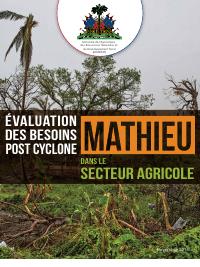
Post-Cyclone Matthew Needs Assessment: Agriculture Sector
- Places 3.3 million people, 30.6 percent of the Haitian population, in the zone affected by Matthew.
- Notes that the cyclone struck during the full summer campaign, about 20 percent of national agricultural production, with the spring campaign's annual crops still in the fields, so two harvests were exposed at once.
- Values crop production losses at 162,230,969 US dollars, of which 148,342,334 in annual and perennial crops and 13,888,636 in already-harvested stocks destroyed.
- Counts livestock losses of 2 million poultry, 374,000 goats, 163,000 pigs, 102,000 cattle, 74,000 sheep and 23,000 equines, in four departments that held 34 percent of the country's cattle, pigs and goats and 30 percent of its poultry.
- Puts forest product losses, timber and charcoal, at 134.6 million dollars, with Grand'Anse at 48.3 million ahead of Sud at 42.6 million, Nippes at 21.4 million, Nord-Ouest at 15.3 million and Sud-Est at 7.0 million.
- Values fisheries and aquaculture damage at 10,764,744 dollars, and records damage to MARNDR administrative, training and research buildings at 1,897,231 dollars and to processing enterprises, mills, guildives, vetiver factories, cassava works and an abattoir, at 1,835,923.
- Argues for a national rather than zone-limited response in order to mobilize the country's full production capacity, with the long-term phase from October 2019 rebuilding investment capacity through guarantee funds and lower interest rates.
The agriculture volume of the post-Matthew needs assessment, prepared and approved by MARNDR and published unedited in November 2016. Agriculture is where the storm did most of its economic damage, and this volume is the sector count behind that claim.
It puts 3.3 million people, 30.6 percent of the Haitian population, in the affected zone, and notes what the timing cost: the cyclone struck during the full summer campaign, some 20 percent of national agricultural production, with the spring campaign's annual crops still standing in the fields. The four worst-hit departments held 34 percent of the country's cattle, pigs and goats and 30 percent of its poultry.
The valuation is built sub-sector by sub-sector. Crop production losses come to 162,230,969 US dollars, of which 148,342,334 in annual and perennial crops and 13,888,636 in already-harvested stocks destroyed. Livestock losses run to 2 million poultry, 374,000 goats, 163,000 pigs, 102,000 cattle, 74,000 sheep and 23,000 equines. Forest product losses, timber and charcoal, total 134.6 million dollars, the largest single department being Grand'Anse at 48.3 million ahead of Sud at 42.6 million. Fisheries and aquaculture damage is 10,764,744 dollars. Recovery is set out over three horizons, with the long term from October 2019 aimed at rebuilding investment capacity in the sector through guarantee funds and lower interest rates. The volume argues for a national response rather than one confined to the affected zone, in order to mobilize the country's full production capacity.
How to cite
Ministry of Agriculture, Natural Resources and Rural Development (MARNDR), 2016, Post-Cyclone Matthew Needs Assessment: Agriculture Sector, https://agriculture.gouv.ht/view/01/IMG/pdf/marndr-evaluation-besoins_reponse-ouraganmatthew-final.pdf