
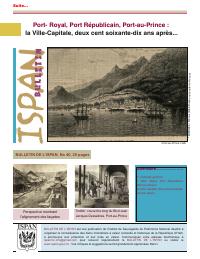
Bulletin de l'ISPAN, No 40: Port-Royal, Port-Républicain, Port-au-Prince: the continuation of the study of the capital's two hundred and seventy years
Summary: The Bulletin de l'ISPAN, No 40, of July to October 2019. The issue covers Port-Royal, Port-Républicain, Port-au-Prince: the continuation of the study of the capital's two hundred and seventy years. The Bulletin is the publication of Haiti's national heritage institute, which documents the country's built heritage monument by monument, its state of conservation and the work carried out on it. 20 pages.
Key Findings
- The bulletin places Port-au-Prince within the wider colonial urban system of Saint-Domingue.
- Colonial towns are presented as instruments of territorial exploitation, trade organization and military control.
- Port-au-Prince is distinguished by especially wide streets compared with Cap-Français and Les Cayes.
- The issue links the city's morphology to repeated shocks, including fires, revolution, occupation, war and earthquakes.
- The capture of Port-Républicain by the Indigenous Army on 8 October 1803 is treated as an under-known episode before Vertières.
- ISPAN argues that the historic downtown grid remains a key memory structure even after most buildings from the period disappeared.
Full Description
The Bulletin de l'ISPAN, No 40, of July to October 2019. The issue covers Port-Royal, Port-Républicain, Port-au-Prince: the continuation of the study of the capital's two hundred and seventy years. The Bulletin is the publication of Haiti's national heritage institute, which documents the country's built heritage monument by monument, its state of conservation and the work carried out on it. 20 pages.
How to cite
Institute for the Protection of National Heritage (ISPAN), 2019, Bulletin de l'ISPAN, No 40: Port-Royal, Port-Républicain, Port-au-Prince: the continuation of the study of the capital's two hundred and seventy years, https://www.dloc.com/AA00065766/00042