
Bulletin of the ISPAN, No. 27: Laws, Decrees and the Safeguarding of Heritage
- The bulletin reviews Haiti's legal framework for heritage protection and argues that generous legal principles have often produced rules that are difficult to apply.
- It traces early Haitian monument interventions under Stenio Vincent, when repair and sanitation slowed deterioration but often subordinated historic techniques and material aging to reinforced concrete and substitution.
- The issue identifies the 1940 Vincent law as a key Haitian statute on sites and monuments, alongside earlier and later legal instruments.
- It presents heritage protection as a public responsibility grounded in the idea that citizens are custodians of national cultural goods.
- The bulletin also reports a UNESCO-supported process to update Haiti's cultural-heritage law, including methodology and terms of reference.
- Its chronicle notes cultural-sector planning gaps, the role of cultural professions, and the death of Lenord Fortune, known as Azo, as a defender of Haitian cultural heritage.
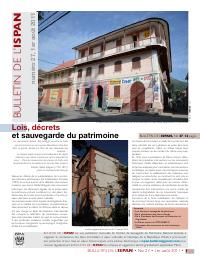
The legal framework for heritage protection in Haiti, from the first genuinely Haitian statute — the Loi Vincent, promulgated in 1940 by President Sténio Vincent on the protection of sites and monuments — through the classes of property it covers, including shores, ports and roadsteads, islands and islets, gates, walls, ditches, ramparts of fortified places and fortresses. The cover is a traditional house in the historic center of Cap-Haïtien, in private hands. One issue of the Bulletin de l'ISPAN, the monthly bulletin of Haiti's Institut de Sauvegarde du Patrimoine National, which ran from June 2009 to at least November 2011 and documented one monument, site or historic center per issue.
How to cite
Institute for the Protection of National Heritage (ISPAN), 2011, Bulletin of the ISPAN, No. 27: Laws, Decrees and the Safeguarding of Heritage, https://www.haiti.org/