
Law of 1963 declaring the Morne l'Hôpital catchment a protected zone
- Morne l'Hôpital's springs supply Port-au-Prince with drinking water, and its floods damage the capital.
- The law ends agricultural and soil-exploiting industrial activity on the hillside.
- The named drivers are fascine cutting, hillside annual cropping, lime burning and sand and gravel quarrying.
- The hillside is now largely built over and flooding off it remains a recurring cause of loss.
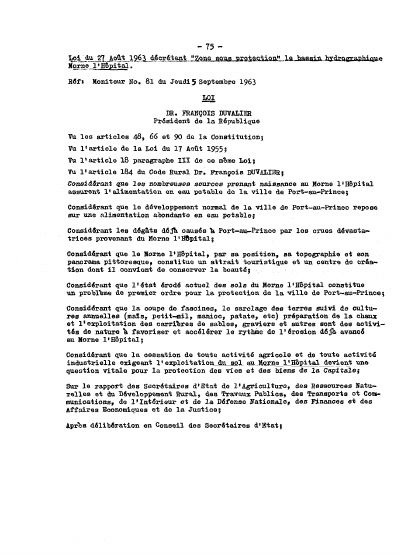
The law published in Le Moniteur No. 81 of 5 September 1963 under François Duvalier, taken under the law of 17 August 1955 and article 184 of the Rural Code.
The preamble is a compact statement of the problem: the many springs rising on Morne l'Hôpital supply Port-au-Prince with drinking water; the city's normal development rests on an abundant supply; devastating floods coming off the hillside have caused damage in the capital; the hillside's position, topography and panorama make it a tourist attraction worth preserving; the eroded state of its soils is a first-order problem for the protection of the city; and ending all agricultural activity and all industrial activity requiring exploitation of the soil there has become a condition of protecting lives and property in the capital. The activities named are fascine cutting, weeding followed by annual crops of maize, sorghum, cassava and sweet potato, lime preparation and the working of sand and gravel quarries.
Morne l'Hôpital is now largely built over, and the flooding the law sought to prevent is a recurring cause of loss in Port-au-Prince. The corpus holds the CIAT urban planning material and the metropolitan water studies that return to this catchment.
How to cite
Legislative Body of Haiti, Law of 1963 declaring the Morne l'Hôpital catchment a protected zone, https://www.fao.org/faolex/country-profiles/general-profile/en/?iso3=HTI
- Rights holder
- Government of Haiti