
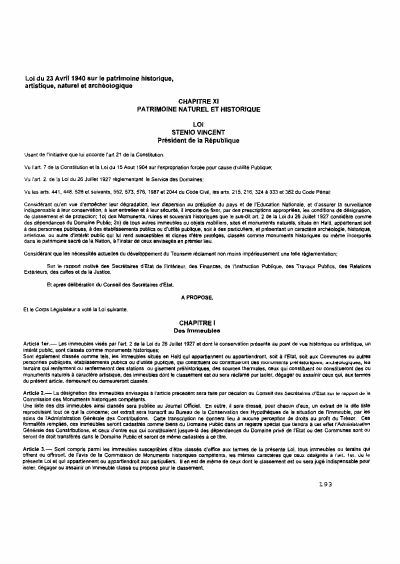
Law of 23 April 1940 on historic, artistic, natural and archaeological heritage
- The law covers monuments, ruins, historic remains, natural sites and movable objects, in public or private hands.
- Expropriation for public utility is available where conservation requires it, under the law of 15 August 1904.
- Historic remains treated as public domain dependencies come from article 2 of the law of 26 July 1927.
- The natural-site limb feeds the 1968 national parks decree, which cites this law.
The law of 23 April 1940, held here as Chapter XI, Natural and Historic Heritage, of a compilation.
The preamble states its purpose: to prevent degradation and dispersal to the country's and national education's prejudice, and to secure the supervision needed for conservation, upkeep and safety, by fixing the conditions for designating, classifying and protecting first the monuments, ruins and historic remains that article 2 of the law of 26 July 1927 treats as dependencies of the public domain, and second all other immovables and movable objects, sites and natural monuments situated in Haiti, whether belonging to persons or otherwise. It cites article 7 of the Constitution and the law of 15 August 1904 on compulsory expropriation for public utility, articles of the civil code on ownership and of the penal code on damage.
Heritage classification is the legal basis for the Citadelle and Sans-Souci designation, for ISPAN's mandate and for the built-heritage component of post-disaster recovery, and the natural-site limb of it feeds directly into the 1968 national parks decree. The corpus holds the ISPAN instruments and the 1983 national park decree, which cites this law.
How to cite
Legislative Body of Haiti, Law of 23 April 1940 on historic, artistic, natural and archaeological heritage, https://www.fao.org/faolex/country-profiles/general-profile/en/?iso3=HTI
- Rights holder
- Government of Haiti