
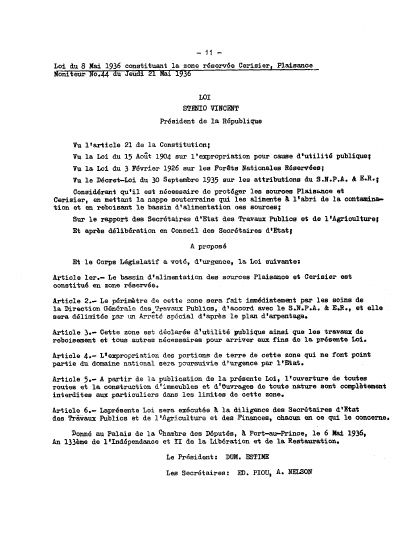
Law of 8 May 1936 constituting the Cerisier and Plaisance springs catchment a reserved zone
- The catchment is both a reserved zone and a public utility declaration, and the second of those makes expropriation available.
- Road opening and all private construction are forbidden inside the zone from publication.
- The perimeter is fixed by a special arrêté on a survey plan by Public Works with the agricultural service.
- The same template recurs in 1943 for the Thor springs, 1947 for the Mornes du Cap and 1963 for Morne l'Hôpital.
The law of 8 May 1936, published in Le Moniteur No. 44 of 21 May 1936 under Sténio Vincent.
Article 1 constitutes the catchment of the Plaisance and Cerisier springs a reserved zone. Article 2 puts the perimeter survey with the Direction Générale des Travaux Publics acting with the agricultural service, to be fixed by a special arrêté on the survey plan. Article 3 declares the zone of public utility along with the reforestation and other works needed to give effect to the law. Article 4 requires the State to pursue expropriation of the parcels not already in the national domain as a matter of urgency. Article 5 forbids, from publication, the opening of any road and the construction of buildings or works of any kind by private parties inside the zone.
The preamble states the reason: protecting the springs by shielding the aquifer that feeds them from contamination and reforesting the catchment. This is the template Haiti has used for urban water supply ever since, and the same reasoning reappears in the 1943 Thor springs decree, the 1947 Mornes du Cap arrêté and the 1963 Morne l'Hôpital law, all held in this corpus.
How to cite
Legislative Body of Haiti, Law of 8 May 1936 constituting the Cerisier and Plaisance springs catchment a reserved zone, https://www.fao.org/faolex/country-profiles/general-profile/en/?iso3=HTI
- Rights holder
- Government of Haiti