
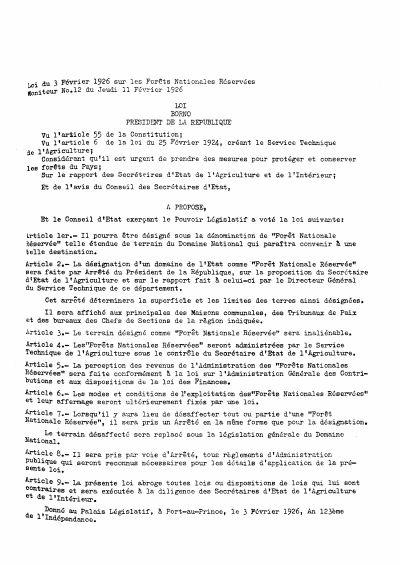
Law of 3 February 1926 on National Reserved Forests
- Designation is by presidential arrêté, on the agriculture secretary's proposal, fixing area and boundaries.
- Reserved land is inalienable.
- Release requires an arrêté in the same form, returning the land to the ordinary law of the national domain.
- The arrêté must be posted at commune offices, justices of the peace and section chiefs' offices.
- Every later protected-area instrument in this corpus cites this law.
The law of 3 February 1926, published in Le Moniteur No. 12 of 11 February 1926 under President Louis Borno, creates the category Forêt Nationale Réservée.
Article 2 puts designation in a presidential arrêté taken on the agriculture secretary's proposal and the Service Technique's report, fixing area and boundaries, and requires it to be posted at the commune offices, the justices of the peace and the section chiefs' offices of the region. Article 3 makes reserved land inalienable. Article 4 places administration with the Service Technique de l'Agriculture. Article 5 routes revenue collection through the general contributions administration and the finance law. Article 7 requires an arrêté in the same form to release land, which then returns to the ordinary law of the national domain.
Every later protected-area instrument in this corpus cites this law: the 1937 and 1947 reserved-forest arrêtés, the 1968 national parks decree, the 1983 Morne La Visite and Macaya decree and the 2017 national park arrêtés. It is the statutory base of a protected estate that now covers the water catchments supplying Port-au-Prince and Cap-Haïtien.
Full Document Text
Extracted text from the original document for search indexing.
How to cite
Corps Législatif d'Haïti, Law of 3 February 1926 on National Reserved Forests, https://www.fao.org/faolex/country-profiles/general-profile/en/?iso3=HTI
- Rights holder
- Government of Haiti