
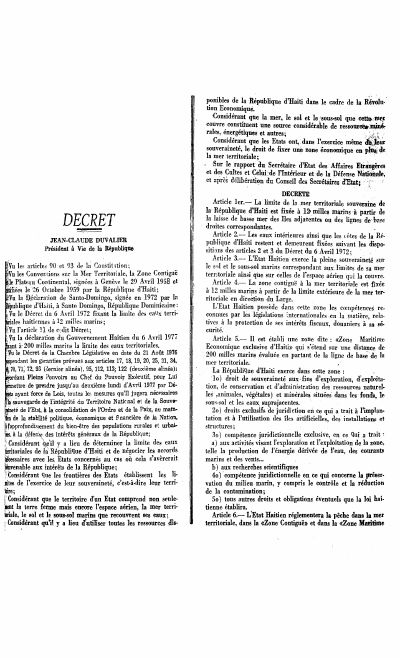
Decree fixing the limits of the territorial sea and the exclusive economic zone
- The territorial sea is 12 nautical miles and the exclusive economic zone 200.
- The preamble cites the 1958 Geneva conventions ratified by Haiti on 26 October 1959 and the 1972 Santo Domingo Declaration.
- It states that the territory comprises the air space, the territorial sea and the seabed and subsoil beneath its waters.
- The EEZ is the basis for fisheries jurisdiction and for any offshore hydrocarbon claim.
The decree of Jean-Claude Duvalier fixing the limits of Haiti's territorial sea, contiguous zone and exclusive economic zone.
The preamble cites the Geneva conventions on the territorial sea, the contiguous zone and the continental shelf signed on 29 April 1958 and ratified by Haiti on 26 October 1959; the Santo Domingo Declaration signed by Haiti in 1972; the decree of 6 April 1972 fixing the territorial sea at 12 nautical miles and its article 11; the Haitian government's declaration of 6 April 1977 extending the limit to 200 nautical miles; and the legislative chamber's decree of 21 August 1976 granting full powers to the head of the executive until the second Monday of April 1977. It reasons that a state's frontiers fix the limits of its sovereignty, that its territory comprises the land, the air space, the territorial sea and the seabed and subsoil its waters cover, and that all available resources should be used within the framework of the Économic Revolution.
The EEZ is the legal basis for Haitian fisheries jurisdiction and for any future offshore hydrocarbon or seabed claim, and it is the boundary that matters in the maritime delimitation questions the corpus tracks with Jamaica, Cuba and the Dominican Republic.
How to cite
Presidency of the Republic of Haiti (PRH), 1977, Decree fixing the limits of the territorial sea and the exclusive economic zone, https://www.fao.org/faolex/country-profiles/general-profile/en/?iso3=HTI
- Rights holder
- Government of Haiti