
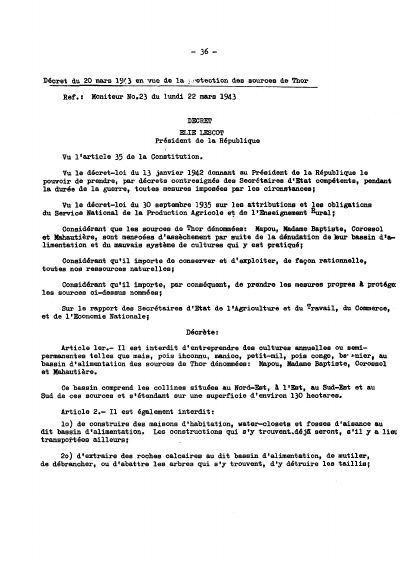
Decree of 20 March 1943 protecting the Thor springs
- The catchment is about 130 hectares of hills north-east, east, south-east and south of the springs.
- Annual and semi-permanent crops, dwellings, latrines, limestone extraction, tree felling and new lime kilns are all forbidden.
- Existing structures in the catchment are to be moved where necessary.
- The springs supply part of the Port-au-Prince metropolitan area.
The decree of 20 March 1943, published in Le Moniteur No. 23 of 22 March 1943 under Élie Lescot.
The preamble states that the Thor springs, named Mapou, Madame Baptiste, Corossol and Mahautière, are threatened with drying up through the stripping of their catchment and the cropping system practised there. Article 1 forbids annual and semi-permanent crops such as maize, beans, cassava, sorghum, pigeon pea and banana in the catchment, described as the hills lying north-east, east, south-east and south of the springs over about 130 hectares. Article 2 also forbids building dwellings, water closets and latrines in the catchment, with existing structures to be moved where necessary; extracting limestone; mutilating, lopping or felling trees and destroying scrub; and building new lime kilns.
Thor supplies part of the Port-au-Prince metropolitan area's water. The decree is the 1943 instance of the catchment-protection pattern Haiti has applied since 1936, and its list of prohibited activities names the drivers, charcoal, lime burning and hillside cropping, that the corpus's later watershed diagnostics still identify.
How to cite
Presidency of the Republic of Haiti (PRH), Decree of 20 March 1943 protecting the Thor springs, https://www.fao.org/faolex/country-profiles/general-profile/en/?iso3=HTI
- Rights holder
- Government of Haiti