
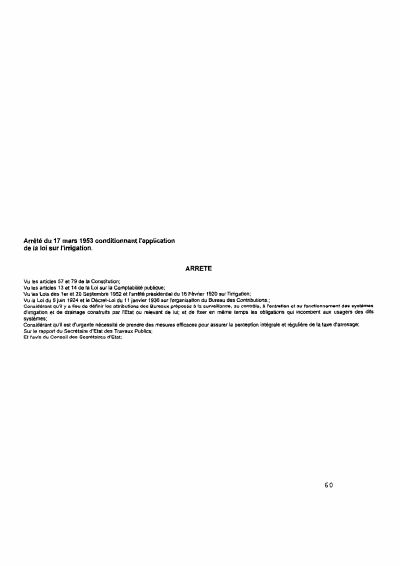
Arrêté of 17 March 1953 conditioning the application of the irrigation law
- The arrêté repeals the presidential arrêté of 16 February 1920 and rebuilds the irrigation administration.
- Cadastral and irrigation offices are set up in each region with a state-controlled network.
- Their work pairs a cadastre of irrigated properties with the operation of the systems.
- The stated motive is the full and regular collection of the watering tax.
The arrêté of 17 March 1953, taken under the irrigation laws of 1 and 20 September 1952 and the presidential arrêté of 16 February 1920.
The preamble gives two reasons: defining the duties of the offices responsible for supervising, controlling, maintaining and operating the irrigation and drainage systems built by or belonging to the State, together with the obligations falling on their users; and the urgent necessity of measures to secure the full and regular collection of the watering tax. Article 1 repeals the presidential arrêté of 16 February 1920. Article 2 requires the Public Works department to establish one or more cadastral and irrigation offices in each region holding a network or systems it controls, working under the irrigation service director on the cadastre of irrigated properties and on the administration and operation of the systems.
Irrigation charges are among the few user fees Haitian public infrastructure has tried to collect, and pairing a cadastre of irrigated parcels with the tax is the mechanism: without knowing which parcel is watered, there is no basis to bill. The corpus holds the 1959 irrigation tax decree, the 1960 decree on the special irrigation fund and the 1990 irrigation water management decree, which together document a lane that runs from 1920 to the present.
How to cite
Presidency of the Republic of Haiti (PRH), Arrêté of 17 March 1953 conditioning the application of the irrigation law, https://www.fao.org/faolex/country-profiles/general-profile/en/?iso3=HTI
- Rights holder
- Government of Haiti