
Haiti Land Dispute Country Conditions (March 27, 2017)
- Haiti does not have an effective national cadastre or a comprehensive, functional system for recording land ownership.
- Before the 2010 earthquake only 40% of landowners possessed documentation such as a legal title or transaction receipt.
- The Direction Générale des Impôts, responsible for land registration records, had its building severely damaged and the status of its records was unknown.
- Landowners and squatters disputed land chosen for relocation camps such as Corail-Cesselesse, where squatters reported encounters with men they believed were sent by landowners.
- High interest rates of about 33% and the lack of ownership documents may limit credit for reconstruction.
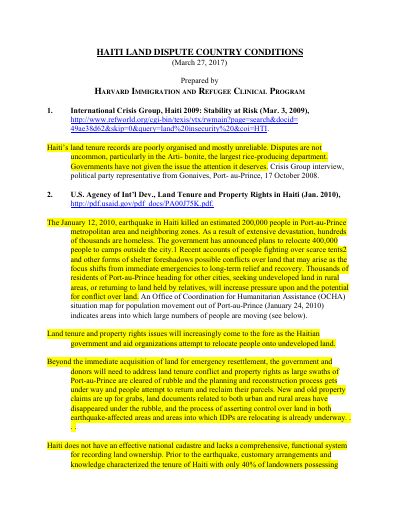
The memo is built from numbered excerpts of sources, among them Crisis Group (2009), USAID (January 2010), Associated Press, NewsOne and Reuters reports of 2010, and UN-HABITAT. It states that Haiti has no effective national cadastre and that, before the earthquake, only 40% of landowners possessed documentation such as a legal title or transaction receipt. Excerpts describe land records lost in the earthquake, damage to the Direction Générale des Impôts building that held registration records, disputes over land chosen for relocation camps such as Corail-Cesselesse, and the risk of land conflict when urban residents return to rural areas. Sources report that less than 5 percent of Haiti's land is officially accounted for in public land records and that courts take on average five years to resolve a case.
How to cite
Harvard Immigration and Refugee Clinical Program (HIRC), Haiti Land Dispute Country Conditions (March 27, 2017), accessed via HaitiDocs, https://www.haitidocs.org/doc/hirc-2017-03-haiti-land-dispute-country-conditions
- Rights holder
- Harvard Immigration and Refugee Clinical Program (HIRC)