
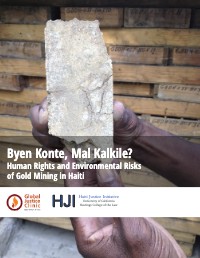
Byen Konte, Mal Kalkile? Human Rights and Environmental Risks of Gold Mining in Haiti
- No metal mine was active in Haiti, and mining activity has been on hold since early 2013.
- The Senate passed a resolution calling for a moratorium on mining in February 2013.
- Two Canadian and two U.S. companies reportedly invested more than US$30 million in exploration between 2006 and early 2013.
- A task force presented a draft mining law in August 2014 to replace the 1976 Mining Decree.
- The draft was prepared with input from mining companies but without public participation.
- The report recommends transparency, public education and community engagement before any mining begins.
The 276-page report, published in December 2015, has an executive summary, methodology and recommendations followed by five chapters: Haiti's gold past and present, the modern mine and mining in Haiti today, environmental risks, the economics of gold mining, and the legal framework. It records that no metal mine was active in Haiti, that two Canadian and two U.S. companies reportedly invested more than US$30 million exploring between 2006 and early 2013, and that the Senate called for a moratorium in February 2013. Some estimates put the value of the gold alone at US$20 billion. The report profiles permit holders VCS Mining, Majescor-SOMINE and the Newmont-Eurasian joint venture, communities at Grand Bois and La Montagne, cyanide processing, tax and royalty terms, the 1976 Mining Decree and the August 2014 draft mining law. It includes recommendations.
How to cite
Haiti Justice Initiative; UC Hastings; NYU School of Law, 2015, Byen Konte, Mal Kalkile? Human Rights and Environmental Risks of Gold Mining in Haiti, https://en.ayitikanpemin.org/resources-list/byen-konte-mal-kalkile-human-rights-and-environmental-risks-of-gold-mining-in-haiti