
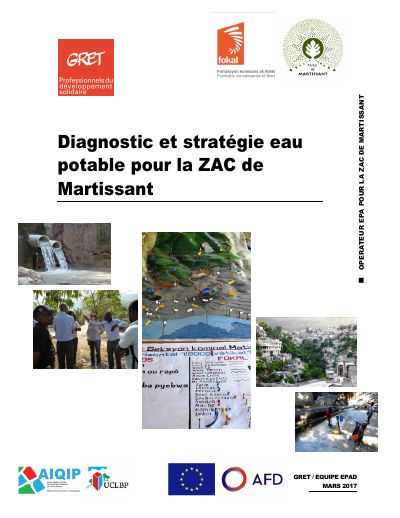
Diagnosis and Drinking Water Strategy for the Martissant ZAC
- Nine standpipes connected to the CTE network serve the seafront zone, 5 at Martissant 2A and 4 at Martissant 2B, run by water committees.
- The Martissant 2A committee sells 2,000 to 3,000 cubic meters of water a month and the 2B committee about 1,200.
- The Leclerc spring produces 34 liters per second and the study proposes supplying zone 3 from it to protect it.
- The Sorey committee has 65 active household connections paying a flat 200 gourdes a month.
- In zone 4 the average price of water is above 10 gourdes per bucket and goes up to 25 gourdes from informal sellers.
- The IDB-financed Port-au-Prince III program plans about USD 54 million and a pipe serving nearly 230,000 people at 40 liters per person a day, with 30 kiosks along the Route des Dalles.
- An EU-financed Grand Ravine water system estimated at USD 850,000 was abandoned.
The report is the water part of the mission that FOKAL gave the GRET in April 2016 as water and sanitation operator for the ZAC of Martissant, under the project ownership of the UCLBP and with financing from the AFD and the EU. It uses the four zones of the 2012 planning scheme, field visits, meetings with DINEPA, its western regional office OREPA Ouest and the technical operating center of the metropolitan region (CTE RMPP), and one focus group of about fifteen people per zone.
The inventory describes access by zone. In the seafront zone, 9 standpipes connected to the CTE network are run by water committees: the Martissant 2A committee manages 5, with 2,000 to 3,000 cubic meters sold a month, and the Martissant 2B committee manages 4, with about 1,200 cubic meters a month. The Leclerc spring produces 34 liters per second, and in the hills households buy water from informal sellers at prices well above those of the CTE. In zone 3 the Sorey committee has 65 active households paying a flat 200 gourdes a month. Zone 4 has no network or spring: water costs more than 10 gourdes per bucket on average and up to 25 gourdes from informal sellers, and women and children face risks when using sand trucks.
The strategy is tied to two projects financed by the Inter-American Development Bank: the renewal of the western main pipeline of the metropolitan network under Port-au-Prince III, with a planned cost of about USD 54 million, and the replacement of the Leclerc-Bolosse aqueduct. The Port-au-Prince III design plans a pipe able to serve a population of nearly 230,000 along the Route des Dalles at an average of 40 liters per person a day and 30 kiosks. A project for Grand Ravine financed by the EU and estimated at USD 850,000 was abandoned. The cross-cutting proposals cover service continuity and quality, strengthening of water committees and the technical and commercial management, awareness and dialogue with users, coordination of projects with FOKAL as a possible lead, and changes to the regulatory framework.
How to cite
Groupe de recherche et d'échanges technologiques (GRET), 2017, Diagnosis and Drinking Water Strategy for the Martissant ZAC, accessed via HaitiDocs, https://www.haitidocs.org/doc/gret-2017-zac-martissant-strategie-eau-potable
- Rights holder
- Groupe de recherche et d'échanges technologiques (GRET)