
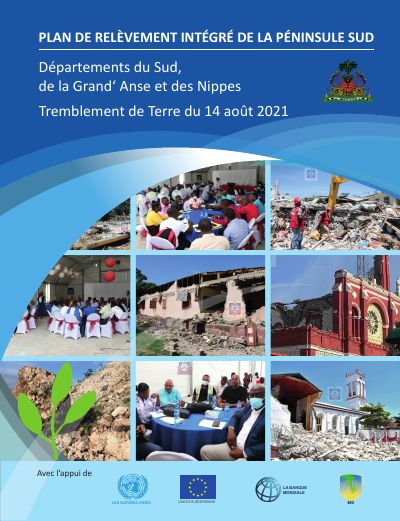
Integrated Recovery Plan for the Southern Peninsula: Sud, Grand'Anse and Nippes Departments, Earthquake of August 14, 2021
- Recovery needs identified in the PDNA are about 192.5 billion gourdes; the plan covers 48 months, from October 1, 2021 to September 30, 2025.
- The financing table totals US$1,978,069,325, with US$324,742,502 available and a deficit of US$1,653,326,823 (84 percent).
- Protection and social inclusion accounts for US$1,129,358,221 of the total, of which housing is US$976,464,309.
- Resilient infrastructure has US$520,952,563, governance US$162,072,368 and economic recovery US$165,686,173.
- Four strategic axes organize eleven sectors and the cross-cutting themes of gender, livelihoods and employment.
- Coordination runs through a Strategic Committee chaired by the Prime Minister, MPCE technical coordination and quarterly monitoring with independent mid-term and final evaluations.
The Ministry of Planning and External Cooperation presents the plan as the government's statement of recovery needs identified in the PDNA and of its vision for rebuilding the Southern Peninsula. The foreword puts needs at about 192.5 billion gourdes, gives the plan a horizon of 48 months, and invites technical and financial partners to the high-level event of February 16, 2022 in Port-au-Prince. The plan recalls the 2,246 dead, 12,763 injured and 329 missing, effects of US$1,620,071,414, and more than 690,000 people affected, 45 percent of the population of the three departments, and notes that the area was still recovering from Hurricane Matthew in 2016.
The plan sets the vision of a recovery that is resilient to multiple and complex hazards, three guiding principles (including marginalized territories, ownership by local actors, and inclusive and sustainable economic recovery) and four strategic axes: recovery governance, economic recovery, resilient infrastructure with territorial planning and better living conditions, and protection and social inclusion. The territorial frame is the Southern Peninsula's 3 departments, 11 districts and 43 communes, with 1,585,802 inhabitants in 2015. Gender equality, livelihoods and employment are treated across the axes, and the plan links its actions to the humanitarian response plan.
Implementation is coordinated at three levels: an Interministerial Strategic Coordination Committee chaired by the Prime Minister, technical coordination by the Ministry of Planning and External Cooperation with the Ministry of the Interior and Territorial Collectivities, and operational coordination through sector working groups. The monitoring framework is updated at least quarterly, with independent evaluations at mid-term (fiscal year 2022-2023) and at the end (fiscal year 2024-2025). Needs are prioritized over the four years from October 1, 2021 to September 30, 2025 in three phases (zero to one year, one to two years, two to four years). The financing table totals US$1,978,069,325, of which US$324,742,502 is available and US$1,653,326,823 is a deficit (84 percent). By axis, the total is US$162,072,368 for governance, US$165,686,173 for economic recovery, US$520,952,563 for resilient infrastructure and US$1,129,358,221 for protection and social inclusion, where housing alone is US$976,464,309. The plan proposes a United Nations multi-partner trust fund with fees of 1 percent for the administrative agent and 7 percent for project management, and half-yearly financial reports to the Aid Effectiveness Committee. The annex lists the action plan by sector and the financing needs by axis, sector and period.
How to cite
Ministry of Planning and External Cooperation (MPCE), 2022, Integrated Recovery Plan for the Southern Peninsula: Sud, Grand'Anse and Nippes Departments, Earthquake of August 14, 2021, https://www.undp.org/latin-america/publications/plan-de-relevement-integre-de-la-peninsule-sud-departements-du-sud-de-la-grand-anse-et-des-nippes-avec-lappui-de
- Rights holder
- Ministère de la Planification et de la Coopération Externe (MPCE)