
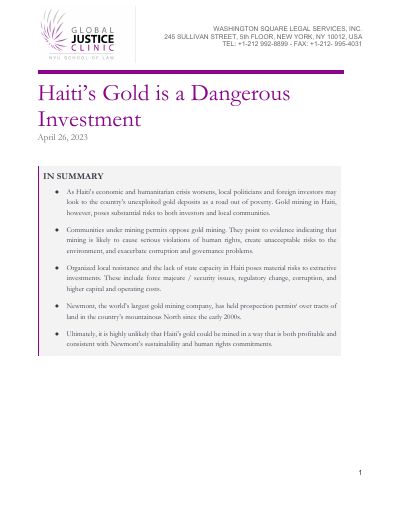
Haiti's Gold is a Dangerous Investment
- No company has begun to exploit Haiti's gold deposits despite three exploitation permits issued in 2012.
- The 2013 Senate moratorium, the 1976 Mining Decree and the 2017 draft mining law leave the legal framework contested.
- Communities in the North strongly oppose mining and exploration has not gained a social license.
- Haiti's bilateral investment treaty with the United States has not entered into force, so it gives no protection from expropriation.
- The authors conclude that the risks of mining far outweigh the sector's potential profitability.
The brief, issued by Washington Square Legal Services, says that Haiti's mineral deposits were documented in the 1970s and that, after companies staked claims in the early 2000s, no company has begun to exploit them even though the Office of Mines and Energy issued three exploitation permits in 2012. It lists the obstacles: the 2013 Senate moratorium on mining, the 1976 Mining Decree and a 2017 draft mining law that communities oppose, strong opposition from communities in the North, political and regulatory uncertainty, and an uncompetitive sector.
Newmont, which has held prospection permits in the North since the early 2000s and has had a presence in Haiti since 2008, is presented as the largest investor in the gold sector. The authors argue that its sustainability and human rights commitments cannot be met while mining in Haiti and that the risks outweigh the profitability.
How to cite
Global Justice Clinic; Washington Square Legal Services, 2023, Haiti's Gold is a Dangerous Investment, https://en.ayitikanpemin.org/s/Newmont-Investor-Brief_GJC_April-2023.pdf
- Rights holder
- Global Justice Clinic|Washington Square Legal Services