
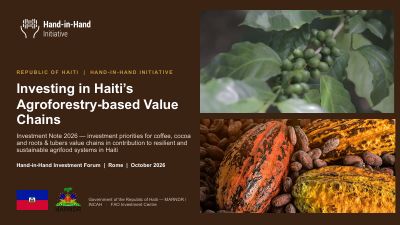
Investing in Haiti's Agroforestry-based Value Chains: Investment Note 2026 (coffee, cocoa, roots and tubers)
- Coffee area fell 89% and production 90% between 1961 and 2024, to 8,477 ha and 4,371 t, with smallholder yields at or below 200 kg/ha.
- Up to 80% of coffee is traded informally and official exports were USD 1.57M in 2024 (161 t), compared with about USD 90M a year in the 1980s.
- The proposed program costs USD 35.7M over 2026-2031: 3,000 ha of coffee in 10 clusters (about USD 27.0M, 8,000 families), 650 ha of cocoa (USD 3.2M) and about 1,000 ha of roots and tubers (USD 1.8M), reaching 9,300 families.
- Expected results at full development are about 700 MT of green coffee a year, formal coffee exports above USD 4M a year and an economic internal rate of return of 14.2% (NPV USD 10.2M, B/C 1.10).
- The note names cooperatives (COOPCAB, APCAB, UCOCAB, CACGAVA, COOPACVOD, RECOCARNO, RECOCAS, RECARB) and exporters and roasters (Rebo, Selecto, Geo Wiener, Novella) as partners.
- Figures are marked as under validation (September 2026), and the note invites partners to co-finance nine further clusters.
The note describes coffee as the anchor chain of an agroforestry investment program, with cocoa and roots and tubers as complements. It reports that Haiti's coffee area fell from 80,000 ha to 8,477 ha and production from 45,720 t to 4,371 t between 1961 and 2024, that smallholder yields do not surpass 200 kg/ha, and that up to 80 percent of the crop is traded informally across the Dominican border. Official coffee exports were USD 1.57M in 2024 (161 t of green coffee), compared with about USD 90M a year in the 1980s. The note pairs this with an ICO composite price of about 249 US cents per pound in June 2026 and the EU deforestation regulation (EUDR), which it presents as an opening for traceable agroforestry origins.
The proposed program costs USD 35.7M over 2026-2031. Coffee takes about USD 27.0M for 3,000 ha in 10 clusters of 300 ha across Sud-Est, the Grand Sud (Grande-Anse, Sud, Nippes), Nord and Nord-Est, and Centre and Artibonite, reaching 8,000 families. Cocoa adds 650 ha and USD 3.2M, and roots and tubers add about 1,000 ha and USD 1.8M, for 9,300 families in all. The investments cover production packages in four agroforestry models, nurseries, bio-input factories and seed centers, 4 large and 6 medium wet processing centers with solar dryers and roasters, seven cocoa fermentation centers, digital traceability, revolving funds, a guarantee and interest facility for credit at 3 to 5 percent, and INCAH research. The note names the cooperatives, exporters and roasters it counts as partners.
At full development the note expects about 700 MT of green coffee a year and formal coffee exports above USD 4M a year. It reports an economic internal rate of return of 14.2 percent in the base case, a net present value of USD 10.2M and a benefit-cost ratio of 1.10, and about 560,000 tCO2e avoided or sequestered over 20 years. Its figures are marked as under validation as of September 2026. It invites development banks, climate funds, UN pooled funds and bilateral partners to co-finance further clusters, with GEF-9 anchoring the Sud-Est.
From the document
Text extracted from the original document. It may contain character recognition errors.
How to cite
Ministry of Agriculture, Natural Resources and Rural Development (MARNDR); Institut National du Café d'Haïti (INCAH); Food and Agriculture Organization (FAO), Investing in Haiti's Agroforestry-based Value Chains: Investment Note 2026 (coffee, cocoa, roots and tubers), https://storage.googleapis.com/hih-resources/IF%202026/Haiti.pdf
- Rights holder
- Ministère de l'Agriculture, des Ressources Naturelles et du Développement Rural (MARNDR)|Institut National du Café d'Haïti (INCAH)|FAO