
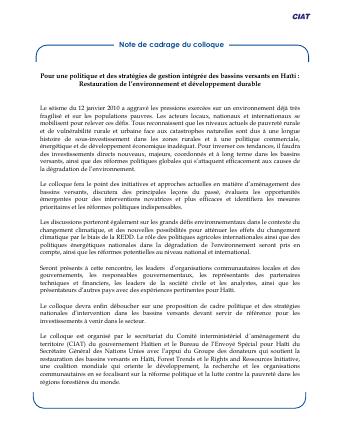
Framing Note: Colloquium on a Policy and Strategies for Integrated Watershed Management in Haiti
- Frames the CIAT watershed colloquium of 17-18 June 2010, five months after the earthquake.
- Argues the quake aggravated pressures on an already degraded environment and on poor populations, and mobilized actors.
- Three papers from the same session are held alongside it: intervention history, investment typology, and a PDNA-based environmental assessment.
This one-page note sets the terms for the colloquium the CIAT convened on 17 and 18 June 2010 to arrive at a policy and strategies for integrated watershed management, environmental restoration and sustainable development. Its argument for the timing is the earthquake: the 12 January event aggravated pressures already bearing on a badly degraded environment and on poor populations, and in its aftermath local, national and international actors were mobilized in a way they had not been before. Watersheds matter to a territorial-planning body because they are the unit on which erosion, flooding, water availability and agricultural viability all turn, and because their degradation is what converts a rainstorm into a disaster downstream in a city. Three papers from the same session are held alongside this note: a history of past watershed interventions and their lessons, a typology of investments then under way, and an assessment of watershed environmental condition drawn from the post-earthquake PDNA.
How to cite
Government of Haiti; Interministerial Committee for Territorial Planning (CIAT), 2010, Framing Note: Colloquium on a Policy and Strategies for Integrated Watershed Management in Haiti, http://ciat.gouv.ht/sites/default/files/docs/Note%20de%20cadrage%20du%20colloque.pdf