Full Description
Cocoa is one of the few Haitian export crops with a premium market and a concentrated production zone in the Grand Sud, which makes the state of its plantations an economic question for the whole region. This presentation opens on the destruction of old plantations, and the ambiguity there is real: Matthew destroyed trees, but an ageing stand is also a chain-wide problem independent of any storm, since cocoa yields decline with tree age and replanting is a multi-year investment few smallholders can self-finance. Setting opportunities against stakes and challenges is the standard value-chain frame, and its usefulness here is that it puts a tree-crop recovery timeline next to the credit and tree-damage papers from the same session, which are the two things that determine whether replanting actually happens.
Full Document Text
Extracted text from the original document for search indexing.
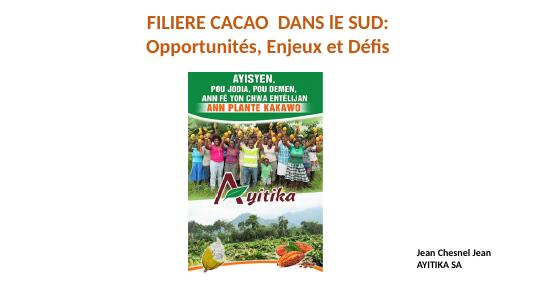
FILIERE CACAO DANS lE SUD:
Opportunités, Enjeux et Défis
Jean Chesnel Jean
AYITIKA SA
�Destruction d’ anciennes plantations
�AYITIKA SA est une ‘’entreprise citoyenne ‘’’spécialisée dans
le développement durable des la filière cacao. AYITIKA est
une entreprise de services et de production.
Intégration verticale (recherche, propres productions, vente
de plantules de qualité, vente d’appui technique ,
exportation cacao fermenté à venir )
�DEGATS MATTHEW
�Destruction de parcelles en cours
d’installation
AYITIKA, PNUE (NORVEGE)/FOKAL
�Cacaoyers “super tree’’ (manman kakao’’)
selectionnés affectés (AYITIKA/CIRAD
�Destruction infrastructures AYITIKA
�SITUATION A DATE
6000
cacaoyers
réhabilités à
Saint Louis
(Fondation
de France)
• Rehabilitation des nouvelles
plantations
�Reprise des ‘’manman kakao’’selectionnés par AYITIKA
�Réhabilitation des infrastructures de
Production AYITIKA
�Production de compost
Capacité annuelle: 300 t environ 250 hectares
�Opportunités
Marchés de niche rémunérateurs
Systèmes rentables /3000 us/ha/an (hypothèses pessimistes
Agroécologie favorable/changement climatique)
Producteurs motivés (jeunes)
Base technique en construction (AYITIKA: Formation cadres à CATIE CostaRica, Spécialistes Cubain
Divers Bailleurs de Fonds interessés
o Norvège (PNUE) -100 hectares en cours d’installation (400 producteurs)
o AFD-projet GEF -100 hectares à venir
o Projet en cours PADF, CRS
o Appel d’offre chaines des valeurs AMC
�Opportunités (suite)
Divers Bailleurs de Fonds interessés
o Norvège (PNUE) -100 hectares en cours
d’installation (400 producteurs)
o AFD-projet GEF -100 hectares à venir
oProjet en cours PADF, CRS
oAppel d’offre chaines des valeurs AMC
�LES ENJEUX
�Garantir durablement l’accès du cacao
haïtien aux marchés de niche/biologique
�Garantir la rentabilité des systèmes
cacaoyers (diversification intelligente)
�Garantir emplois durables (jeunes)
�Preserver durablement les systèmes cacaoyers
Monillose, phytophtora
�Prix différencié sur le marché
Cacao fin exclusive;
12 000 T
US 5000-10000+/T
Cacao fin; 230 000 T
US 3700-5000+/T
Cacao ordinaire certifié
; 600 000 T
US 3100- 3700/T
Cacao ordinaire;
3 200 000 T
US 2100- 3200T
�LES DEFIS
�Garantir aux producteurs l’accès à du
matériel de qualité (variétés du terroir ????)
Un cacaoyer=1 kg
cacao de qualité par
récolte
Eviter l’importation:
risques de transporter
des maladies
�Amélioration des techniques de production
Mode de production Amérique
centrale
Avantages
• Garantir regularité aromatique
• Garantir productivité
• Garantir diffusion de plantes
saines
�Renforcement capacités locales/Développement
de corps de métier
Greffage
Cadres haitiens en formation à CATIE
Costa-Rica
�-Corps de métier possibles???
• Entreprise de production
plantules, fertilisans organiques
• Agent agroforesterie
• Agent greffeurs
• Pollinisateur
• Spécialistes qualité
(fermentation, dégustation)
• Transformateurs
• Agent commercial/marketing
etc.
�Acces au financement pour les acteurs
Conditions et modalités de remboursement
adaptées aux cycles de production des systèmes
cacaoyers
Cout/ha intallation (4600 us/hecatre
�LES FONDAMENTAUX
Dynamisation de la recherche et formations spécialisées (Universités, ecoles
techniques régionales avec supports d’institutions internationales: CIRAD, CATIE)
Stratégie régionale avec un engagement des acteurs à intervenir dans les
standards requis (adaptation du modèle Amerique latine), harmonisation des
approches
Améliorer la gouvernance : Etat haitien (partenariats avec des pays d’Amérique
Latine, Intégration Haiti dans ICCO… , prevention sanitaire (monillose)
Engagement financier sur le long terme
�