
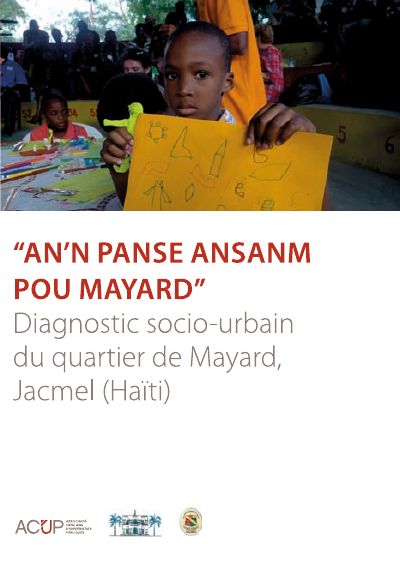
"An'n panse ansanm pou Mayard": Socio-Urban Diagnostic of the Mayard Neighborhood, Jacmel, Haiti
- Mayard covers 13.7 hectares and has an estimated 1,650 to 1,700 residents in 448 buildings.
- 330 household questionnaires completed by 60 resident enumerators from seven associations.
- 60 percent of residents were displaced to Mayard after the 2010 earthquake; children are 40 percent of the population.
- 70 percent of households own their dwelling.
- Unpaved streets follow seasonal ravines and flood in the rainy season.
- Residents' priorities: street works to control runoff, drinking water, drainage, a health center, electricity.
- Waste is burned or dumped at the Trou Bourrique site.
The Catalan Association of Public Universities (ACUP) ran a project from October 2012 to March 2014, funded by the "la Caixa" Foundation and Barcelona City Council, to train the Local Technical Agency (ATL) of the Jacmel town hall. The mayor of Jacmel chose Mayard as the pilot neighborhood. This report presents the diagnostic phase: 60 enumerators drawn from seven neighborhood associations completed 330 household questionnaires, and the team mapped every building in the neighborhood with GIS.
Mayard covers 13.7 hectares less than a kilometer from Jacmel's historic center, in the 1st communal section Bas Cap Rouge. The report estimates 1,650 to 1,700 residents and counts 448 buildings, all self-built. Households average 5.0 people, 37 percent of residents live in households of 7 to 19 people, and most of the neighborhood was built after 1990. Displaced people arriving after the 2010 earthquake make up 60 percent of the population, children 40 percent, and 70 percent of households own their dwelling. Streets are unpaved and follow seasonal ravines, so the neighborhood floods in the rainy season, and waste is burned or dumped at the Trou Bourrique site.
Earlier chapters set out Jacmel's geography, hydrological and seismic risks, and Haiti's territorial administration and decentralization. Residents ranked their priorities as street works to control runoff, access to drinking water, drainage, a health center, a stronger electricity supply, a public space, schools and a vocational center for young people. The report recommends that the project's improvement works be planned and evaluated with residents and that the most active associations be supported in becoming legally registered.
How to cite
Association Catalane des Universités Publiques (ACUP), 2014, "An'n panse ansanm pou Mayard": Socio-Urban Diagnostic of the Mayard Neighborhood, Jacmel, Haiti, https://www.acup.cat/app/uploads/2025/12/diagnostic-socio-urbain-mayard-jacmel_4.pdf
- Rights holder
- Association Catalane des Universités Publiques (ACUP)