
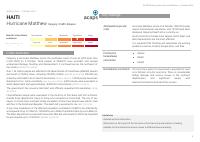
ACAPS Briefing Note: Haiti, Hurricane Matthew, 5 October 2016
Summary — ACAPS Briefing Note: Haiti. The document runs to 9 pages.
Key Findings
- ACAPS Briefing Note: Haiti.
- The first assessment as the category 4 hurricane crossed the country, with the anticipated scope of damage and the key findings on humanitarian need.
Full Description
ACAPS Briefing Note: Haiti. The document runs to 9 pages. The first assessment as the category 4 hurricane crossed the country, with the anticipated scope of damage and the key findings on humanitarian need.
Full Document Text
Extracted text from the original document for search indexing.
ACAPS Briefing Note: Hurricane Matthew – 5 October 2016
Briefing Note – 5 October 2016
Key findings
HAITI
Hurricane Matthew Category: 4 Saffir-Simpson
Need for international
assistance
Not required
Moderate
Significant
Major
Low
Moderate
Significant
Major
It is expected that flooding will exacerbate pre-existing
epidemics such as cholera, dengue fever, and Zika.
X
Crisis overview
Category 4 Hurricane Matthew struck the southwest coast of Haiti at 0700 local time
(1200 GMT) on 4 October. Wind speeds of 230km/h were recorded, and caused
widespread damage, flooding, and displacement. It continued across the northwest of
the country (UNOSAT 5/10/2016).
Over 1.24 million people are affected in the departments of Grand Anse (468,000 people)
and South (775,000) alone, including 522,000 children (UNICEF 04/10/2016). 350,000 are
presently estimated to be in need of assistance (OCHA 4/10/2016). 14,530 people have been
displaced so far, some voluntarily (Alter Press 5/10/2016). 6,000 people were evacuated in
South department and approximately 18,000 from Grand-Anse (UNICEF 4/10/2016).
Hurricane Matthew struck on 4 October. 350,000 people
require humanitarian assistance, and 14,530 have been
displaced. Reported death toll is currently six.
South, South-Est, Grande Anse, Nippes, North West, and
West departments are the most affected.
X
Very low
Expected impact
Low
Anticipated scope and
scale
Priorities for
humanitarian
intervention
Shelter
WASH
Health
Humanitarian constraints Port-au-Prince airport is closed and is expected to open
on 6 October at 6 Am local time. There is considerable
bridge damage and access issues in the southern
departments,
and
significant
issues
with
telecommunications and electricity access.
The government has issued a Red Alert and officially requested UN assistance (OCHA
4/10/2016).
Flood-affected people were evacuated in the districts of Port-Salut and Port-a-Piment,
Grande Anse department; many of those who remained at home died. The city of Les
Cayes, in Grand Anse, has been totally inundated. At least two people have died in Haiti
and four in the Dominican Republic. The death toll is expected to rise (BBC 5/10/2016).
A pre-crisis breakdown of the affected population estimated 213,800 to be affected by
wind speeds of up to 120km/h, 793,000 by up to 90km/h and 8.8 million by up to 60km/h.
The West department is expected to be worst affected, with nearly 91,000 to be impacted
by wind speeds up to 120 km/hr (UNOSAT 5/10/2016).
Limitations
- Detailed sectoral information.
- Information on the impact of the hurricane on food security and protection is lacking.
- Updates on the humanitarian access issues to affected areas are lacking.
1
ACAPS Briefing Note: Hurricane Matthew – 5 October 2016
Operational constraints
Lessons learned
Crisis impact
Port-au-Prince: The airport is closed on 5 October. It is uncertain whether the airport will
reopen on 6 October (Vant Bef Info 04/10/2016). The bridge in Croix des Missions has
been cut to both cars and pedestrians. (Haiti Libre 04/10/2016) A high voltage cable has fallen
onto the Rue Fleury Bathier in Port-au-Prince. (Haiti Libre 04/10/2016). There is reportedly
no electricity available in Port-au-Prince (Haiti Libre 04/10/2016). Distribution of non-food
items was possible from the beginning of the crisis in some areas in Port-au-Prince (CARE
Roads were reported to be blocked by protestors shortly after the 2010 earthquake
– burning tyres prevented access on the road between Port-au-Prince and Carrefour
– an area in West department, about 15km from Port-au-Prince and therefore likely
to strongly rely on that road for aid delivery (RFI 03/10/2016).
Humanitarian access was reportedly difficult in mountain areas after the
earthquake, which are relatively far away from cities (Deseret News 25/05/2011).
There are many reports of bad road conditions, and there are many non-crime
related security issues, especially outside daylight hours in rural areas. (OSAC
05/10/2016).
West departement: Damage to electricity pylons is repored in West department
(Alterpresse 04/10/2016). The route de Laboule in West department has been cut due to a tree
that fell, causing traffic jams in the area. (Haiti Libre 04/10/2016) The Island of Gonave, in the
West department, is reportedly inaccessible (CARE 05/10/2016).
South departement: The bridge leading to Route Nationale 2, the only access to the
south from Port-au-Prince, is down (UNICEF 04/10/2016). There are unconfirmed reports
that the Ladigue bridge has collapsed; this bridge connects the departements of Nippes,
Grande-Anse and South to the rest of Haiti (Humanity Road 05/10/2016).
03/01/2016)
Monitoring and cross-sectoral synergy among interventions in targeted communes
will allow for better prioritisation and resource mobilisation (UNICEF 2014).
Shared information permits more rational use of limited logistics capabilities (ACF
19/03/2009).
GPS use in early assessments is highly recommended (ACF 19/03/2009).
High population density can be leveraged to facilitate distribution operations (water,
food, NFI) (ACF 19/03/2009).
Road access to Anse Milieu, in the South department has been cut off by road access
(ACT Alliance 05/10/2016). Landslide has caused a breakage of traffic in Anse Milieu, on the
Route Les Anglais and Tiburon. (Haiti Libre 04/10/2016)
In Coteaux, in South department, floods are reported on the Boulevard Saint-Pierre. (Haiti
Libre 04/10/2016). There is reportedly no electricity available in the South department. (Haiti
Libre 04/10/2016) Communication problems due to problems with the Digicel network were
reported in the communes of Les Cayes, in the South department and Jeremie, in the
Grande Anse department (Humanity Road 04/10/2016).
South-East departement: The road to Jacmel, in South-Est, has reportedly been
damaged. A power outage is reported and the telephone service is poor. (OCHA
05/10/2016)
2
ACAPS Briefing Note: Hurricane Matthew – 5 October 2016
Shelter
Key documents
Crisis impact
Comité Thématique Evacuation et Gestion des Abris Provisoires, April 2014, Reponse
aux desastres : abris d’urgence, habitat, et regroupements
http://www.iom.int/files/live/sites/iom/files/pbn/docs/Reponse-aux-desastres-Abrisdurgence-habitat-et-regroupements.pdf
234 shelters have been opened across the country, including 186 temporary shelters
across the south. The 18,000 people evacuated in Port-Salut and Port-a-Piment, South
departement, have shelter needs, as do 6,000 people from South departement. An
estimated 14,530 in total have been displaced so far, some voluntarily. 1,885 houses have
been flooded (Haiti Libre 5/10/2016; Alter Press 5/10/2016)
DHS Program, 2012, Enquête Mortalité, Morbidité et Utilisation des Services,
http://dhsprogram.com/publications/publication-FR273-DHS-Final-Reports.cfm
Pre-crisis
The majority of rural and urban housing consist of two-room houses made of mud walls
and floors. Roofs are often thatched with grasses or palm leaves but may also be made
of plastic or corrugated metal. Windows are panel-less and covered with wooden
shutters. Housing in slums is makeshift. Professionally constructed buildings suffer from
lax enforcement of zoning and safety rules (Encyclopaedia Britannica 09/2016).
38% of Haitian households have electricity, including 72% in urban areas, 50% in camps,
and 15% in rural areas (DHS 2012). Hurricane affected areas were largely rural. 55% of
homes have earth floors, 35% clay or sand, and 6% have ceramic or mosaic tiles (DHS
2012).
Many areas, particularly around Les Cayes, in South department, as well as on the
northern coast of Nippes department, are vulnerable to flooding (Haiti ICT 2016).
All 55,107 IDPs living in camps in Haiti, as of September 2016, were in West department
(IOM 27/09/2016)
Lessons learned
Adaptability is important in post-earthquake reconstruction; best practices include
holding beneficiary surveys and midterm reviews, as well as a large contingency
budget.
Adding a veranda with rainwater catchment system to reconstructed homes was
also found to be useful (IFRC 2012).
Avoid the creation of collective housing if possible; they can lead to conflicts
between different camp committees, camp managers, service providers, and
population as well as increase the risk of disease transmission and protection
issues (IOM 04/2014).
3
ACAPS Briefing Note: Hurricane Matthew – 5 October 2016
Health
Crisis impact
Existing disease in the region, particularly cholera, is likely to spread further, as
infrastructure damage and contamination of water sources by rainfall and flooding
facilitate transmission (UNICEF 04/10/2016). On 3 October, cholera has been reported in
Randel (Port-à-Piment, South department) and has led to five deaths in the community
and one in hospital (UNICEF 04/10/2016).
more deaths (OCHA 30/09/2016). Sporadic flooding in July resulted in a resurgence of
cholera cases in several towns, including in the departments of Artibonite, Centre, Nippes,
North, and West (OCHA 31/07/2016). The situation is most critical in the departments of
West and Artibonite. Approximately 18 towns were on red alert and 10 on orange alert
during August 2016 (OCHA 26/09/2016). 790,000 cholera cases, including 9,243 deaths, have
reported since the start of the epidemic in October 2010 (OCHA 26/09/2016, OCHA 30/06/2016).
Cholera cases in Haiti, 2010–2016
Zika and dengue are also prevalent in hurricane-affected areas, and likely to be
exacerbated by the hurricane and associated heavy rainfall and flooding (UNICEF
04/10/2016). Zika response strategies will also be impacted by the storm (UNICEF 04/10/2016).
Number of
cholera cases
Deaths
2016 (Jan-Aug)
28,145
255
West, Artibonite
In Port-au-Prince, emergency health kits are needed (HaitiLibre 04/10/2016).
2015 (Jan-Dec)
36,045
322
West, Artibonite
In Port-Salut (75,000 inhabitants in the district) and Port-à-Piment (19,000 inhabitants in
the commune) flood victims were evacuated. It is estimated that flood victims who did
not leave their home died (UNICEF 04/10/2016).
2014 (Jan-Dec)
27,753
296
West, Artibonite, North and Centre
2013 (Jan-Dec)
58,809
593
West, Artibonite, North and Centre
2012 (Jan-Dec)
112,076
894
West
2011 (Jan-Dec)
340,311
2,869
West, Artibonite, North, Centre, NorthEst and South
2010 (Oct-Dec)
179,379
3,990
West, Artibonite and North
Year
Pre- crisis
The 2010 earthquake destroyed an estimated 60% of Haiti’s health system, including 50
health centres, and a number of hospitals have still not been fully rehabilitated. Others
lack staff and essential medical equipment (USAID 31/01/2016).
Suspected cholera cases in Haiti, as of 31 August 2016 (OCHA 2016)
Most affected departments
Source: OCHA 2016, PAHO and WHO 2016
Lessons learned
Natural disasters can lead to disruption of usual water sources and contamination
by damaged sewage infrastructure, resulting in unsafe drinking water being
consumed (WHO 30/01/2010).
Population displacement can result in overcrowding, raising the risk of transmission
of communicable diseases that are spread from person to person through
respiratory droplets, such as measles, diphtheria, pertussis (vaccine-preventable
disease) and acute respiratory infections (WHO 30/01/2010).
Key documents
UNICEF
Haiti,
04/10/2016,
Hurricane
Matthew
–
Situation
Report
#2,
http://reliefweb.int/report/haiti/unicef-haiti-hurricane-matthew-situation-report-2-4-october-2016
Poor access to WASH means Haiti is at a high risk of waterborne diseases. As of 26
September, 28,145 new suspected cholera cases have been reported in 2016, including
259 deaths. This is 27% more suspected cases than in the same period of 2015, and 34%
UNICEF, 04/10/2016, LAC Humanitarian Situation Report on Hurricane Matthew (4
October 2016), http://reliefweb.int/report/haiti/unicef-lac-humanitarian-situation-report-hurricanematthew-4-october-2016
4
ACAPS Briefing Note: Hurricane Matthew – 5 October 2016
OCHA,
30/09/2016,
Haiti:
Humanitarian
Snapshot
(September
2016),
http://www.redhum.org/uploads/documentos/pdf/Redhum-HT-Snapshot_humanitario_Sep_2016OCHA-20160930-AM-19287.pdf
PAN/WHO, 12/09/2016, Cholera in the Americas – Situation summary,
http://www.paho.org/hq/index.php?option=com_docman&task=doc_view&Itemid=270&gid=36116&lan
g=en
WASH
Crisis impact
Water, sanitation, and hygiene support is urgently needed to help prevent the spread of
diseases such as cholera (IMC 04/10/2016, Caritas 04/10/2016).
Pre-crisis
1.35 million people are in need of WASH assistance, about 10% of the population,
including some 726,000 people in need of access to safe water and hygiene items (OCHA
02/03/2016, OCHA 07/06/2016).
42% of the population does not have access to a safe drinking water source (CIA
28/09/2016).
7.6 million people or 72% of the population, lack access to improved sanitation (AFP
07/04/2016/OCHA 31/03/2016).
Lack of awareness means that people in rural areas often do not understand the dangers
of contaminating drinking water with trash and chemicals (AFP 07/04/2016, OCHA 31/03/2016).
Lessons learned
Water trucking is very expensive and not sustainable. It may eventually be replaced
by strategically located wells (ACF 19/03/2009).
Logistic is a major challenge in WASH response, especially if access is blocked.
Need to identify land access vulnerabilities and have a back-up plan to gain rapid
access to the site in case of blocked roads (ACF 19/03/2009).
5
ACAPS Briefing Note: Hurricane Matthew – 5 October 2016
Food security and livelihoods
Crisis impact
Existing vulnerabilities, particularly in Grand Anse, West, North-West and South
departments are likely to be greatly exacerbated by the hurricane.
The impact of Hurricane Matthew upon the harvest is uncertain, though it is likely that
planting will be affected.
Pre-crisis
An estimated 3.2 million people were food insecure across Haiti in September, including
456,000 who were severely food insecure (OCHA 04/2016).
The majority of the South department, particularly around the hurricane-affected regions
of Port-a-Piment, Les Anglais, and Chardonnieres would be experiencing at least Stressed
(IPC Phase 2) food security conditions if it were not for humanitarian intervention. The
North-Est department was experiencing Crisis (IPC Phase 3), while the West and NorthEst were largely experiencing Stressed conditions. The bean and yam harvest is
anticipated from September until mid-November. Crops had already reported damage
due to the hurricane, and this is likely to impact food security in the future (FEWSNET
09/2016).
Over 30% moderate and severe food insecurity has been reported in WFP surveys of
major population centres. In hurricane-affected areas, Les Cayes had 31% moderate food
insecurity, Jacmel 23%, and Jeremic 47% (WFP 30/08/2016).
Cereal imports are forecast to reach 650,000 metric tons, 3% below last year’s record
level. Before the hurricane, cereal production was anticipated to recover strongly from
previously drought-induced shortages, if weather conditions continued as normal during
the growing period (FAO 4/10/2016).
Rice is Haiti’s main staple and is mostly imported from the United States. The price of
imported rice is higher in Jacmel and Jeremie – both affected by the hurricane – than in
Port-au-Prince (FAO 4/10/2016). High food prices have reduced food access for the most
vulnerable households throughout 2016, and September saw little change in prices (OCHA
04/2016).
6
ACAPS Briefing Note: Hurricane Matthew – 5 October 2016
Haiti seasonal calendar
Protection
Crisis impact
Some inmates in high-risk prisons have been transferred as a precaution, including 42
people transferred from Miragoane to Fond-des-Negres, 60 from Aquin to Port-au-Prince,
and 102 in Les Cayes and 323 in Mackandal, Jeremie, who went to local police stations
(Haiti Libre 04/10/2016).
Pre-crisis
Lessons learned
Prepositioning food stocks in the most vulnerable areas is extremely important, as
natural disasters can cut off roads for re-supplying. WFP has worked closely with
the Haitian government and non-governmental partners to prepare for hurricane
systems since 2013 (WFP 2013).
Closer cooperation with local actors, the UN, and security forces has facilitated rapid
and efficient food distribution in the past (HPN 08/2010).
Election-related violence has been reported this year. Most of protests and violent
political incidents occur in Port-of-Prince (OSAC 03/01/2016). Platform Pitit Desalin’s
electoral trailer was hit by rocks in Miragoane, Nippes (Alterpresse 27/07/2016). In Cerca-laSource, in Plateau department, the campaign bus of the Platform’s presidential candidate
has been vandalised (Alterpresse 27/07/2016). In Milot, in the North department, there were
clashes between supporters of Moise and those of the Parti Haitien Tet Kale (Alterpresse
27/07/2016). In the commune of Petit-Goave, in West department, protestors prevented a
political meeting of the Fanim Lavalas party on 24 September; it was ultimately held in
Jancem, in South-Est department (Alterpresse 27/07/2016). On 22 September, senatorial
candidate Gracia Delva suffered gunshot injuries in Saint-Marc, in Artibonite (ANMWE
24/09/2016). There is a consensus that violence against women is widespread in Haiti
(GSDRFC 03/08/2013).
Key documents
WFP, 30 August 2016, Urban Food Security Assessment
https://www.wfp.org/content/haiti-urban-food-security-assessment-august-2016
Lessons learned
It is important to improve capacity building, coordination and advocacy when
addressing post-disaster psychological issues, and to facilitate the participation of
the affected people (IOM 2010).
There were many documentation issues with Haitian returnees from the Dominican
Republic. It is reported that two thirds of the returnees do not have any
documentation. (IOM 29/09/2016)
IDPs have faced many protection issues during the last natural disasters hitting
Haiti, especially the 2010 earthquake (Protection Cluster 05/07/2010). These
include crimes in IDP camps, and many IDPs were reportedly raped by people who
escaped prison (Protection Cluster 05/07/2010). Water reserves and food supplies
were also reportedly depleted from IDPs after the recent earthquake (Protection
Cluster 05/07/2010).
7
ACAPS Briefing Note: Hurricane Matthew – 5 October 2016
The spike in crime that followed the 2010 earthquake was reportedly particularly
high in Port-au-Prince. (Protection Cluster 05/07/2010).
It is important to ensure access to support services for victims of gender-based
violence (UNICEF 31/07/2010).
Thousands of children were reportedly living unaccompanied after the 2010
earthquake in Port-au-Prince, and were especially susceptible to be hired as unpaid
domestic servers. (Save the Children 31/12/2010)
Lighting and cooking sources
Access to electricity: 38% (2013 est.)
Use of electricity for cooking: 0%
Use of charcoal for cooking: 41.6%
Use of wood for cooking: 51.8%
Other cooking sources: 6.6%
WASH
Improved drinking water sources total: 57.7% of population
(2015 est.)
Improved sanitation facility: 27.6% of population (2015 est.)
Health
Life expectancy at birth: 63.8 years (2016 est.)
Maternal mortality rate: 359 deaths/100,000 live births
(2015 est.)
Infant mortality rate: 48.2 deaths/1,000 live births (2016
est.)
Hospital bed density: 1.3 beds/1,000 population (2007)
Food security
Global Hunger Index: 37.3; alarming severity (2015 est.)
Population food insecure: 3.2 million (September 2016 est.)
Population severely food insecure: 1.5 million (February
2016 est.)
Nutrition
Prevalence of overweight in children under 5: 3.6% (2015
est.)
Global acute malnutrition: 5.2% (2015 est.)
Severe acute malnutrition: 1% (2012 est.)
Stunting: 21.9% (2015 est.)
Literacy
60.7% (2015 est.)
Others
Population density is fairly even, with largest concentrations
located near coastal areas
Key documents
Amnesty International, January 2013, Nowhere to Go: Forced Eviction in Haiti’s
Displacement Camps,
http://www.globalprotectioncluster.org/_assets/files/field_protection_clusters/Haiti/files/HLP%20AoR/Force
d_Evictions_Haiti_Displacement_Camps_2013_EN.pdf
Bailey, Sarah et al., September 2012, Humanitarian Policy Group (HPG), Avoiding Reality:
Land, Institutions and Humanitarian Action in Post-Earthquake Haiti,
http://www.globalprotectioncluster.org/_assets/files/field_protection_clusters/Haiti/files/HLP%20AoR/Land_I
nstitutions_&_Humanitarian_Action_HPW_Report_2013_EN.pdf
Save the Children, December 2010, Haiti’s Children One Year Later: A Country at a
Crossroads, http://www.savethechildren.org/atf/cf/%7B9def2ebe-10ae-432c-9bd0df91d2eba74a%7D/SAVE_THE_CHILDREN_HAITI_1YR_REPORT_DEC2010.PDF
Key characteristics
Key indicators
Total population
Haiti
10,485,800 (July 2016 est.)
% population in rural areas
41.4% (2015 est.)
Gender and age distribution
of population
0-14 years: 33.39% (0.99 male(s)/female)
15-24 years: 21.35% (1 male(s)/female)
25-54 years: 36.24% (0.99 male(s)/female)
55-64 years: 4.94% (0.91 male(s)/female)
65 years and over: 4.08% (0.81 male(s)/female) (2016 est.)
State capital
Port-au-Prince
Sources: CIA World Factbook, Global Alliance for Clean Cookstoves, Global Hunger Index, Coordination
Nationale de la Sécurité Alimentaire 2016, WFP Food Security Reports, Global Nutrition Report, 2015 Haiti
Nutrition Country Profile,
8
ACAPS Briefing Note: Hurricane Matthew – 5 October 2016
Departement population data
Key indicators
Total population
South
774,976 (2015 est.)
South-East
632,601 (2015 est.)
Grande-Anse
468,301 (2015 est.)
Nippes
342,525 (2015 est.)
West
4,029,705 (2015 est.)
North-West
728,807 (2015 est.)
% population in
rural areas
77.3% (2015 est.)
85.2% (2015 est.)
76.4% (2015 est.)
81.8% (2015 est.)
15.7% (2015 est.)
72.1% (2015 est.)
Density
292 (2015 est.)
311 (2015 est.)
245 (2015 est.)
270 (2015 est.)
809 (2015 est.)
347 (2015 est.)
Sources : Direction des Statistiques Démographiques et Sociales (DSDS), Institut Haïtien de Statistique et d'Informatique (IHSI), mars 2015
9
How to cite
Assessment Capacities Project (ACAPS), ACAPS Briefing Note: Haiti, Hurricane Matthew, 5 October 2016, https://acaps.org/fileadmin/Data_Product/Main_media/20161005_acaps_briefing_note_haiti_hurricane_matthew.pdf