
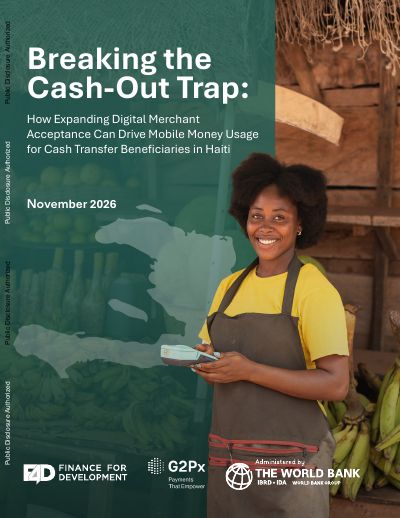
Breaking the Cash-Out Trap: How Expanding Digital Merchant Acceptance Can Drive Mobile Money Usage for Cash Transfer Beneficiaries in Haiti
- 89 percent of PSARA beneficiaries withdraw their full transfer immediately; 11 percent use mobile money for purchases.
- 76 to 82 percent say merchants near them do not accept mobile payments.
- More than 90 percent of Grand'Anse merchants hold a personal wallet, fewer than 9 percent a merchant account, 73 percent want one.
- Proof of address (held by 9 percent) and patente (5 percent) block merchant accounts.
- Unofficial agent fees of HTG 300 to 500 per withdrawal; PRONAP closed to nonbank operators.
- Recommends an instant payment system, tiered KYC, agent fee supervision and a Grand'Anse merchant pilot.
The report, published by the World Bank in November 2026 in English and French, examines why mobile money users in Haiti withdraw cash and seldom pay with it, focusing on beneficiaries of the PSARA (Klere Chimen) cash transfer program in Grand'Anse. It draws on impact evaluation surveys of nearly 11,000 beneficiary households, third-party and post-distribution monitoring, a survey of 341 merchants and 42 interviews across 17 organizations.
Formal account ownership among PSARA beneficiaries rose from 30 to 49 percent between 2022 and 2024, mostly through mobile money accounts opened to receive transfers. Usage did not follow: 89 percent withdraw their full benefit at the first opportunity, only 11 percent use mobile money for purchases, and 76 to 82 percent report that no merchant nearby accepts mobile payments. Remittances reached US$4.1 billion in 2024, about 16.9 percent of GDP.
On the merchant side, over 90 percent of surveyed merchants in Grand'Anse hold a personal mobile money account, fewer than 9 percent a merchant account, and 73 percent want one. Only 9 percent can show proof of address and 5 percent hold a business license (patente). Agents often charge unofficial withdrawal fees of HTG 300 to 500, a flat US$1.50 fee on international transfers under BRH Circular No. 98 penalizes small remittances, PRONAP is closed to nonbank operators, and network outages and agent liquidity shortages are frequent. Merchants name the risk of theft when holding cash as their main reason to accept digital payments.
The BRH issued Circular No. 129-1 in February 2026 with simplified due diligence for low-risk customers, partly informed by this work. The report recommends that the BRH build a national instant payment system, open PRONAP to licensed nonbank entities, adopt tiered risk-based KYC, apply the 2025 electronic signature decree, replace the flat remittance fee, supervise agent fees under Circular No. 131 and update the 2014 financial inclusion strategy. It asks mobile money operators to use agents for merchant onboarding and to build business-to-business payments, and proposes a Grand'Anse pilot of simplified onboarding and a market-level campaign.
How to cite
World Bank, 2026, Breaking the Cash-Out Trap: How Expanding Digital Merchant Acceptance Can Drive Mobile Money Usage for Cash Transfer Beneficiaries in Haiti, http://documents.worldbank.org/curated/en/099110526113010019
- Rights holder
- World Bank