
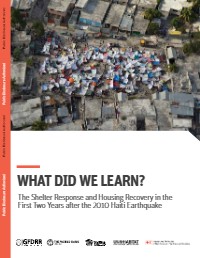
The Shelter Response and Housing Recovery in the First Two Years After the 2010 Haiti Earthquake: What Did We Learn?
- The informal sector was the biggest player in housing recovery, through informal settlements, repairs in informal neighborhoods and unpermitted rental construction.
- Guidelines for small masonry buildings were completed by January 2011 and retrofitting guidelines published in 2012, but were not widely distributed.
- The building safety assessment launched by MTPTC in March 2010 covered all buildings in the affected area.
- Without a strong lead agency for risk reduction, no agreement was reached on what building back better and acceptable risk meant.
- Most households were not assisted by any reconstruction project and recovered on their own.
This 220-page report, published in 2016 by the World Bank and the Global Facility for Disaster Reduction and Recovery (GFDRR), with the Red Cross and Red Crescent federation (IFRC), UN-Habitat and Habitat for Humanity, comes out of a joint analysis begun in 2013. It synthesizes what practitioners learned from the shelter response and housing recovery in the two years after the January 2010 earthquake, and states that it is not a formal evaluation. Chapters cover the shelter response, the housing response, disaster risk reduction, land and urban development, and recovery finance, followed by recommendations. Nine case studies include Katye in Port-au-Prince, rental assistance, the Canaan settlement and the 16 Neighborhoods project. It finds that the informal sector was the largest provider of housing for displaced people.
How to cite
World Bank; Global Facility for Disaster Reduction and Recovery (GFDRR), 2016, The Shelter Response and Housing Recovery in the First Two Years After the 2010 Haiti Earthquake: What Did We Learn?, accessed via HaitiDocs, https://www.haitidocs.org/doc/wb-2016-shelter-response-housing-recovery