Extracted text from the original document for search indexing.
OFFICE OF INSPECTOR GENERAL
February 2025
Report 1-521-25-001-A
U.S. Agency for International Development
Haiti: Risks to U.S. Foreign Assistance
A Complex Crisis: Haiti continues to experience catastrophic political, security, and humanitarian crises.
The 2021 assassination of President Jovenel Moïse sparked a wave of violence, and by early 2024 competing
gangs controlled an estimated 80 percent of Haiti’s capital. By the end of September 2024, nearly half of
Haiti’s population, 5.4 million people, was projected to face acute food insecurity at crisis level or worse due to
safety threats, high prices, and reduced agricultural production. In addition, more than 1 million Haitians were internally
displaced as of December 2024, marking a threefold increase since 2023.
USAID Support: The U.S. government committed over $1.1 billion in foreign assistance to Haiti between fiscal years
2021 and 2024 with humanitarian assistance funding increasing steadily since October 2022. At the same time, USAID
has continued longstanding development programs across the country that provide basic healthcare and education,
create jobs, and support government and civil society. The Congressional Research Service has reported that the United
States is the largest humanitarian donor to Haiti and that congressional appropriations support Haiti’s recovery from
recurrent natural disasters and foster long-term stability in one of the United States’ closest neighbors.
Vulnerabilities: The volatile environment in Haiti presents significant challenges to ensuring U.S. foreign assistance is
used for its intended purposes. Risks are elevated for fraud, corruption, and diversion; sexual exploitation and abuse;
and program waste and mismanagement. In addition to reports of theft and losses of USAID-funded aid, freedom
of movement and program oversight remain severely constricted due to ongoing insecurity. Since July 2023, USAID’s
in-person presence in Haiti has fluctuated, with U.S. direct hires and personal services contractors facing multiple
mandatory evacuations to the United States and at least one-third of locally employed Haitian staff departing for new
opportunities, safer areas, and family needs. By December 2024, USAID senior leadership filled just one position in Haiti
on a rotating basis to guide the mission’s budget, which reached nearly $400 million in fiscal year 2024. Meanwhile,
USAID’s remaining U.S. direct hires and personal services contractors managed Haiti programs remotely from the United
States. Haitian staff followed U.S. Embassy guidance to work in-person when deemed safe to do so or from their homes
during periods of heightened insecurity, where staff reported experiencing unstable electricity and internet connectivity.
Independent Oversight: The Office of Inspector General (OIG)—drawing on lessons from its oversight of USAID’s
humanitarian and development work in similar contexts and OIG Hotline reports—initiated an audit in December 2024 to
examine how USAID monitors its ongoing development activities in Haiti given the country’s complex crisis environment.
We plan to report our findings in 2025. This briefer presents observations as of December 2024.
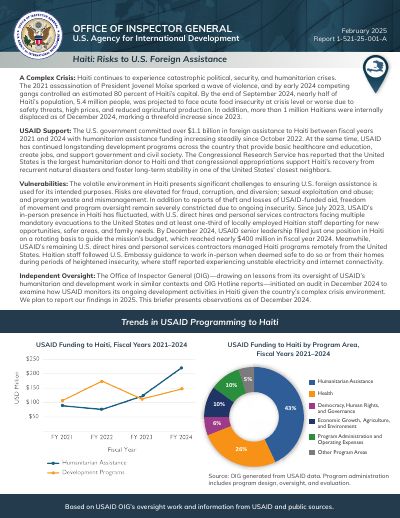
Trends in USAID Programming to Haiti
USAID Funding to Haiti, Fiscal Years 2021–2024
USAID Funding to Haiti by Program Area,
Fiscal Years 2021–2024
10%
5%
Humanitarian Assistance
Health
10%
43%
Democracy, Human Rights,
and Governance
Economic Growth, Agriculture,
and Environment
6%
26%
Program Administration and
Operating Expenses
Other Program Areas
Source: OIG generated from USAID data. Program administration
includes program design, oversight, and evaluation.
Based on USAID OIG’s oversight work and information from USAID and public sources.
�Key Considerations From USAID OIG’s Prior Oversight Work
OIG provides independent oversight of U.S. foreign
assistance worldwide, including in nonpermissive
environments such as Ukraine, Gaza, and Syria.
OIG’s prior audits, investigations, and other oversight
activities have highlighted vulnerabilities in USAID’s
accountability mechanisms. The Agency can consider
outcomes from OIG’s work in similar contexts to help
reduce risks to its programs and operations in Haiti.
1. Reinforcing implementer accountability. USAID
primarily executes foreign assistance programs
through awards to implementing organizations,
such as contractors, nongovernmental
organizations, and United Nations (UN)
agencies. In Haiti, implementers range from the
UN World Food Programme to U.S.-based forprofit companies such as Chemonics to Haitian
organizations such as Group Croissance S.A.
To ensure program integrity, OIG has previously
identified the need for USAID to:
• Conduct due diligence of public international
organizations, including UN agencies. Actions
such as pre-award organizational capacity
reviews can identify areas of weakness in
policy, organizational framework, operations,
and management to inform project design and
funding decisions.
• Design awards to enable the United States to
bring suit against foreign nongovernmental
organizations in U.S. court.
• Expand pre-award certifications to capture
whether prospective awardees have engaged
with entities subject to U.S. anticorruption and
human rights sanctions.
• Ensure awardees fully understand
accountability and reporting requirements.
2. Continuing efforts to prevent, detect, and
report exploitation and abuse. Humanitarian
crises exacerbate conditions that enable sexual
predators working for aid organizations to prey
on vulnerable populations. OIG has previously
identified the need for USAID to:
• Standardize code-of-conduct requirements
for implementers to reduce confusion on
acceptable behavior.
• Standardize reporting requirements and
educate implementers on when and how to
report allegations of sexual exploitation and
abuse.
• Engage with implementers and other donors
to prevent the recirculation of perpetrators
through the international aid sector.
• Ensure pre-award risk assessments include
reasonable measures to protect beneficiaries
from bad actors.
• Reiterate internal processes and responsibilities
for USAID staff, such as those stated in the
USAID’s Counter Trafficking in Persons Code of
Conduct.
3. Maintaining vigilance against fraud and
corruption. Organized criminal enterprises can
use their influence to steer procurements for
personal gain and steal commodities meant for
individuals in need. OIG’s work has previously
identified the need for USAID to:
• Strengthen controls that facilitate timely
reporting by USAID-funded implementers
of criminal activity, such as by clarifying
expectations, processes, and timeframes.
• Recognize red flags of emerging fraud
schemes. Examples include business email
compromises, conflicts of interest, currency
arbitrage (buying a currency in one market
and selling it at a higher rate in another
market), and using the USAID brand to
defraud prospective applicants pursuing U.S.
government jobs, grants, and visas.
• Take proactive measures to appropriately
safeguard staff, beneficiaries, and in-kind
assistance, such as by increasing security and
controls around the transport, storage, and
distribution of material aid.
4. Adapting approaches for monitoring risks and
progress. Conflict and instability can make it
unsafe for USAID to physically monitor and verify
aid and development programs. Furthermore,
restricted movement in-country leaves gaps in
traditional management and oversight methods.
OIG’s work has previously identified the need for
USAID to:
• Systematically assess risks and develop
appropriate response plans for evolving
scenarios.
Based on USAID OIG’s oversight work and information from USAID and public sources.
�Key Considerations From USAID OIG’s Prior Oversight Work, Continued
• Adjust staffing footprints and implement
workplace flexibilities to maintain continuity of
operations.
• Establish processes to deploy qualified thirdparty monitors to supplement Agency oversight
efforts.
• Formally address third-party monitor
recommendations and track them through
resolution.
5. Strengthening transition planning and local
capacity. An immediate crisis response can
overshadow longer term stabilization and
development efforts, particularly if the crisis
becomes protracted like it has in Haiti. OIG’s work
has previously identified the need for USAID to:
• Establish processes and offer clear guidance to
staff for transition planning.
• Bolster opportunities to coordinate
humanitarian assistance with longer term
development programs to complement
efforts and reduce risks of duplication and
redundancy.
• Understand local capacity strengths and
weaknesses and develop a plan to address
deficits, particularly when local organizations
are intended to be part of the long-term
solution.
Recognize and Report Fraud, Waste, Corruption, and Abuse
OIG receives reports of theft and looting, violence, and
interference from gangs and other unlawful groups
impacting USAID-funded programs in Haiti. Over
the last few years, OIG has opened 5 Haiti-related
investigations and provided fraud awareness briefings
to over 260 USAID and implementer staff working on
USAID programs in Haiti.
OIG Hotline Reports Related to USAID Programs in
Haiti, Fiscal Years 2021–2024 (third quarter)
Source: OIG generated from OIG Hotline data from
October 1, 2021, to July 30, 2024.
Report Fraud, Waste, Corruption, and Abuse
USAID OIG Hotline Portal
Request a Fraud Awareness Briefing
Contact Assistant Special Agent in Charge over Haiti programs
Recognize Fraud Schemes
Business Email Compromise
Conflicts of Interest
Currency Arbitrage
USAID Brand Misuse
OIG prepared this brief in accordance with its policies and procedures for agile products, which are aligned with CIGIE’s Quality
Standards for Federal Offices of Inspector General and other audit, inspection, and evaluation policies and guidance.
For more information, visit http://oig.usaid.gov.
�