
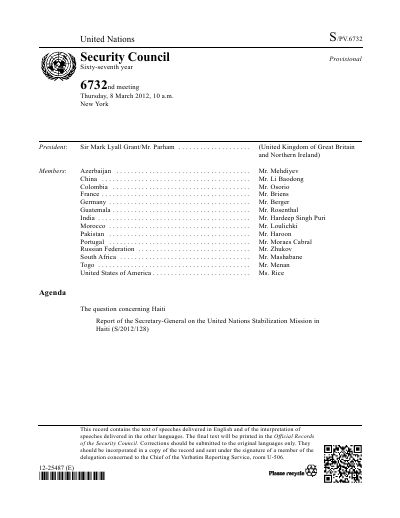
S/PV.6732: Security Council meeting on Haiti, 2012-03-08
Summary — The Haiti debate of 8 March 2012 under the United Kingdom presidency, with the Secretary-General's report S/2012/128 before it and Brazil, Canada, Chile, Haiti, Japan, Peru, Senegal, Spain and Uruguay invited to participate.
Key Findings
- Held on 8 March 2012 with the Secretary-General's report on MINUSTAH (S/2012/128) before the Council.
- The United Kingdom held the presidency, with Sir Mark Lyall Grant in the chair.
- Nine states were invited to participate: Brazil, Canada, Chile, Haiti, Japan, Peru, Senegal, Spain and Uruguay.
- The debate addressed the drawdown agreed in October 2011 and its continuation through June.
- It precedes resolution 2070 (2012), which reduced the military component to 6,270.
Full Description
The Haiti debate of 8 March 2012 under the United Kingdom presidency, with Sir Mark Lyall Grant in the chair and the Secretary-General's report on MINUSTAH (S/2012/128) before the Council. Nine states were invited to participate: Brazil, Canada, Chile, Haiti, Japan, Peru, Senegal, Spain and Uruguay.
The discussion addresses the drawdown agreed in October 2011 and its continuation through June, the question that resolution 2070 (2012) then settled in October by reducing the military component to 6,270 and the police component to 2,601.
Full Document Text
Extracted text from the original document for search indexing.
United Nations
S/PV.6732
Security Council
Provisional
Sixty-seventh year
6732nd meeting
Thursday, 8 March 2012, 10 a.m.
New York
President:
Sir Mark Lyall Grant/Mr. Parham . . . . . . . . . . . . . . . . . . . .
(United Kingdom of Great Britain
and Northern Ireland)
Members:
Azerbaijan . . . . . . . . . . . . . . . . . . . . . . . . . . . . . . . . . . . . .
China . . . . . . . . . . . . . . . . . . . . . . . . . . . . . . . . . . . . . . . . .
Colombia . . . . . . . . . . . . . . . . . . . . . . . . . . . . . . . . . . . . . .
France . . . . . . . . . . . . . . . . . . . . . . . . . . . . . . . . . . . . . . . . .
Germany . . . . . . . . . . . . . . . . . . . . . . . . . . . . . . . . . . . . . . .
Guatemala . . . . . . . . . . . . . . . . . . . . . . . . . . . . . . . . . . . . . .
India . . . . . . . . . . . . . . . . . . . . . . . . . . . . . . . . . . . . . . . . . .
Morocco . . . . . . . . . . . . . . . . . . . . . . . . . . . . . . . . . . . . . . .
Pakistan . . . . . . . . . . . . . . . . . . . . . . . . . . . . . . . . . . . . . . .
Portugal . . . . . . . . . . . . . . . . . . . . . . . . . . . . . . . . . . . . . . .
Russian Federation . . . . . . . . . . . . . . . . . . . . . . . . . . . . . . .
South Africa . . . . . . . . . . . . . . . . . . . . . . . . . . . . . . . . . . . .
Togo . . . . . . . . . . . . . . . . . . . . . . . . . . . . . . . . . . . . . . . . . .
United States of America . . . . . . . . . . . . . . . . . . . . . . . . . . .
Mr. Mehdiyev
Mr. Li Baodong
Mr. Osorio
Mr. Briens
Mr. Berger
Mr. Rosenthal
Mr. Hardeep Singh Puri
Mr. Loulichki
Mr. Haroon
Mr. Moraes Cabral
Mr. Zhukov
Mr. Mashabane
Mr. Menan
Ms. Rice
Agenda
The question concerning Haiti
Report of the Secretary-General on the United Nations Stabilization Mission in
Haiti (S/2012/128)
This record contains the text of speeches delivered in English and of the interpretation of
speeches delivered in the other languages. The final text will be printed in the Official Records
of the Security Council. Corrections should be submitted to the original languages only. They
should be incorporated in a copy of the record and sent under the signature of a member of the
delegation concerned to the Chief of the Verbatim Reporting Service, room U-506.
12-25487 (E)
*1225487*
S/PV.6732
The meeting was called to order at 10.05 a.m.
I take this opportunity to welcome the presence of the
Haitian ambassador.
Adoption of the agenda
I would like to start by quoting the speech
President Michel Joseph Martelly delivered on
9 January on the occasion of the inauguration of the
Haitian Parliament. In a moving speech, the President
stated the following:
The agenda was adopted.
The question concerning Haiti
Report of the Secretary-General on the
United Nations Stabilization Mission in
Haiti (S/2012/128)
The President: In accordance with rule 37 of the
Council’s provisional rules of procedure, I invite the
representatives of Brazil, Canada, Chile, Haiti, Japan,
Peru, Senegal, Spain and Uruguay to participate in this
meeting.
In accordance with rule 39 of the Council’s
provisional rules of procedure, I invite Mr. Mariano
Fernández, Special Representative of the SecretaryGeneral and Head of the United Nations Stabilization
Mission in Haiti, to participate in this meeting.
Under rule 39 of the Council’s provisional rules
of procedure, I invite Mr. Thomas Mayr-Harting, Head
of the Delegation of the European Union to the United
Nations, to participate in this meeting.
The Security Council will now
consideration of the item on its agenda.
begin
its
I wish to draw the attention of Council members
to document S/2012/128, which contains the report of
the Secretary-General on the United Nations
Stabilization Mission in Haiti.
I now give the floor to Mr. Fernández.
Mr. Fernández (spoke in Spanish): I would like
to thank you, Sir, and the other members of the
Security Council for having organized today’s meeting,
the purpose of which is to present to the Council the
most recent report of the Secretary-General on the
United Nations Stabilization Mission in Haiti
(S/2012/128).
I welcome today’s opportunity to share with the
Council an assessment of the most recent developments
in the political and security situation in Haiti, and of
the activities carried out by the United Nations
Stabilization Mission in Haiti (MINUSTAH) over the
past six months in support of peacebuilding, political
stability, the strengthening of the rule of law and
recovery work after the earthquake of 12 January 2010.
2
“Eight million Haitians, out of an estimated
population of 10 million, live without electricity.
Five million cannot read or write and are in the
dark both day and night. Eight Haitians out of
every 10 are living on less than $2 a day. Two per
cent of Haitians control 69 per cent of the
country’s wealth. With a working population that
is put at 4.2 million, fewer than 200,000 have
regular formal work. At least 84 per cent of
university graduates live abroad.”
I wish today to highlight the relevance of those words,
which dramatically reflect and unambiguously confirm
a situation that Council members were able to observe
during their recent visit to Haiti a couple of weeks ago.
After the nearly eight years that MINUSTAH has
been in Haiti, the results of peacebuilding and
stabilization efforts are visible. However, the
earthquake of 12 January 2010 was a serious setback
caused by large-scale human and material losses, the
traces of which Council members saw during their
recent visit. In order to move forward in strengthening
the rule of law, public security and the socio-economic
sphere, a major effort of the entire international
community has been necessary for Haiti’s
reconstruction and the recovery of its institutions, the
re-engineering of its police security structure, and
broad cooperation and aid to stimulate socio-economic
development.
Our main goal is to ensure that present and future
progress allows us to consolidate efforts to ensure
stability and peace so that Haiti can overcome the
situation described by President Martelly once and for
all and so that the country can take off politically and
socio-economically.
With regard to the current political situation, the
report of the Secretary-General mentions the recent
resignation of Prime Minister Garry Conille after only
four months in office. His resignation was a worrying
and telling sign of the state of the governability of
Haiti. The credibility and strength of democratic
12-25487
S/PV.6732
institutions depend on their ability to respond to
political crises and to avoid negative cyclical
situations, the majority of which are artificial, that
threaten Haiti’s progress towards democracy.
As noted by the Council during its visit,
throughout our mission we have emphasized the
importance of avoiding such Government crises and of
reducing disputes between the executive and legislative
branches. Avoiding such unproductive conflicts must
be part of an ongoing effort to improve the quality of
Haitian politics. The main problem is the severe
difficulty encountered by the political class in
achieving collective agreements that would allow
consensus to strengthen institutions and public action.
We have therefore stressed the need for a pact for
democratic governance that would facilitate consensus
and provide solutions for Haiti’s main political
problems. We have worked for all of society: members
of Parliament, political parties, unions, employers, the
church and representatives of civil society.
Today the President put forward a candidate for
Prime Minister — the current Foreign Minister,
Laurent Lamothe, who must be approved by
Parliament. MINUSTAH is working in earnest to
ensure that Haiti can soon again have a Government.
The times when there has been no Prime Minister and
no Cabinet in Haiti have seen a rise in insecurity and a
clear decline in governability, with obvious negative
repercussions for development. We are therefore
working with Parliament and the Government to
achieve the appointment of a Prime Minister as soon as
possible.
As to the rule of law and security, without solid
rule of law institutions and an agreement on
governability, it will be difficult if not impossible to
lay a firm foundation for peace and security for all
Haitians. Despite the slow pace, after five years Haiti
finally has a fully staffed Supreme Court. The Court
had no President or members for five years. No
democratic judicial system can work without an
independent and self-regulating judiciary. This
progress is very significant when we consider all that
has occurred in Haiti.
The Security Council’s visit provided members
with a snapshot, as it were, that was in many instances
quite upsetting. For us, however, it is more like
watching a film that allows us to discern some
progress. I stress the establishment of the Supreme
12-25487
Court because it is extremely important in moving
towards the rule of law. We have worked to strengthen
the rule of law and institutions, not just conceptually
but physically. MINUSTAH has built 50 courthouses to
ensure the effective provision of justice, and will build
another 30 to complement its support for the judicial
system in Haiti.
Another fundamental pillar of the rule of law —
apart from the judiciary, on which we continue to
work — is the main instrument of the rule of law,
namely, the police force. In this regard, we have been
working for quite some time now, and I can assure the
Council that, over the past six months, the MINUSTAH
police, together with the Haitian National Police
(HNP), has carried out 21,000 patrols and more than
31,000 actions in camps for refugees or internally
displaced persons (IDPs) in Port-au-Prince and the
provinces. Alongside the military component of
MINUSTAH, the HNP has conducted operations to
disband criminal gangs that posed one of the most
serious challenges to stability in Haiti.
Although the response of the police to security
challenges has improved, much remains to be done.
Our current task is to remove the obstacles to better
police action and to strengthen the Haitian National
Police. Today, the HNP numbers 10,000, which is
nearly three times as many as in 2004. However, for a
country of 10 million people, it is still insufficient.
Together
with
the
international
community,
MINUSTAH has developed a support programme to
ensure that, by 2016 — the last year of President
Martelly’s term in office — we will have provided
professional training to 5,000 or 6,000 officials to
endow Haiti with a significant Police force, thereby
enabling a MINUSTAH drawdown by the end of that
period. In the context of this five-year programme, we
convened a special seminar between the Police and the
international community in order to consider, assess
and improve the efforts under way to ensure that the
outcome will be highly positive.
As is noted in the most recent and important
Security Council resolution 2012 (2011) on Haiti, the
reduction of the military and police components of
MINUSTAH is to be completed by June, pursuant to
the Secretary-General’s reports and the resolutions of
the Council. This has not affected security, and we
have had an effective redeployment of forces. We have
maintained the staffing levels of the United Nations
police. There are fewer soldiers and formed police
3
S/PV.6732
units, but the same number of United Nations police,
which remains unchanged. We trust that this will
continue to be the case, given its important cooperation
with the Haitian National Police.
Political violence has virtually disappeared.
Ordinary crime — principally murders — is relatively
low compared to other countries in the Caribbean and
Central America. However, very serious challenges
remain in ensuring security for the most vulnerable
sectors, in particular with regard to domestic violence
and the abuse of women. In order to be more effective
against such crimes, we have increased patrols, trained
police officers, set up solar-powered street lighting,
and patrolled 24 hours a day, seven days a week in the
main IDP camps. Today, 8 March, International
Women’s Day, I wish once again to affirm
MINUSTAH’s commitment to countering gender-based
abuse and to contributing to the promotion of Haitian
women in their daily lives and in their professional and
civic roles.
Another problem affecting the rule of law and
security is the emergence of illegal military forces in
the wake of programmatic campaign statements made
by President Martelly concerning the restoration of the
Haitian army dissolved in 1995. MINUSTAH and the
international community have clearly told the
Government that, without prejudice to the sovereignty
of Haitian institutions, they will not lend support to
such forces. We believe and have reiterated that illegal
armed forces are unacceptable. The Government
responded to our demands in a communiqué issued on
3 March, containing a five-point plan to regularize the
situation. The measures proposed include prohibiting
the use of military uniforms and weapons, reviewing
the pensions received by retired military personnel,
ensuring the smooth conduct of this process, and
liberating those areas occupied by the military.
Yesterday, the Haitian Government convened an
important meeting with MINUSTAH, seeking
cooperation in putting an end to this issue once and for
all. We asked the Government to formally declare the
illegality of these groups and to proceed to identify
retired military personnel who are owed pensions in
order to distinguish them from the young people who
are participating in such activities due to lack of
employment. We are ready to assist and to mitigate the
unnecessary tensions that these activities are raising.
4
The Government has said that it wants Haiti to be
open to business, and we have said that in this regard
words must be followed by deeds. The Government has
yet to address the issues of constitutional reform,
elections, the creation of a land registry and a civil
identification registry, a constitutional tribunal and a
law on political parties. As I have mentioned, the
Government has already completed some of those
tasks, such as with regard to the Supreme Court, and
has announced the upcoming establishment this month
of the Superior Council of the judiciary, which will be
responsible for discipline in the judicial system. All of
that represents a significant step forward.
We have said that Haiti must hold elections soon.
The elections that were scheduled for November did
not take place. We have told the President that he has a
historic opportunity to organize transparent and
irreproachable elections, with the assistance of the
international community. We have also said that
successful elections could serve to strengthen the
socio-political
consensus;
conversely,
delayed,
contested or postponed elections will without a doubt
undermine the efforts to promote the image of a stable
and dynamic country looking towards the future.
Last week, the President invited the entire
diplomatic corps accredited to Haiti to a meeting
intended to launch the electoral process. We view that
as a positive sign. MINUSTAH, which is serving as the
international community’s focal point, will this week
meet with Haitian technical experts in order to prepare
pre-election steps.
A few moments ago, I said that MINUSTAH
believes that it is essential for there to be a
Government in Haiti. In the past, when there has been
a President but no Cabinet or Prime Minister, violence
has increased and economic developed has fallen off.
The Economic Commission for Latin America and the
Caribbean (ECLAC) projected that there would be
10 per cent economic growth in Haiti during 2011. But
five months without a Government meant that, in the
end, growth would only be 4.5 per cent. ECLAC
projects 8 per cent growth in 2012, which, in the midst
of the economic crisis, is quite high. We have no doubt
that, if the President continues to be without a
Government, growth in Haiti will decrease, resulting in
serious harm to the Haitian people. That is yet another
reason that we are working hard to ensure that the
Haitian President can soon count on a Prime Minister
and that the State can function normally. That will help
12-25487
S/PV.6732
to reduce violence and will improve economic results,
as has been shown in various situations that we have
studied.
Major efforts have been made with regard to
human rights, correctional matters and humanitarian
issues. The Council, which had an opportunity to visit
prisons and camps, knows first-hand what is taking
place. We are making strenuous efforts in order to
make significant progress in this area. In recent
months, our team of lawyers has succeeded in securing
the release of 230 people who had been imprisoned
without trial for many years. There is similar success
with regard to prisons. We are working to improve
conditions for prisoners and are contributing materially
to building prisons in Haiti.
Last September, we announced that displaced
persons still included 634,000 victims of the
earthquake. However, that figure represented only a
third of the original 1,800,000. We can today say that
the number of displaced persons at the end of January
stood at 515,000, a reduction of 120,000 since
September. In our view, those are positive statistics, as
those reductions have made it possible to identify new
populations and resources and to abandon certain sites
where habitation is increasingly difficult owing to a
reduction in international assistance with regard to
food, sanitation and supplies necessary for camp living.
I would like to say that those efforts by
MINUSTAH, which include many positive aspects, are
marred by the moral attributions that Haitian society
attach to the effects of the cholera epidemic, which has
resulted in more than 7,000 deaths, as well as the
sexual abuse committed by military and police
personnel members of our force. I personally believe
that there can be no immunity with regard to crimes
committed against minors, such as rape. I support a fair
trial that includes protections for the rights of the
accused. But they must be carried out in a transparent
manner and include penalties adequate to the severity
of the crimes. And there must be a lifetime ban against
those convicted working with the United Nations, as
the moral values intrinsic in peacekeeping operations
are what gains them respect throughout the world. It is
both an honour and a privilege to be part of them, both
for individuals and for the countries that contribute
personnel for the noble task of contributing to
defending peace in any part of the world where there is
a need.
12-25487
In conclusion, I believe that we have an arduous
task before us in Haiti. However, there is no denying,
from the impression that I have developed during the
eight months that I have been in my post, that this is a
slow process that includes certain reversals but that, in
the end, produces a degree of stabilization vis-à-vis
living conditions, political activity, economic
development and attention to social issues. Some
things in Haiti are a matter of history, including the
risk of authoritarianism and a winner-takes-all
situation. But today there is also a process wherein the
President is learning to work with the Parliament and
vice versa. Between them, with the assistance of the
international community, institutions are being built for
the rule of law in a way that, slowly, a legal order is
being put in place that is much more acceptable today
than it was three to five years ago.
The President: I thank Mr. Fernández for his
briefing.
I shall now give the floor to the members of the
Security Council.
Ms. Rice (United States of America): I would
like to thank Special Representative of the SecretaryGeneral Fernández for his briefing.
As Council members saw on our recent trip, and
as the report (S/2012/128) of the Secretary-General
makes clear, Haiti’s stands at a moment of decision. In
the two years since the earthquake, Haiti has made
progress. Haitians have strengthened their democracy,
maintained security and begun rebuilding their
shattered country. But serious problems remain, most
notably a lack of Haitian political consensus and
resolve. The achievements that have been made are
fragile at best. The United States stands in solidarity
with the Haitian people as they tackle the many
challenges that face them. We will continue to be
firmly committed to helping Haiti build a better future.
Over the past two years, we have seen a peaceful
electoral process and transfer of power, followed by
the filling of key executive and judicial positions.
Today, however, the political stalemate threatens those
hard-won gains. Haiti’s politicians need to temper their
partisan interests, put aside winner-take-all politics and
work together in a spirit of compromise. We urge the
authorities in Haiti to confirm a new Prime Minister as
soon as possible. Otherwise, they risk undermining the
gains made in the areas of security and reconstruction.
5
S/PV.6732
Haiti cannot afford further gridlock. Effective
Haitian leadership is critical. The economic and
security programmes supported by the United Nations
and other external partners do not run themselves.
They require policy guidance from a fully functioning
Haitian Government. Towards that end, the
Government needs to hold the next round of elections
for local Government positions and one third of the
Senate as soon as possible.
While the security situation has been largely
stable, significant threats remain. The United States
believes that any determination of the future size of the
United Nations Stabilization Mission in Haiti
(MINUSTAH) forces must be based on security
conditions on the ground, including the ability of the
Haitian National Police (HNP) to take on greater
responsibilities.
That said, MINUSTAH cannot be a permanent
solution to Haiti’s security needs. The Government of
Haiti’s next budget proposal to Parliament provides a
critical opportunity to commit the resources and
demonstrate the political determination needed to
strengthen the Haitian National Police so that it has the
right quality and quantity of personnel to assume full
responsibility for Haiti’s security. That is what Haitians
have told us they want. We urge the Parliament and
executive branch to commit sufficient and lasting
budgetary resources to the HNP, in particular to
strengthen the administrative and logistical systems
that will enable the HNP to function on its own.
The international community, of course, is there
to help. The United States urges the United Nations
and the Haitian Government to maintain their focus on
strengthening the HNP. We hope that MINUSTAH and
the HNP will work jointly to implement a development
plan that bolsters the HNP’s capacity to meet Haiti’s
law enforcement needs and that enables the gradual
transfer of responsibility from United Nations forces to
the HNP.
United Nations training and police mentoring can
deliver important results, and United Nations technical
assistance can truly help the HNP to plan its future.
The Government of Haiti announced an ambitious goal
of training 2,000 new HNP officers this year. Close
collaboration between the HNP and MINUSTAH is
necessary to achieve this target.
Beyond the HNP, we encourage the Government
of Haiti and the United Nations to collaborate in
6
strengthening other rule of law institutions, including
courts and prisons. We urge the United Nations to work
collaboratively
with
the
Haitian
presidential
commission on the rule of law to present the updated
criminal code and criminal procedure codes to
Parliament. Those updated codes will help address the
issue of prolonged pre-trial detention and reduce
corruption in the legal system. As we saw ourselves,
prison overcrowding remains a grave problem — one
where MINUSTAH and Government of Haiti
collaboration can yield real benefits. Haiti and its
international partners have built a new prison at Croix
des Bouquets, but the prison is unutilized because the
Haitian Government has avoided making some key
decisions that would enable the prison to open.
Turning to economic development, we applaud
the Government’s desire to shift Haiti away from
dependence on international assistance to reliance on
investment to create jobs and spark sustainable
economic growth. But for now, political friction and
weak rule of law institutions may in fact deter
investors from coming to Haiti. The executive branch
needs to fulfil its commitment to reducing the time it
takes to register a business and to easing the processes
for obtaining permits in the construction industry. Both
would help empower Haitian entrepreneurs. Getting
those reforms through Parliament would send a clear
signal that Haiti is indeed open for business and
determined to create jobs.
The Government of Haiti needs to set clear
reconstruction and development priorities and work
more actively with donors. When the mandate for the
Interim Haiti Recovery Commission ended, the Prime
Minister’s office became the focal point for working
with international donors on post-earthquake
reconstruction and creating economic opportunities.
That office, of course, is now in the hands of a
caretaker and the reconstruction effort risks loosing
direction.
Let me close with a few words about
MINUSTAH. The United States greatly appreciates the
dedicated service of the men and women of
MINUSTAH. They perform important services under
difficult conditions. However, we are and remain
deeply concerned by serious accusations that some
MINUSTAH personnel have engaged in sexual
exploitation and abuse. Any occurrence of such
misconduct is absolutely unacceptable. It violates the
principles of the Organization and destroys the bonds
12-25487
S/PV.6732
of trust between Haitians and the United Nations. The
United Nations must increase its efforts to prevent any
incidents of sexual exploitation and abuse. It must
ensure that all allegations are thoroughly investigated
and that those responsible are held fully and
transparently accountable.
When the Council visited Haiti, many Haitians
told us of their appreciation for all that MINUSTAH
has done over the years to improve the country’s
security. The United States shares this gratitude and
will continue to support MINUSTAH, its troop- and
police-contributors and its Haitian partners in this
crucial work.
Mr. Mehdiyev (Azerbaijan): At the outset, I
would like to thank the United Kingdom for convening
this debate on the United Nations Stabilization Mission
in Haiti (MINUSTAH). We also thank SecretaryGeneral Ban Ki-moon for his report, (S/2012/128) and
his Special Representative, Mr. Fernández, for his
briefing.
Azerbaijan commends the efforts undertaken by
the Government and people of Haiti to achieve stability
and sustainable growth in the country. MINUSTAH
and the United Nations country team have also played
an important role in supporting the recovery and
stability of Haiti.
At the same time, as we witnessed during the
recent visit of the Council to Haiti and as the report of
the Secretary-General makes clear, more should be
done by the national authorities and the international
community in the broader interests of the Haitian
people. Political stability in the country is a key
priority for the stabilization and development of Haiti.
It is important that all political leaders responsibly
approach and engage in constructive political dialogue
to address their differences in a spirit of compromise.
We encourage MINUSTAH to continue facilitating
political dialogue among the branches of Government
and other key political actors. As Haiti approaches its
elections, the United Nations should further support the
electoral process.
We note with satisfaction that the overall security
situation has been relatively stable in recent months
and that the politically motivated violence has
significantly diminished. However, the high crime rate
remains a matter of serious concern. Therefore, the
continued close cooperation between the Haitian
National Police and MINUSTAH is vital to effectively
12-25487
addressing the security challenges and to ensuring that
the former move towards reaching the capacity
necessary to handle full responsibility for the provision
of internal security. It is also important that the Haitian
National Police not only react to criminal acts but also
undertake preventive measures, including through
public information and education programmes for
youth and vulnerable groups. The development of
border security is also critical to addressing the
challenges of organized criminality.
The humanitarian situation in Haiti has shown
improvement as the number of people living in tents
has declined. However, the country continues to face
significant challenges, with more than 1 million
Haitians remaining in camps and many others
continuing to lack access to housing and basic services.
Strong international engagement is crucial to ensuring
that all pressing humanitarian needs are met. At the
same time, external assistance and support do not
release the Haitian authorities from carrying out their
responsibilities in providing at least basic services,
housing and protection to those still displaced by the
earthquake.
We are confident that, against the background of
unprecedented international support, Haiti and its
people have an opportunity to make genuine progress
in rebuilding the nation, strengthening institutions and
promoting sustainable development.
Mr. Briens (France) (spoke in French): At the
outset, I would like to thank the Special Representative
of the Secretary-General, Mr. Mariano Fernández, for
his briefing. I align myself with the statement to be
made by the observer of the European Union and the
representative of Uruguay on behalf of the Group of
Friends.
This biannual debate comes just a few weeks
after the Security Council visit to Haiti. That visit
allowed us to reaffirm our collective support to the
Haitian population and its representatives. That support
is combined with recognition of the progress made
since the earthquake, be it in terms of the 119,000
Haitian refugees who have been able to leave camps
since June 2011, or as it pertains to the removal of
debris. I bear in mind the numerous humanitarian
challenges that the country continues to face, which
were mentioned by the Secretary-General in his report
(S/2012/128). For its part, France is determined to
deliver on the commitments undertaken by its
7
S/PV.6732
President, which now total €326 million, including our
share of European aid.
countries. And we provide it with significant resources
every year for it to carry out its mission.
However, the challenges facing Haiti today
require the mobilization of the international
community and of all the Haitian leaders. In Port-auPrince we saw how the current level of tensions —
aggravated since the Council’s return by the
resignation of Prime Minister Garry Conille — is such
that it is impeding the regular functioning of
institutions and risking generating unrest within the
population. That situation is all the more unfortunate
since, on the other hand, certain progress has been
made at the institutional level. The police are
increasingly visible and respected. The President and
Vice-President of the Superior Council of the Judiciary
have finally been nominated. An encouraging sign in
the struggle against impunity is that those responsible
for the massacre that took place in Les Cayes prison in
January 2010 have been brought to justice.
At the same time, however, it is well known that
the task of the peacekeeping operation is not to remain
indefinitely in Haiti to maintain order or to carry out
reconstruction and development. It is therefore
important to have a clear idea of what we want to
achieve and by when.
Finally, as the Secretary-General’s report notes,
the security situation is relatively stable, although still
fragile. To continue its stabilization and reconstruction
efforts, the international community needs political
stability. It needs an established Government. It also
needs coordination on the part of donors, as such
coordination is no longer carried out by the Interim
Haiti Recovery Commission since October 2011. The
foreign investment requested by President Martelly
also requires political stability.
We would therefore remind the Haitian
authorities of their responsibilities to the people who
elected them. We expect them to set a date for interim
local and legislative elections, adopt a budget, swiftly
promulgate the constitutional amendments with
guarantees for the President, establish a permanent
electoral council, appoint a Prime Minister and respect
a truce between the executive and the legislature. We
also call on President Martelly to take all the steps
necessary to halt the grouping of armed men claiming
to be former members of the Haitian armed forces.
MINUSTAH has been deployed in Haiti for eight
years. It is responsible for maintaining order and
stability and support to the Haitian police. It has
gradually strengthened the capacities of the Haitian
National Police, which today numbers 10,000 men. It
has several highly professional civilian and military
staff that have been provided by troop-contributing
8
During the years of presence in Haiti, the
Missions that have accumulated via mandates, the
inexcusable conduct of certain elements deployed in
Haiti and the tragedy of the cholera outbreak have
tainted our image in the eyes of Haitians. We can regret
that but certainly not ignore it; just as we cannot ignore
the will expressed by some Haitians to see the
departure of MINUSTAH one day.
After the tragedy of the earthquake, we decided
urgently to increase the MINUSTAH contingent.
Today, what we must do is to pursue the dual
movement of drawdown and adaptation set out in
resolution 2012 (2011), taking into account, of course,
the conditions on the ground.
We must refocus MINUSTAH’s efforts on police
training and improving the rule of law. To do that, we
need to improve the balance within the Mission among
troops, police and civilians. Although outbreaks of
violence are still possible, the basic tendency is
towards an improved security situation that will enable
a significant reduction in MINUSTAH’s overall
strength.
The status quo and the current drawdown are both
fraught with instability and tension. Because the
United Nations presence in Haiti is viewed in the long
term and we want MINUSTAH to be the last
peacekeeping operation deployed in Haiti, we want the
Mission to evolve in a gradual, responsible manner
towards a withdrawal in good conditions.
Mr. Osorio (Colombia) (spoke in Spanish):
Allow me, first of all, to welcome and thank
Mr. Mariano Fernández, Special Representative of the
Secretary-General for Haiti, for his briefing and for his
introduction of the report of the Secretary-General
(S/2012/128) before the Council today. I would also
like to thank him for the welcome and guidance that he
provided to Council members during our recent visit to
Haiti. In that regard, I also welcome the briefing on
28 February (S/PV.6724) by Ambassador Susan Rice,
12-25487
S/PV.6732
which presented the opinions and analysis of all
Council members.
The purpose of the Council’s visit was to reassert
its commitment to help and support the Haitian people
in building peace, stability, democratic governance and
the rule of law, as well as in promoting recovery and
sustainable development.
Given the report of the Secretary-General and the
meetings and visits carried out during the Council’s
mission, I should like to make several comments. First,
we were able to witness first-hand the weak political
relations between the Executive and the Parliament, the
challenges and expectations as well as the increased
divisions, which, as we know, led to the resignation of
the Prime Minister a few days after our visit.
We learned subsequently that President Martelly
had proposed to Parliament that his Minister for
Foreign Affairs, Mr. Laurent Lamothe, become the new
Prime Minister. We trust that the problem will be
resolved in line with a settled political environment
that will enable all political persuasions to join
together for the good of the nation in addressing the
major challenges facing the nation. In that respect, all
possible assistance must be welcomed, and provided to
those endeavouring to bring about national unity, if we
are asked for such help. The Secretary-General and
Special Representative Fernández should also continue
to strengthen efforts to that end.
Secondly, it is only right to acknowledge that the
country, under the helm of the President, has started to
deal with the major challenges of education, job
creation and the protection of the environment. But
much remains to be done. I am very concerned about
the reference made by the Director of the World Food
Programme to the risk of the school meals programme
in Haiti coming to an end in June, due to a lack of
funding. It would be shameful for that to happen, given
that 1 million children partake of those daily meals —
a fact that has indirectly enabled them to remain at
school. They can expect to rely on international
support to continue that programme. Given that
situation, the programme requires food and financial
aid, as well as support at meetings of the Organization
aimed at preserving the programme.
The third aspect I wish to address has to do with
the relationship between the United Nations
Stabilization Mission in Haiti (MINUSTAH) and the
Haitian people, referred to in detail by Mr. Fernández.
12-25487
While the efforts of MINUSTAH are acknowledged —
as we ourselves personally witnessed, as in the case of
the work of the military engineers on reconstruction
and damage repair, as well as on security — there is
concern with regard to the reports of violence and
sexual abuse on the part of some members of the
Mission and the alleged responsibility for the
introduction of the cholera epidemic.
In that regard, we must reiterate the commitment
of the United Nations to ensure the achievement of its
zero-tolerance policy in the context of sexual abuse
related to its peacekeeping operations and the
commitment to investigate and punish such conduct, as
well as the positive attitude of Governments in the
investigation of such cases. Situations of this kind
cannot continue to occur within MINUSTAH, or in any
other United Nations mission. The Security Council
must be absolutely firm on this issue. We fully support
the remarks of the Special Representative of the
Secretary-General in that regard.
As far as we are concerned, given the stated need
to re-establish the Haitian army as a key element in
MINUSTAH’s eventual withdrawal, which will have to
take place, although that remains a sovereign matter for
each country, we must nonetheless bear in mind the
importance of ensuring that the process encompasses
the necessary reform, strengthening and consolidation
of the Haitian police as a viable, safe force capable of
providing stability and security. While security during
the period covered in the Secretary-General’s report
was relatively stable and fragile — and the figures we
were offered today show significant progress —
MINUSTAH’s work in that context remains vital. Any
reduction in numbers must not discount that important
vision in the future.
Two other important aspects that I would like to
emphasize concern the judicial system and correctional
issues. In our view, the lack of across-the-board
institutionality creates difficulties in access to prompt
justice, which in turn gives rise to disputes and
conflicts among groups of the population. The same
may be said of the Court of Cassation, which should be
the guarantor of last resort in judicial proceedings. We
need to reinforce international efforts to consolidate a
broader, more robust presence of the judicial system,
including more humane prisons, which we have seen
are overcrowded and in precarious condition.
9
S/PV.6732
With the dissolution of the Provisional Electoral
Council last December, it will no longer be possible to
hold the elections originally scheduled for ay. We
therefore urge the Government to swiftly establish an
electoral authority that will guarantee the timely issue
of a schedule allowing the population to express its
views through a democratic process.
Last but not least, we are concerned that, despite
the considerable efforts of the Haitian people and the
international community, the impact of the earthquake
is still clearly visible in the streets and buildings,
revealing the magnitude of the damage. It is also
evident in the refugee camps, where more than 500,000
people are still living in 700 separate locations, the
majority of them on the outskirts of Port-au-Prince.
International support, including that of MINUSTAH’s
corps of engineers, should be maintained to enable
them to surmount their precarious living conditions and
to offer new alternatives for living.
As a final word of conclusion, I would like to
emphasize the importance and necessity of achieving
solid institutionality and the rule of law, which are
essential conditions for advancing on the path towards
economic and social prosperity and for guaranteeing
the security of the Haitian people.
Mr. Loulichki (Morocco) (spoke in French):
Allow me first of all, Sir, to thank the Special
Representative of the Secretary-General, Mr. Mariano
Fernández, for his presentation, and to congratulate the
entire team of the United Nations Stabilization Mission
in Haiti (MINUSTAH) for their efforts on the ground. I
would
also
like,
through
their
Permanent
Representative, who is here today, to convey my thanks
to the Haitian authorities for organizing and hosting the
Council’s visit.
A little more than two years after the catastrophe
that struck Haiti, the joint efforts of the Government,
donors, the United Nations and the population have
brought improvements to the overall situation of the
country. Indeed, as we saw, Haiti is making its long
way back. We also witnessed close-up the extent of the
damage and the scope of the challenges that lie ahead.
But no one can question the progress made by the
Haitian authorities in enabling their country to recover
from the aftermath of the earthquake, or the relevance
of the initiatives taken to improve the security situation
and regenerate the economy and the social fabric of
Haiti.
10
We hope that the establishment of a new
Government will help to ensure greater unity of
Governmental action and lead to a national consensus
on long-awaited major reforms. Morocco hails the
efforts of the Haitian authorities to promote the
reforms under way, including those concerning the
Permanent Electoral Council, the Supreme Court and
the signing of the International Covenant on Economic,
Social and Cultural Rights. Those reforms deserve to
be fully implemented and should be complemented by
measures to strengthen the rule of law in all its
dimensions.
We particularly commend the improvements in
the security situation and MINUSTAH’s decisive
contribution to maintaining a stable environment. We
observed not only the Haitian people’s aptitude but
also their pride in being able to take responsibility for
their own national security by their own means.
With respect to the process of recovery and
development, huge challenges remain despite the
rebuilding efforts undertaken by the Government and
MINUSTAH, and also despite the notable progress
made in terms of clean-up and the reconstruction of
schools and housing. The problem of employment,
especially for young people, is easy for any visitor to
see. Young people deserve the priority attention of the
Government and the support of the international
community. Improving the climate for foreign
investment is critical in that regard, in order to attract,
reassure and encourage investors from abroad.
The day after the earthquake of January 2010, the
response of the international community was one of
spontaneous, unanimous and generous solidarity and
assistance. It made all the difference in comforting the
Haitian people. From the outset, the United Nations,
through MINUSTAH, played an early and decisive
role. Nothing, and I repeat, nothing can tarnish the
sacrifices that the Mission has made or the devotion
and integrity of the thousands of men and women who
compose its ranks.
Mr. Moraes Cabral (Portugal) (spoke in
French): I would like at the outset to thank the Special
Representative of the Secretary-General, Mr. Mariano
Fernández, for his most useful report (S/2012/128),
which reminds us of the progress that has been made
but above all also of the immensity of the task that
remains to be accomplished.
12-25487
S/PV.6732
I welcome the presence in the Chamber of our
Haitian colleague, Ambassador Jean Cazeau. Like
other colleagues, I thank him for all the support his
Government provided to our recent visit to Haiti. We
naturally share the perspective that will be presented
later in this meeting on behalf of the European Union.
Today’s discussion naturally concerns not only
the activities of the United Nations Stabilization
Mission in Haiti (MINUSTAH), but also the situation
in Haiti and its challenges: security, reconstruction,
economic and social development, functioning
institutions and strengthened rule of law, as well as the
defence and promotion of human rights, all in a context
affected by very considerable obstacles, as we have
just heard and as we recently saw for ourselves.
Indeed, the Haitian people and authorities face
the particularly daunting challenge of building a
working democracy in a context of weakened security,
widespread shortages of basic goods, generalized
suffering and specific problems with respect to
economic and social development. This is not,
unfortunately, an entirely unprecedented situation. In
order to confront it, however, and to overcome the
challenges, the first requirement is political stability,
clearly defined goals, determination and effective
cooperation among the institutions that were
legitimized by the democratic election. The resignation
of Prime Minister Conille a mere four months after his
appointment is naturally cause for increased concern,
since it affects the normal functioning of national
institutions and the accomplishment of critical and
urgent tasks. My delegation has full confidence in the
sense of responsibility of Haitian officials and in their
commitment to democratic values and practice, the
reconstruction of the country and a democratic State.
We call on them to act accordingly.
Security has long been a central issue in Haiti.
Despite being strengthening, the Haitian National
Police it is still not in the position to enforce law and
order throughout the country. That is why MINUSTAH
still has an important role to play in this sphere, even
in the context of the progressive drawdown of its
personnel. Nevertheless, the drawdown to the level of
January 2010 must take place without reducing
capacities of the MINUSTAH police and the Haitian
National Police.
It is evident that ensuring security and peace in
Haiti is first and foremost the responsibility of the
12-25487
Haitian people and authorities. The international
community does not want to substitute for the national
authorities and can act only in support of the
stabilization and development that Haiti itself carries
out.
During the recent Security Council visit, the issue
of training a Haitian national army was raised. We
know that the question was discussed during the
electoral campaign and studied at the national level.
Naturally, we do not question the right of Haiti’s
independent and sovereign State to an army. The
question is rather to determine whether this is the right
moment to allocate and spend significant material and
human resources on a project whose effective
contribution to resolving the serious and urgent
problems that Haiti faces remains unclear. That is why
we call on the Government of Haiti to act to ensure that
the issue is broadly and transparently discussed,
allowing conclusions anchored in reality.
The humanitarian situation and the protection of
human rights remain causes of concern for us. The
marginalization of particularly vulnerable groups, the
significant number of internally displaced persons and
gender violence are a problem for us. We congratulate
MINUSTAH on its work with UNICEF and the
International Organization for Migration (IOM) to
harmonize the law on human trafficking with the
Protocol to Prevent, Suppress and Punish Trafficking in
Persons,
Especially
Women
and
Children,
supplementing the United Nations Convention against
Transnational Organized Crime, ratified by Haiti in
2009.
The Secretary-General’s report also voices
concerns regarding impunity. The efforts carried out by
the Haitian authorities and MINUSTAH are
commendable, but we believe that additional efforts,
above all the in the cases specifically highlighted in the
report, will still be necessary in the key area of
consolidating the rule of law.
In conclusion, MINUSTAH is adapting to new
human and material conditions in order to fulfil its
mandate in a difficult and sometimes adverse
environment. It is sometimes the object of denigration
the basis for which cannot be objectively determined.
This increases the pressure on MINUSTAH officials,
international partners and the Haitian authorities. It is
important that we be able to continue giving our
solidarity to the Haitian people and to MINUSTAH,
11
S/PV.6732
which is clearly committed to its mission. For our part,
this unwavering support cannot be called into question.
Allow me also to assure the Ambassador of Haiti of the
continued support of Portugal for the stability,
reconstruction and development of his country.
Mr. Rosenthal (Guatemala) (spoke in Spanish):
We thank the Secretary-General for his report
(S/2012/128) and welcome his Special Representative,
Mr. Mariano Fernández, to New York. We commend
him for his endeavours.
For many years, we have followed the evolving
situation in Haiti and have been a formal stakeholder,
given our participation in the United Nations
Stabilization Mission in Haiti (MINUSTAH) as a troop
contributor. However, this is our first statement on the
matter as a member of the Security Council.
Haiti, of course, faces many challenges, which
were only compounded by the legacy of the horrific
earthquake of January 2010. Addressing those
challenges requires a comprehensive approach, but
today I would like to focus on three areas of special
concern.
First is the matter of political stability. The year
2012 began with promise. On 9 January, we were
encouraged by President Martelly’s pledge before
Parliament, as he announced his priorities for the year,
to seek close coordination with all branches of
Government. Of particular importance was an
agreement with the ¬legislative branch regarding,
among other aspects, the appointment of a Prime
Minister.
Unfortunately, our optimism of some months ago
has been mitigated by the recent resignation of the
Prime Minister and the mounting tensions between the
legislative and the executive branches. We therefore
meet today as events continue to unfold in a context of
greater political uncertainty, as outlined in paragraph
55 of the Secretary-General’s report. Some slightly
more encouraging aspects were indicated by
Mr. Fernández.
Obviously, the absence of a duly constituted
Government adversely impacts decision-making on key
issues. At the same time, the experience of recent
decades in Haiti has shown that the holding of
elections and democratic governance, in accordance
with the Constitution, are the only way to achieve
long-term stability. Municipal elections and the
12
renewal of one-third of the Senate are now overdue,
although we note the President’s recent remarks that
these elections are of high priority to his
Administration. We trust that these will take place as
soon as possible, especially since the SecretaryGeneral’s report reminds us that the outgoing Senators’
terms expire in May.
I would also like to take a moment to comment
on the status of the Provisional Electoral Council. Its
temporary nature should not prevent the preservation
of the know-how and technical capacity for future
elections. In that respect, it would be worth considering
the establishment of a permanent support office to this
effect. On the other hand, if the idea of a permanent
electoral council evolves, it is of utmost importance to
guarantee its independence. At the same time, we
invite the Government to begin engaging with
MINUSTAH to take the logistical, operational and
concrete measures necessary for the preparation for
holding these elections.
The second area of concern is recovery and
reconstruction efforts. I stress the importance of
renewing the mandate of the Interim Haiti Recovery
Commission that expired last October. We believe that
the added value of that mechanism is unique, not only
for the donor community but in particular for Haiti.
The Government is an essential player in attempts to
rebuild a country. The Commission makes it easier to
take the Haitian view as the basis of its proposals. We
further believe that the public sector must be
strengthened and that international assistance should
take that carefully into account. The Commission
offers a practical, transparent and inclusive solution to
closing the gap between existing capacities and the
unmet needs of the Haitian people. Although it is
currently intended to be an interim commission, its
establishment as a long-term institution should be
considered so that the country has a national focal
point through which to channel international
assistance.
This brings me to the matter of the remaining
internally displaced persons camps. We appreciate the
19 per cent reduction of the total number of persons in
camps cited in the report. We also support enhanced
efforts to protect vulnerable groups exposed to the
cholera epidemic, food insecurity and gender-based
violence, among other threats. However, we believe
that more must be done to adopt a comprehensive camp
closure plan and to find alternative long-term housing
12-25487
S/PV.6732
and sites. We note that, on average, displaced persons
in Africa spend well over a decade in temporary
settlements. Unless this remains a priority, we risk
replicating that distressing situation in Haiti.
The third concern is security, a subject to which
my previous remarks were also related. It is now
broadly acknowledged that security gains could be
undermined by weak socio-economic development and
governance and that, consequently, there is a need for a
balanced approach to security and non-security
considerations. The report before us reminds us of the
important role that MINUSTAH fulfils in Haiti,
particularly on the security front. It is understood that
peacekeepers cannot remain in Haiti in perpetuity, but
it is equally important not to abandon Haiti
prematurely.
We look forward in the following months to
receiving detailed information on the request made to
the Secretary-General in paragraph 24 of resolution
2012 (2011) concerning a comprehensive assessment
of threats to security in Haiti, including options, as
appropriate, to reconfigure the composition of
MINUSTAH.
Finally, we take note of paragraph 56 of the
report and of the initial steps taken by the Government
to contain the emergence of uniformed militias that are
organized
without
official
approval.
These
observations are also based on our recent visit to Haiti
in February.
The international community, in particular the
countries of Latin America and from the Caribbean,
have a clear stake in Haiti’s success and we fully
commit to continuing to support the process of
political, economic and social development. I recall
that, while the international community is willing to
play a supporting role, the primary responsibility rests
first and foremost with the Haitians themselves.
Mr. Mashabane (South Africa): We would like to
thank Mr. Mariano Fernández, Special Representative
of the Secretary-General, for his comprehensive
statement. At the outset, we wish to express and
reiterate our continued support for the United Nations
efforts in Haiti.
Haiti has undergone significant change since its
emergence from the devastating earthquake of January
2010 and the conflict. The country had to face the
daunting task of reconstruction while at the same time
12-25487
it had to deal with the challenges of governance and
democracy. Despite these seemingly very difficult
challenges, Haiti has made significant progress.
Towards the end of last year, we saw progress on
the political front after the compromise between the
President and Haiti’s legislators that led to the
swearing in of a new Government and the appointment
of a Prime Minister. However, we are concerned that
the strained relationship between the presidency and
Parliament has paralysed progress towards developing
a consensual legislative agenda and the adoption of the
national budget, as well as progress relating to the
upcoming elections.
The resignation of Prime Minister Conille should
not be allowed to hamper any political progress
achieved so far. We hope that the Haitians are able to
reach consensus on all these outstanding issues. Stable
governance is essential if the Haitian people are to lead
efforts to rebuild their country. We encourage
collaboration between the executive and legislative
branches of the Government. A rapid resolution of this
crisis will allow the Haitians and the international
community to focus on the key challenges of
development and the reconstruction of Haiti.
The Council has previously recognized the
interconnected nature of the challenges facing Haiti.
We reaffirm that security, institution-building — such
as in the area of the rule of law — the consolidation of
national government structures, democracy and
development are mutually reinforcing.
The strengthening and capacity-building of the
Haitian National Police is critical to ensuring stability
in Haiti and to laying a firm basis for the withdrawal of
the United Nations Stabilization Mission in Haiti
(MINUSTAH) in the future. The Haitian Government,
working with MINUSTAH, must identify critical
capacity gaps within the police service and develop
strategies to address them as soon as possible.
Importantly, the promotion of the rule of law at all
levels is critical to ensuring stability and to facilitating
development in Haiti. In this regard, we also welcome
President Martelly’s appointment of the President and
Vice-President of the Supreme Court, which further
strengthens the rule of law institutions in the country.
We note from the Secretary-General’s report
(S/2012/128) that the overall security situation is
stable. However, we are concerned over reports of the
increased mobilization of several hundred armed
13
S/PV.6732
former members of the Haitian armed forces. We share
the view expressed by the Secretary-General that this
mobilization poses a threat to the stability of the
country and that the Government should take necessary
measures to address the issue.
South Africa commends MINUSTAH’s military
and police personnel, as well as the Haitian National
Police, for their contribution to the improvement of the
overall security situation in Haiti. While we welcome
this positive development, we are mindful of the fragile
stability of the situation, due to civil unrest related
mainly to socio-economic grievances.
We hold the view that addressing these socioeconomic challenges should be prioritized, as they also
contribute to security and stability. Given the strong
linkages between peace, stability and development, we
welcome President Martelly’s pronouncement of his
Government’s priorities, which include security, the
resettlement of the displaced, job creation,
environmental protection, health care, education and
schools, among others.
The case of Haiti clearly illustrates the
relationship between security and development. We
note the positive contribution of MINUSTAH’s
engineering components and quick-impact projects to
improving the lives of those most in need. These
aspects of MINUSTAH’s work help to establish
conditions conducive to long-term reconstruction and
recovery, and support the notion of peacekeepers as
early peacebuilders.
My delegation welcomes the work done by
MINUSTAH’s Conduct and Discipline Unit to address
the allegations of sexual misconduct by the Mission’s
personnel by strengthening prevention measures,
accelerating disciplinary case management and taking
remedial action, in line with the United Nations zero
tolerance policy regarding misconduct by its personnel.
We recognize that Haiti continues to face
humanitarian challenges. The cholera epidemic and
food insecurity necessitate enhanced international
assistance in Haiti. It is therefore incumbent on the
international community to continue to support Haiti in
its recovery from the humanitarian challenges it faces,
without which the country will not be able to achieve
stability and development.
South Africa is committed to assisting the people
of Haiti. In addition to our bilateral assistance, South
14
Africa will continue to work with its partners in the
India-Brazil-South Africa IBSA Facility for Poverty
and Hunger Alleviation.
In conclusion, Haiti has made significant strides
towards peace and stability. Challenges remain and it is
imperative that the Haitian people, with the sustained
support of the international community, work with
MINUSTAH to overcome all these obstacles.
Mr. Berger (Germany): Germany aligns itself
with the statement to be made by the observer of the
European Union. I thank the Secretary-General for his
report and Special Representative Mariano Fernández
for today’s briefing.
At the outset, let me underscore our continued
willingness to help and support the Haitian
Government in its efforts to build a better life for its
people. Since the earthquake Germany has, bilaterally
and through the European Union, provided
€146 million for reconstruction and €41 million for
humanitarian assistance, apart from €230 million in
private donations. At the same time, we wish to
underline that the primary responsibility for recovery
and reconstruction lies with the Government of Haiti.
Against that backdrop, we note with concern the
continued stand-off between the executive and
legislative authorities and the resulting state of
blockage and inaction, which prevents Haiti’s State
institutions from delivering on promises made to their
people. Haiti and the Haitians simply cannot afford to
wait any longer for effective Government.
We join the Secretary-General in his call on all
political actors in Haiti to engage in constructive
political dialogue. Haiti’s political leaders must work
together in a spirit of compromise. A new, widely
accepted
Prime
Minister
must
take
office
expeditiously. The appointment process must not again
become the object of partisan infighting, but rather
must be accomplished without delay in the best
interests of the country.
Germany
strongly
encourages
Special
Representative Fernández in his efforts to advocate a
political pact to advance the stabilization and
development of Haiti. In that context, we cannot
overemphasize enough the importance of the rule of
law and good governance. A lack of political and legal
certainty is a major impediment to development,
including to increased foreign investment.
12-25487
S/PV.6732
I would like to focus on three aspects, namely, the
Haitian National Police, elections and human rights.
First, we note the Secretary-General’s assessment that
“the Haitian National Police is gradually
improving, [but] … the institution is not yet in a
position to assume full responsibility for the
provision of internal security.” (S/2012/128,
para. 11)
That indicates that political support of the Government
in building the capacity of Haiti’s National Police is
key and must be enhanced. The United Nations
Stabilization Mission in Haiti (MINUSTAH) still has a
crucial role to play in maintaining a secure
environment and protecting human rights, including
the fight against sexual and gender-based violence.
With the primary focus currently on enhancing
policing capacity, the Council should consider further
downsizing MINUSTAH’s military capacities, in line
with developments on the ground. Efforts aimed at
enhancing the Haitian National Police should not be
diluted by plans to reintroduce Haitian armed forces. In
that context, we note with concern that armed groups
consisting of former members of the Forces armées
d’Haiti have resurfaced in several departments, and
former army elements and new recruits were witnessed
conducting training exercises throughout the country.
Haiti’s international partners have clearly indicated
that they are not willing to fund any military in the
country. Germany strongly shares that view.
Secondly, regarding elections, we urge the
political leadership to take the steps necessary to avoid
a continued institutional vacuum, in a timely manner,
as discussed with representatives of the Security
Council on 1 March in Port-au-Prince. In order to build
confidence and trust, Germany encourages the Haitian
leadership to invite external missions to observe the
upcoming electoral processes. Haiti cannot afford to
enter into another period of political stalemate — in a
phase when the ability of the administration to act and
govern is of the utmost importance.
Thirdly, Germany joins the Secretary-General in
his call on Haiti’s authorities to spare no effort in the
fight against impunity. The establishment of
accountability and of the rule of law remains a central
benchmark for success. Accountability and the rule of
law are not only of key importance in their own right,
but they also help to create conditions for sustainable
economic development. Strengthening the rule of law
12-25487
is an investment that pays off. Capacity-building,
including in the justice system and corrections
facilities, must therefore remain a priority. Germany
also underlines the importance of continued
enforcement of the United Nations zero-tolerance
policy on misconduct by its personnel, and appreciates
the steps that have been taken so far, as outlined by the
Special Representative. Indeed, that is important for
the acceptance of all peacekeeping forces — not only
in Haiti.
In
conclusion,
MINUSTAH
remains
a
prerequisite for the stability and development of Haiti
and for peace and security in the region. At the same
time, it is evident that the agenda for MINUSTAH
needs adjustments, streamlining and focus in line with
developments on the ground. While Germany is open
to discussions on the scope of MINUSTAH’s mandate,
we are of the opinion that civil reconstruction is best
placed in the hands of specialized United Nations
organizations dedicated to that task. Given the
multifarious nature of MINUSTAH’s mandate, the
Council might also wish to look into ways of making
the priorities among MINUSTAH’s tasks clearer for all
concerned.
Finally, I would like to join previous speakers in
thanking all countries that have contributed troops to
MINUSTAH and would like extend sincere thanks to
the personnel of the Mission in Haiti for their
dedicated work.
Mr. Li Baodong (China) (spoke in Chinese): I
wish to thank Special Representative of the SecretaryGeneral Mariano Fernández for his briefing.
With support and help from the international
community, Haiti has recently been actively carrying
out post-disaster reconstruction, taking forward the
political process, scaling up its national security and
building institutions, showing considerable progress —
which deserves our recognition. We also note that Haiti
is still faced with grave challenges ahead in
maintaining stability and promoting development —
calling for greater efforts on the part both of Haiti and
the international community. I wish to underscore the
following points.
First, political reconciliation is the key to the
maintenance of peace and stability in Haiti. China is
concerned by the current political situation in Haiti. We
hope that the parties will seize the opportunity,
strengthen unity, enhance mutual trust, settle disputes
15
S/PV.6732
through consultations, form a new Government as soon
as possible and consolidate the hard-won gains.
Secondly, post-disaster reconstruction and
development is the central task for Haiti. At present,
recovery and reconstruction is slow. Problems such as
poverty, unemployment, a weakened education system
and poor infrastructure are so acute that they warrant
great attention. The Haitian Government needs to be
better able to bear the primary responsibility for
development, improve governance, attract investment
and create job opportunities. It is also our hope that the
international community will fulfil its assistance
commitments, improve the efficacy of its aid and
provide constructive support to Haiti for its
reconstruction and development.
Thirdly, the United Nations Stabilization Mission
in Haiti (MINUSTAH) is playing a significant role in
maintaining peace and stability in Haiti. China thanks
Special Representative Fernádez and MINUSTAH for
their efforts and their contribution to the maintenance
of security and stability in Haiti, and it hopes that
MINUSTAH will actively implement its Security
Council mandate and complete its drawdown as
scheduled, while continuing to assist in maintaining
security and stability, taking forward the political
process and strengthening the rule of law and
institution-building.
Mr. Zhukov (Russian Federation) (spoke in
Russian): We are grateful to Special Representative of
the Secretary-General Fernández for his briefing on the
situation in Haiti and the work of the United Nations
Stabilization Mission in Haiti (MINUSTAH). We have
listened with interest to the briefing and have taken
note of the Secretary-General’s report (S/2012/128),
whose assessments we share. The Security Council’s
mission to Haiti has proven a significant resource for
information.
Unfortunately, despite some stabilization, the
situation in Haiti remains complex. We are concerned
about political rivalry, including between the executive
and legislative branches of the Government. We hope
that the resignation of Prime Minister Conille will not
lead to even greater political and social division.
Regrettably, political upheavals have overshadowed the
country’s socio-economic recovery. The Government
must take urgent steps to achieve national consensus
and to unite society. It must assume leadership in
tackling key tasks, in particular economic and
16
humanitarian issues. There should be no delay in
adopting crucial decisions directly linked to the
country’s recovery. That applies to stepping up the
constitutional process, the adoption of relevant laws
and the implementation of reforms.
In that regard, questions have been raised over
the announcement by the executive of tentative plans
to re-establish the country’s armed forces. We do not
question the sovereign right of Haiti to independently
take decisions on security sector reform, but while the
key challenges are linked to the imperative for
economic recovery and the need to combat crime and
strengthen legality and the rule of law, the primary task
in that regard should be improving the effectiveness of
the National Police. We believe that the
implementation of such plans, if they become a
realistic possibility, can only increase political tension
and cause concern among the international community,
which is giving Haiti its firm support.
I would like to note MINUSTAH’s significant
contribution to stabilize the situation in the country, in
particular its assistance towards maintaining security,
establishing State institutions and enhancing the
capacities of the national police in improving law and
order. We are pleased that the reconfiguration of the
Mission, in accordance with resolution 2012 (2011), is
going according to plan. MINUSTAH must smoothly
conclude the reform process under way and work
within a new format, both quantitatively and
qualitatively. We can then assess the effectiveness of
the implementation of its mandate under Chapter VII
of the Charter, and possibly consider additional
measures.
With regard to the accusations of peacekeepers
committing serious crimes, we think that exacerbating
the negative atmosphere concerning the Mission’s
work would be counterproductive. Such incidents
should be promptly and thoroughly investigated, with
the involvement of the troop-and police-contributing
countries. If certain troops are found to be guilty by the
relevant national judicial bodies, they should definitely
face punishment in line with the criminal legislation of
the countries of which they are citizens. The Mission
needs to focus on enhancing the degree of discipline
and to do its utmost to prevent the recurrence of such
cases. Only through actual acts can it repair the
damage to its authority.
12-25487
S/PV.6732
The international assistance given to Haiti, in
which the United Nations plays a leading role, is
unprecedented in terms of scale and solidarity. We
believe that efforts to provide comprehensive
assistance to Haiti, including for the strengthening of
State authority structures, must continue so that the
Haitians can independently tackle all issues in the areas
of security and recovery and of ensuring sustainable
national development.
Mr. Hardeep Singh Puri (India): At the outset, I
would like to join others in thanking Special
Representative of the Secretary-General Mariano
Fernández for his comprehensive briefing on the recent
developments in Haiti and for presenting the report of
the Secretary-General on the United Nations
Stabilization Mission in Haiti (S/2012/128).
Despite periods of political uncertainty and the
resultant instability during the past year, Haiti has
made a notable recovery from the devastating
earthquake of January 2010. Today, there are fewer
people living in camps than last year. More than
1 million people have been relocated so far. Several
hundred schools have been rebuilt. Health services
have improved. More than 100,000 temporary shelter
units have been built to accommodate 400,000 affected
persons. Emergency food assistance now covers
4 million Haitians, and 5 million cubic metres of debris
have been removed. That would not have been possible
without the strong commitment and support of the
international community. We commend the role played
by the United Nations and its agencies, as well as the
Interim Haiti Recovery Commission.
The security situation has also improved,
although it remains fragile and suffers from an
insufficient policing capacity. Moreover, the country
witnessed the peaceful transfer of power last year,
which reflects the faith of the Haitian people in
democracy. In December 2011, the International
Monetary Fund noted that the economic situation in
Haiti is improving, and it predicted positive gross
domestic product growth for the year 2012.
Progress in recovery and reconstruction has,
however, been slowed down due to the continuing
political uncertainty in the aftermath of last year’s
elections. The delay in the formation of a Government
for several months, the lack of understanding between
two important organs of the Government and avoidable
controversies are, unfortunately, affecting the overall
12-25487
gains made on the recovery front. That has affected
donor confidence, and the appeal of the Office for the
Coordination of Humanitarian Affairs was funded to
the tune of only 55 per cent in 2011. The political
infighting has also delayed the adoption of a number of
legislative measures and preparations for elections to
the Senate and local bodies appear stalled. The
resignation of Prime Minister Conille last month has
further exacerbated political tensions. We hope that the
process of parliamentary approval for the new Prime
Minister and the formation of a new Government will
be completed soon.
The need of the hour is for the Haitian leaders to
set aside their differences and to work collectively for
an effective administration that can implement the
reforms necessary for economic growth and strengthen
the capacity of rule of law institutions. Political
stability is fundamental to effective governance, which
alone can stimulate development, investment and the
confidence of the international community.
Given the prevailing situation, the role of the
United Nations Stabilization Mission in Haiti
(MINUSTAH) continues to be critical to recovery
efforts, to ensuring the overall security and stability
and to the capacity-building of Haitian national
institutions, particularly the national police. That will
also help the national authorities deal with the reported
emergence of new armed groups belonging to the
disbanded army. We commend the leadership of
MINUSTAH and its peacekeepers and engineers for
doing excellent work in the most demanding
circumstances. MINUSTAH has provided security for
the distribution of humanitarian assistance to some
4.3 million Haitians and helped provide temporary
shelter to 1.5 million people. Military engineering
companies have played a significant role in removing
rubble, repairing roads and setting up temporary
shelters. MINUSTAH’s important role in assisting the
authorities to respond to the epidemic and the
hurricane can hardly be overemphasized.
We hope that the Haitian national institutions will
gradually assume a larger role and ultimately take over
MINUSTAH’s responsibilities. Against that backdrop,
MINUSTAH should focus its efforts on supporting the
political
process,
capacity-building
and
the
consolidation of Haitian national institutions, including
the national police force. The future force
configuration of the Mission should be based on
overall improvement of the security situation, as well
17
S/PV.6732
as stabilization of the political and socio-economic
situations.
India has contributed three formed police units,
totalling 458 personnel, to MINUSTAH. The
performance of the Indian units has been widely
appreciated in view of their exemplary dedication and
devotion to duty. India also made a modest
contribution to the efforts of the Haitian authorities to
deal with the earthquake devastation in 2010. In the
immediate aftermath of the earthquake, India made a
cash contribution of $5 million to the Government of
Haiti towards relief measures as a token of our
solidarity with the people of Haiti. India has also
contributed $500,000 every year since 2009 to the
Central Emergency Response Fund, which continues to
play an important role in the recovery work in Haiti.
We have also undertaken a waste management project
through a joint India-Brazil-South Africa initiative. In
addition, India will soon undertake a project for the
construction of low-cost housing units.
In conclusion, the continuing support of the
international community, coupled with stable and
effective governance, remains critical for sustainable
peace, security, stability and development in Haiti. We
remain committed to continuing our support for the
efforts of the Haitian authorities to rebuild the country.
It is our hope that Haiti will soon emerge from its
current problems and move towards stability and
development.
Mr. Menan (Togo) (spoke in French): I would
like first of all to thank Special Representative of the
Secretary-General Mariano Fernández for introducing
the report of the Secretary-General on the United
Nations Stabilization Mission in Haiti (MINUSTAH)
(S/2012/128). The report, it must be said, supports and
adds to the observations made by members of the
Security Council during the Council’s mission to Haiti
in February.
After the devastating earthquake that struck Haiti
in January 2010, the entire world wondered how the
country would ever be able to recover. Fortunately,
with the will and the determination of the people of
Haiti and the support of the international community,
the reconstruction of the country is on the right track.
The measures that the Government is implementing in
many areas to bring about the welfare of its people are
aimed at that goal. They involve, inter alia, free
schooling, the rehousing of those who lost their homes
18
in the disaster, and the establishment of a national
programme to fight against hunger and malnutrition.
We also note the adoption of other measures in the
justice sector, in particular, such as the revision of the
criminal code, the appointment of additional judges to
the Court of Cassation and the announcement of the
establishment of the Superior Council of the Judiciary.
Those measures are likely to reassert the authority of
the State and enable the Haitian people to flourish,
which is something that my country welcomes.
However, a feeling of satisfaction does not dispel
our concern with regard to political, security and
humanitarian problems that remain in the country.
Politically, differences run deep, and the political will
to resolve them appears to be lacking. The problems no
doubt feed into the instability characterized recently by
the resignation of Prime Minister Garry Conille, just
four months after his appointment. Moreover, the lack
of consensus, which is very perceptible between the
executive and legislative branches, remains a source of
major concern. These differences in viewpoints do not
inspire confidence and are likely to undermine the
efforts of the international community.
It is important that the authorities and all those
involved in politics in Haiti work to find consensus on
the major issues that divide them. In that regard, Togo
wishes to invite them to follow the road of dialogue
and compromise, overcome partisan differences and
keep firmly on course for reconstruction and
development in a climate of brotherhood, solidarity
and shared responsibility.
With regard to security, which has always been a
major challenge for the Governments of Haiti, it is
encouraging to note that there has been some
improvement. Violence of a political nature has shown
a clear drop, and crime rates for murder, rape and
kidnapping have also declined considerably. My
country commends the efforts being made in that area
and urges the Haitian authorities to continue to pursue
them. However, the perceptible improvement would
not have been possible without the help of
MINUSTAH, which has sought to train the National
Police while providing support in the fight against
organized gangs. We congratulate MINUSTAH for that
cooperation and urge that it be pursued.
In the humanitarian sphere, concerns continue
with regard to the still very high number of internally
displaced persons living in camps, where there has
12-25487
S/PV.6732
been a decline in water and sanitation services due to a
lack of funding. The shortage of financing is likely to
deal a severe blow to that major programme for
helping people, since the State does not yet have
sufficient means to respond and cholera has still not
been eradicated.
The overall situation in Haiti today requires that
the international community continue its efforts. This
is the right place to welcome the role played by the
United Nations, in particular MINUSTAH, in the
country before and in the hours immediately after the
earthquake. Its involvement in many reconstruction,
security and rule of law programmes must be
commended because it renews hope in a country where
fear, fatalism and uncertainty had taken hold in
people’s hearts and minds.
Looking at the progressive drawdown of the
MINUSTAH surge after the earthquake, it is extremely
urgent, as the report mentions, for the Haitian
Government to take over the process of reconstruction
and development. However, the road to reconstruction
in Haiti seems to be a long one. In that regard, efforts
undertaken by the country’s authorities should remain
supported by those from international organizations,
donors and bilateral actors.
Helping Haiti to rebuild itself means bringing
peace to the country and the entire region. Even if
there is a role for the international community to play,
it is first and foremost the Haitians themselves who
must work to build a stable and prosperous State in
their country. That is why we continue to say that now
is not the time for divisiveness or for settling political
accounts. Quite the opposite, Haitians must roll up
their sleeves, and the authorities must establish a
policy of dialogue and national reconciliation so that
all citizens, both in the country and abroad, may take
part in the reconstruction of their country.
Mr. Haroon (Pakistan): I would like to thank
Special Representative of the Secretary-General
Mariano Fernández for his very insightful briefing. I
would also like to thank the Secretary-General for his
report (S/2012/128). From the opinions we have heard
around the table today, it is clear that there is a shared
objective among the United Nations, the people of
Haiti and the international community.
Until 2010, Haiti had made important strides
towards stability, development and a better future. The
devastating earthquake of 2010 reversed those positive
12-25487
gains made incrementally over many years. Those
gains area now lost to Haiti, and it will be difficult to
move back to that period of recovery where the country
was emerging from the shadows.
As noted by the representative of Haiti in the
Security Council in 2011, the country had virtually
collapsed after the earthquake. Rising from such
devastation is no ordinary task. Most earthquake
recovery is challenging in the best of circumstances,
but becomes almost impossible in a post-conflict
country. We therefore urge the Security Council and
the international community to demonstrate patience
towards, and solidarity with, the Government and the
people of Haiti.
Pakistan is proud to stand with the people of
Haiti, not only before but also during and after the
devastation of 2010. Our support has been in the form
of men on the ground, materiel and our strong personal
belief in and commitment to Haiti and its future.
The biannual report of the Secretary-General is a
useful tool for measuring progress and reversals in
Haiti. It is satisfying to note that the report under
consider lists important progress in the area of security.
Improvement in the security situation, with a
diminishing trend of politically motivated violence, is a
propitious development that can lead to long-term
stability and economic recovery. This can be attributed
to the positive efforts of the United Nations
Stabilization Mission in Haiti (MINUSTAH),
especially with regard to the protection of vulnerable
groups, including women and children, through
community-based policing strategies.
The contribution of the Haitian National Police to
improving the security situation can neither be denied
nor denigrated, but Haiti will need a more robust
judicial system in the future. As an evolving institution
of significant promise, the Haitian Police has also
improved its work and capacity, and works alongside
MINUSTAH contingents in the form of joint patrols
and anti-crime operations.
Our delegation has taken serious note of
allegations of misconduct in MINUSTAH, as reported
in the Secretary-General’s report. Such allegations are
taken with utmost seriousness. As a contributor to
MINUSTAH and other United Nations missions,
Pakistan is elaborate in its arrangements and legal
provisions to investigate, prosecute and sentence
anyone guilty of misconduct, with actions ranging from
19
S/PV.6732
dismissal without benefits to imprisonment. These are
serious matters that cannot be the subject of
compromise. Let my voice ring out loud and clear in
this Chamber. The zero tolerance policy for misconduct
is also our policy. There will be no stepping down or
away from it. The high operational standards of our
peacekeepers must match a similar level of excellence
conduct and discipline on the part of its administrators.
The Secretary-General’s report mentions slow
progress in regard to the humanitarian and recovery
situations. The ongoing cholera epidemic, food
insecurity and extreme vulnerability to natural disasters
augment the humanitarian challenge. To an extent,
slow progress in the humanitarian and recovery
situations is understandable given the natural trajectory
of post-disaster recovery, where the initial period of
high performance usually tapers off into a steady phase
and a decline after some time. We are seeing this
happen in Haiti.
However, we must not be complacent and try to
build further on positive achievements. That is why I
do not hesitate to say that the cholera epidemic has
severely tested Haiti and we must, in every way
possible, not only apologize but try to help alleviate
this problem with not only more materiel but with
whatever we have available to set this situation right.
We will urge greater coordination and cohesion among
different actors engaged in humanitarian work. We will
also caution against the donor fatigue that can result
from such protracted crises.
Political uncertainty and lack of national
consensus can erode the nascent gains in the security
and humanitarian sectors. Fissures and divisions
among stakeholders are the usual ingredients of
political discourse. A modicum of national consensus
on the future course is essential. Such consensus has
been eroded in Haiti following recent political events.
Our delegation supports the call for a genuine and
inclusive dialogue in order to achieve political
agreement and reconciliation based on mutual
tolerance, and we must allow Haitians to proceed on
deciding their future by their own thinking and
mechanisms. I would suggest that we listen more
closely to them and to what they visualize, and help
them in any way we can to proceed towards the future
they envisage.
Pakistan has been a participant in United Nations
peacekeeping missions in Haiti since 1993. As a part of
20
MINUSTAH, two formed police units from Pakistan
have been deployed since 2010. Not just the Pakistani
contingent but all components of MINUSTAH are
implementing a challenging mandate under difficult
circumstances.
From a surge of strength in 2010, the military and
police capabilities of MINUSTAH are set to be drawn
down to the pre-earthquake phase by the middle of this
year, and that is what I believe is also wanted by the
people of Haiti. MINUSTAH’s drawdown must be the
result of tangible improvements in the ground
situation, which I am sure will happen. We hope that
the Secretariat, in conjunction with the Haitian
authorities, has conducted a national assessment of the
ground situation in the present and future scenarios.
We hope that any achievements of MINUSTAH will
also be duly acknowledged, here and by the Haitians.
Pakistan supports the sovereignty, political
independence and territorial integrity of Haiti. It will
be important that a similar message of support be
communicated to the brave and resilient people of
Haiti from our collective deliberations in the Security
Council today.
The President: I shall now make a statement in
my capacity as the representative of the United
Kingdom.
Haiti has seen repeated efforts of the international
community that have attempted and failed to provide
stability in the medium to long terms. The United
Kingdom does not want this pattern to continue. It is in
no one’s interest that the United Nations Stabilization
Mission in Haiti (MINUSTAH) should leave before the
security that it has established can be sustained by the
Haitian authorities.
The United Kingdom notes that MINUSTAH
finds itself in an increasingly difficult position,
however. On the one hand, Haiti is heavily dependent
on the Mission to provide security. On the basis of
current trends, that will remain the case for some years.
On the other hand, Haitians from all levels of society
are becoming increasingly vocal in their calls for
MINUSTAH to leave. There is a very real risk that, if
political uncertainty in Haiti persists, MINUSTAH will
be dragged into the debate, making its task harder still.
In part, these calls are being exacerbated by
allegations of misconduct by MINUSTAH personnel.
The United Kingdom is concerned by such allegations,
12-25487
S/PV.6732
which should be taken extremely seriously. We firmly
support the Secretary-General’s zero tolerance policy
on sexual exploitation and abuse, and we urge a
rigorous and transparent approach to these allegations.
This would help MINUSTAH to restore its credibility
with the people of Haiti.
In its efforts following the earthquake in 2010,
MINUSTAH has played a significant role in recovery
and in helping to ensure access to basic services. These
efforts have built support among the local
population — support that has been reinforced by the
quick-impact projects that the Mission has delivered.
But the United Kingdom believes that it is now vital
that the Mission focus on working to ensure that
stability and security can be sustained once
MINUSTAH has departed. To that end, the Mission has
two clear tasks.
First, MINUSTAH must build the capacity of the
Haitian National Police so that it can take full
responsibility for Haiti’s security. There needs to be a
clearer matching of Mission personnel to the various
aspects of this task. This is not a task solely for
MINUSTAH, but there needs to be clarity among all
those involved, in the Mission and beyond, as to what
capacity the Haitian National Police needs to build and
what the benchmarks and timetable will be for
achieving it.
Secondly, there needs to be greater effort to
support the political process, including elections,
democratic governance and related State institutions.
Political uncertainty is the most likely trigger of
instability. Again, MINUSTAH cannot be expected to
do this alone, and needs to coordinate its efforts with
those of other actors. All actors need to play their part,
working in a cooperative and constructive manner,
respecting the Constitution and helping to ensure
political stability.
In conclusion, the United Kingdom believes, of
course, that conditions on the ground will determine
when MINUSTAH draws down. However, in order that
security and stability can be sustained when
MINUSTAH does draw down, it needs to begin
planning for that drawdown now. Only by doing that
can the right balance be struck between the Haitian
National Police taking up the security burden and a
measured drawdown of MINUSTAH that does not
jeopardize security gains.
12-25487
I now resume my functions as president of the
Council.
I give the floor to the representative of Haiti.
Mr. Cazeau (Haiti) (spoke in French): We are
pleased to see you, Sir, presiding over the Security
Council this month. We wish you every success and are
confident that, under your guidance, our debates will
be successful.
On behalf of the people and Government of Haiti,
I would like to thank Secretary-General Ban Ki-moon
for his 29 February report (S/2012/128) on the United
Nations Stabilization Mission in Haiti (MINUSTAH).
It must be acknowledged that, far from being a routine
exercise, the report is first and foremost an outline of
the progress that has in fact been made. However,
much remains to be done in a socio-economic
environment that continues to be somewhat precarious.
But our people, especially youth and women, are
demanding from the powers that be that they be able to
participate in public affairs.
Haiti very much appreciates the ongoing attention
to the situation in our country. That commitment was
reaffirmed by the recent field visit to Haiti by the
Security Council, when the Council was able to see for
itself what is taking place. The Council also heard a
briefing on its mission (see S/PV.6724) for Ambassador
Susan Rice, who led the mission. We thank her for the
dedication and insight.
I am hopeful that, thanks to her leadership and
that of the Security Council, Haiti will one day no
longer figure in United Nations reports and resolutions
as a “threat to international peace and security”, as that
phrase strikes fear in investors. Haiti wants to move
from humanitarian assistance towards sustainable
development through investment, including foreign
direct investment. During his meeting with the
members of the Council’s mission, President Michel
Joseph Martelly pointed out that Haiti was not a threat
to anyone.
The presence here today of Ambassador Mario
Fernández, Special Representative of the SecretaryGeneral for Haiti and Head of the United Nations
Stabilization Mission in Haiti, is a sign of the attention
focused on MINUSTAH’s accomplishments and, above
all, on the state of the Haitian people, who are
determined to fashion a better future for their country,
which has been forced to choose between stability,
21
S/PV.6732
respect from human rights and sustainable
development. We thank him for having agreed to serve
in our country to help the Haitian Government and the
United Nations to coordinate efforts to find lasting
solutions to the situation of my brothers and sisters, in
a word, to change the country’s image.
The political and security situation in Haiti has
remained on the Security Council’s agenda for almost
eight years, which, to a certain degree, may seem like a
long time or serve as a source of discouragement. We
understand that tensions and the all too frequent
political crises are major obstacles to our country’s
stability and development. The Prime Minister and the
members of the Cabinet recently resigned, but the
Government continues to function pending the
confirmation of a new Prime Minister. President
Martelly immediately took the necessary steps to
appoint a new Prime Minister, namely, Foreign
Minister Laurent Salvador Lamothe. He also submitted
Mr. Lamothe’s candidature to the Parliament for
confirmation.
We have heard that members of Parliament,
aware of their responsibilities and the powers conferred
upon them as elected officials, are already at work
looking into the nomination of the Prime Minister. All
indications are that the confirmation process will be
treated as a matter of urgency and that Haiti will soon
have a new Prime Minister, provided that it meets the
demands of the Constitution and our country’s laws.
We fully share the Secretary-General’s observation that
it is up to Haiti’s executive and legislative branches to
act in the broader interests of the Haitian people and
proceed expeditiously with the appointment of a new
Prime Minister.
There have been some recent improvements in
the security situation, thanks to better coordination
between the Haitian National Police (HNP) and
MINUSTAH. That does not mean that there are no
spoilers, on the contrary. Spoilers emerge from time to
time to undo the progress made to date in the security
sector. In that regard, bearing in mind that the troops
arrived in the country in the wake of the earthquake are
beginning to leave, it is appropriate to step up training
and capacity-building for the HNP in order that, in due
course, it is able to take on its responsibilities and be a
true agent for change and development, that is to say, a
professional police force.
22
With regard to the rule of law, in less than five
years, the Government has been able to complete the
Supreme Court.
The public is up in arms about the presence of
former demobilized members of the Haitian armed
forces who have returned to their former barracks, with
some even engaging in military training. They have yet
to return to their homes, despite repeated calls for them
to do so from President Martelly, who wants a
negotiated, peaceful solution to this situation, which
serves to stir up problems and is only fuelling tensions.
There are still approximately 500,000 people
living in tents. With the rainy season almost upon us,
the Government has decided to significantly lower that
number by June. The Council will understand that this
effort requires considerable financial recourses, for it is
not enough just to encourage people to leave their
tents. They must be helped financially to find housing,
as well as allowed to take the first steps in an
environment that is sometimes completely new. The
Haitian Government has made this situation one of its
priorities, which we continue to work on.
Allow me to pay well-deserved tribute to the
various national and international non-governmental
organizations and United Nations agencies that are
doing outstanding work on the ground. By June, some
of them, such as the World Food Programme, will face
disastrous economic situations that will force them to
downscale their activities in tent encampments and
school feeding centres, including considerable
reductions in the number of local personnel, thereby
increasing unemployment, which is already too high. I
take this opportunity to call on Haiti’s friends and on
donors to think about those organizations, the
international community’s valuable and talented
ambassadors on the ground in Haiti, and help them find
the necessary resources to provide a glimmer of hope
for the poorest: education and food.
Haiti is grateful for the assistance and support it
has received from United Nations staff who work for
peace, specifically MINUSTAH, whose plans for a
progressive and coordinated withdrawal from the
country are perhaps already in the works. Those plans
will be made known, in coordination with the Haitian
Government, once the international community sees
that the HNP and Haiti’s judiciary are mature enough
to move the country forward.
12-25487
S/PV.6732
I again wish to thank Ambassador Fernández for
his comments today, as he is on the ground in Haiti on
a daily basis. I also welcome the comments made by
the members of the Council. Finally, I would like to
emphasize the courage of the national authorities of
two troop-contributing countries, to which I shall not
refer by name, who took a resolute decision to try in
their own courts members of their contingents accused
of sexually abusing Haitian minors. Their decision
should serve as an example of the implementation of a
zero-tolerance policy in cases of such allegations, in
Haiti as well as anywhere else in the world.
The President: I now give the floor to the
representative of Brazil.
Mrs. Viotti (Brazil): I would like to thank
Special Representative of the Secretary-General
Mariano Fernández for his briefing and, more
important, for his continued dedication and firm
support to the Haitian people in their efforts to
consolidate democracy and stability, make further
progress in post-disaster recovery and achieve higher
levels of socio-economic development.
Today, the Council is called upon to assess the
situation in Haiti. We have witnessed both significant
progress towards stabilization as well as persistent
economic and political challenges. Brazil encourages
Haitian leaders to work together to ease tensions and
allow for the timely appointment of a new Prime
Minister and for the effective organization of
legislative elections, which will enhance Haitian
democracy. We remain confident in the ability of
Haitians to overcome differences and strengthen their
political institutions in an environment of continued
improvement in the human rights situation.
Also key to making institutional progress in Haiti
today is responding effectively to the illegal occupation
of the former armed forces by groups of individuals in
military fatigue. We take note with satisfaction of the
measures announced by President Martelly in that
regard. We strongly encourage sustained commitment
in this matter of the utmost importance for Haiti’s
stability.
Improvements in the capabilities of the Haitian
National Police (HNP) and enhanced cooperation
between the HNP and the United Nations Stabilization
Mission in Haiti (MINUSTAH) police and military
components are very positive developments. Further
consolidating the HNP is essential to allow for its
12-25487
timely assumption of security tasks currently
undertaken by MINUSTAH’s troops, which we believe
remain indispensable.
In calibrating the pace of the future military
drawdown, the Council must assess the challenges still
ahead and progress in building capacity, training and
equipping the Haitian National Police. Some of the
challenges include the risk of resurgence in gang
violence and specific security needs of the most
vulnerable Haitians, in particular women and children.
Strong political commitment on the part of the
Government to strengthening the HNP will ensure
Haiti’s ability to secure a stable environment in the
country.
As we have stated on many occasions, the
promotion of peace in situations such as that which
prevails in Haiti cannot be dissociated from the
promotion of development in a context of respect for
the sovereignty of the host country. We are glad that
the Security Council, during its recent mission to Haiti,
noted that Haitians’ levels of poverty are incompatible
with the country’s long-term stability. We praise the
work of the United Nations agencies and MINUSTAH
in fostering local capacities and helping to build strong
Haitian institutions.
The work of MINUSTAH’s military engineers
serve as catalytic actions that contribute to further
stability, to saving lives and to supporting the work of
local and international development actors. The
international community has a constructive role to play
in improving the effectiveness and national ownership
of development efforts and fully honouring its
commitments.
In her visit to Haiti last month, President Dilma
Rousseff reiterated Brazil’s solidarity with the Haitian
Government and people and our commitment to a longterm partnership based on mutual respect. In addition
to the continuation of bilateral cooperation projects in
areas such as public health, food security, nutrition and
professional training, Brazil continues to lead
plurilateral efforts towards the construction of the
hydroelectric plant of Artibonite 4C. This project will
generate jobs while providing a large segment of the
Haitian population with a valuable source of renewable
energy. Brazil has committed $40 million to the
construction of this plant. We continue to seek the
engagement of a wider group of partners to complete
23
S/PV.6732
this work, which has been defined as a priority by the
Haitian Government.
We are fully aware of the challenges ahead in
Haiti’s path towards sustainable development and
peace. At the same time, we see that, although much
remains to be done, the progress achieved since the
tragic earthquake of 2010 is significant. The population
still living in camps has been considerably reduced and
a new dynamism is felt in some areas of business. It
has also allowed for a partial drawdown of
MINUSTAH’s military surge capabilities, with an
increased participation of the police contingents and of
the HNP in providing security and stability. We hope
that further political and institutional progress will
sustain this trend.
We are confident that Haiti will succeed in its
efforts with the support of the international community
in an environment of full respect for Haiti’s
sovereignty, mutual respect, commitment and constant
dialogue. That is what Brazil has been doing and will
continue to do.
The President: I now give the floor to His
Excellency Mr. Thomas Mayr-Harting, Head of the
Delegation of the European Union to the United
Nations.
Mr. Mayr-Harting (spoke in French): I have the
honour to speak on behalf of the European Union (EU)
and its member States. The acceding country Croatia;
the
candidate
countries
Iceland,
Macedonia,
Montenegro, Serbia, the former Yugoslav Republic of
and Turkey; the countries of the Stabilization and
Association Process and potential candidates Albania
and Bosnia and Herzegovina; as well as Ukraine and
the Republic of Moldova, align themselves with this
statement.
I first wish to thank the Special Representative of
the Secretary-General, Mr. Fernández, for his briefing
to the Council. I also thank the Permanent
Representative of Haiti for the comments he has just
made.
Last September, during the previous debate
(S/PV.6618) on the United Nations Stabilization
Mission in Haiti (MINUSTAH), we welcomed the
peaceful and democratic election of a new President
and called for the creation of a new Government. Four
months later, our predictions of a period of political
stability and reconstruction have been undermined by
24
the recent resignation of the former Prime Minister,
Mr. Garry Conille. The executive and legislative
branches must engage in a constructive dialogue in
order to work in a spirit of compromise and move
effectively towards the appointment of a new Prime
Minister.
In the coming months, Haiti’s Parliament will
lose a third of its senators as their terms expire, while
the mayors are already working beyond their four-year
terms of office. The timely organization of partial
legislative and municipal elections is therefore
essential to the effective functioning of Haiti’s
democratic institutions and local administration.
In the context of a new reconfiguration of
MINUSTAH’s forces, it will be important for the
Mission to remain focused on its core mandate of
supporting the political process and strengthening the
rule of law and security institutions. The European
Union and its member States will continue to work
hand in hand with the relevant authorities to support
the transition process so that they can take increasing
responsibility for the country’s stability, in particular
the training of a strong and effective National Police.
Progress in this respect should not be undermined by
the establishment of a second security force.
The criticisms of MINUSTAH based on
allegations of serious professional misconduct remain a
reason for grave concern. It is important that the
Mission continue to demonstrate the highest standards
of integrity. It should respond to those allegations with
appropriate investigations and disciplinary measures.
Over the past two years, the European Union has
made an significant contribution to Haiti. In 2010,
€522 million were pledged from the European Union’s
budget to assist the Haitian Government. Today, more
than €358 million have been disbursed. Our assistance
has brought immediate relief to over 5 million Haitians
and aims to ensure the long-term recovery of their
country.
Today, half a million Haitians still live in camps
and cholera persists. Women and children are
particularly affected. The efforts of donors, including
the European Union, to reduce the risk of natural
disasters have increased the country’s ability to better
cope with those disasters. Nevertheless, the country
remains vulnerable.
12-25487
S/PV.6732
The current political stalemate must end. Haiti
and its citizens cannot afford further political turmoil
and instability. The European Union and its member
States remain fully committed to supporting Haiti in its
efforts to build a brighter future for the Haitian
population. The European Union Development
Commissioner, Mr. Piebalgs, was in Port-au-Prince
yesterday for a two-day visit in which he announced a
new contribution of €100 million aimed at
strengthening the reconstruction process.
The President: I now give the floor to the
representative of Spain.
Mr. De Laiglesia (Spain) (spoke in Spanish):
Allow me to start by thanking the Special
Representative of the Secretary-General, Ambassador
Mariano Fernández, for his briefing and commending
him for his excellent work at the head of the United
Nations Stabilization Mission in Haiti (MINUSTAH).
My delegation aligns itself with the statement read out
by the Head of the Delegation of the European Union. I
will make some additional comments in my national
capacity.
Spain continues to follow with concern the new
political crisis affecting Haiti after the resignation of
Prime Minister Garry Conille. It is a potential source of
instability and a serious obstacle to the reconstruction
of the country and the use of economic opportunities
for its development. We trust that the crisis will be
resolved as soon as possible with the appointment of a
new Prime Minister who can carry out the intuitional,
economic and social reforms needed in Haiti in order
to effectively accomplish the task of reconstruction.
Cooperation from all political actors, particularly an
understanding among the legislative and executive
branches, is vital at this critical time.
Two additional measures that will certainly assist
in restoring political stability are, on the one hand, the
promulgation of the constitutional reforms and, on the
other, the holding of partial legislative and municipal
elections through the establishment of a credible
electoral council.
Means must be found to effectively channel
international aid to Haiti, in particular after the
expiration of the Interim Haiti Recovery Commission
this past October. We must effectively undertake the
vast responsibility of channelling such aid and ensuring
that it leads to better conditions for the people of Haiti,
and of establishing a foundation for sustainable and
12-25487
durable economic development. It must not be
forgotten that while three-quarters of the people live on
less than $2 a day, approximately half of the people
live on less than $1 a day.
I have two thoughts on the issue of security. First,
Spain expresses its great concern and condemns the
emergence of armed groups that have increased the
atmosphere of instability and insecurity. The high
potential number of incidents involving those groups or
irregular militias remains of concern. We trust that
there will be an appropriate response from the Haitian
authorities, in particular from the Minister of the
Interior. Secondly, Spain believes that prioritizing the
security sector will promote the strengthening of the
Haitian National Police (HNP). My country considers
it a priority that the HNP be able to assume full
responsibility for security as soon as possible. In that
respect, we share the concern of the Secretary-General
and the Security Council, as expressed in its report on
the mission in Haiti, over the slowdown in recruitment
efforts. The current pace is insufficient for meeting the
target in 5 years and increasing the current 10,000
police to 16,000 by 2016, in compliance with the HNP
Development Plan 2012-2016.
Finally, with respect to MINUSTAH, I will limit
myself to two comments. First, my country believes
that the partial reduction of the post-earthquake surge
carried out under resolution 2012 (2011) adopted in
October 2011, must be continued until its completion
in June. Secondly, we also trust that the response to the
cases of misconduct of which Mission staff have been
accused will be dealt with correctly in accordance with
the zero tolerance policy of the United Nations.
Internal investigations have started and disciplinary
measures have been promptly taken.
My country remains firm in its commitment to
providing assistance. Spain is the third-ranking
bilateral donor to Haiti. When President Martelly
visited my country last July, we set up a fund of
€50 million for small and medium-sized enterprises. I
am pleased to inform the Council today that the fund is
already available.
The President: I give
representative of Uruguay.
the
floor
to
the
Mr. Cancela (Uruguay) (spoke in Spanish): I
have the honour of speaking on behalf of the Group of
Friends of Haiti, comprised of Argentina, Brazil,
Canada, Chile, Colombia, France, Guatemala, Peru, the
25
S/PV.6732
United States of America and my country, Uruguay. I
would like to congratulate you, Sir, and the United
Kingdom delegation on having organized this debate to
discuss the most recent report of the Secretary-General
on the United Nations Stabilization Mission in Haiti
(S/2012/128). The Group of Friends of Haiti welcomes
the presence today of Mr. Mariano Fernández, Special
Representative of the Secretary-General for Haiti, and
thanks him for his comprehensive briefing.
The Group of Friends of Haiti expresses its
continued support for the Government and people of
Haiti in rebuilding their country, consolidating peace,
democracy and stability, and promoting recovery and
sustainable development. The Group of Friends
recognizes the achievements made since the prior
report (S/2011/540) with respect to post-earthquake
reconstruction and peacebuilding, including progress in
the strengthening of the rule of law in Haiti, such as
the long-awaited appointment of the President and
Vice-President of the Supreme Court.
However, the Group notes with concern the
information contained in the recent report of the
Secretary-General on the political tensions among the
branches of the Government, in particular as noted in
paragraphs 54 and 55. The Group of Friends
encourages the representatives of the executive and
legislative branches to coordinate their efforts in a
spirit of compromise in order to strengthen democratic
institutions and the rule of law and, above all, to meet
the needs and aspirations of the people of Haiti.
The Group notes that the overall security
situation in Haiti has remained stable, albeit fragile. In
that context, the Group reiterates that political stability
is essential to maintaining progress towards
stabilization and reconstruction, and underlines the
importance of mitigating the potential negative impact
of political uncertainty on the situation. In that respect,
the Group of Friends emphasizes the critical role of the
Haitian National Police (HNP), and stresses the
importance of completing the process of strengthening
and reforming the HNP to enable its full assumption of
the responsibility for security in Haiti.
The Group acknowledges once again that, since
the prior report of the Secretary-General, the military
and police personnel of the United Nations
Stabilization Mission in Haiti (MINUSTAH) have
continued to play a vital role in maintaining overall
security and stability and in supporting the reform and
26
strengthening process of the HNP, which remain
priorities for MINUSTAH, as well as in reconstruction
and other efforts. It also takes note of the ongoing
process of the drawdown of staff, pursuant to
resolution 2012 (2011), and encourages its smooth and
orderly conduct.
The Group of Friends of Haiti expresses its grave
concern regarding the allegations of serious
misconduct by some MINUSTAH personnel, which
have negatively affected support for the Mission and
risk undermining its work. The Group of Friends urges
all actors involved to assume their responsibilities in
order to prevent such cases, to investigate allegations
and to eventually hold those responsible accountable.
I would like to add a brief note on that issue in
my national capacity. I take this opportunity to affirm
that, since our last attendance at a meeting of the
Security Council to discuss this issue (see S/PV.6618),
Uruguayan authorities have continued to take the
allegation of a case of grave misconduct in Port Salut
very seriously. The case has now been referred to the
ordinary criminal court, which is now considering the
case under statutory norms and developing sustained
cooperation with the Haitian authorities and the
Secretariat in order to achieve justice based on
transparency and due process.
The Group acknowledges with satisfaction the
reduced number of internally displaced persons in
Haiti. However, it would like to underscore that Haiti
continues to face significant humanitarian challenges,
such as the more than 500,000 camp residents, the
ongoing cholera epidemic and dependence on food
assistance. Those challenges remind us of the
importance of maintaining the cooperation between the
international community and the Government of Haiti
to meet the needs of the Haitian people. In that regard,
the Group of Friends of Haiti acknowledges the efforts
of the donor community and calls on them to fulfil the
pledges they have made without delay.
The Group of Friends of Haiti stresses that
security, development and stability are closely related,
interlinked and mutually reinforcing. At the same time,
the Group stresses that there can be no genuine
stability or sustainable development in Haiti without a
strengthening of its democratic institutions. In that
context, the Group emphasizes the importance of
promoting the rule of law in strengthening Haitian
institutions and further reaffirms the responsibility of
12-25487
S/PV.6732
MINUSTAH to support the Haitian State in the fields
of the rule of law, good governance, the extension of
State authority and the promotion and protection of
human rights, in accordance with its mandate.
and devastated infrastructure. The resulting difficulties
in the political, economic and humanitarian spheres
naturally led to an increase in the size of MINUSTAH’s
staff.
Finally, the Group reiterates its solidarity with the
Haitian people and its commitment to working closely
with the Haitian authorities and MINUSTAH, and
encourages the Haitian political leadership to work
cooperatively to provide the political stability
necessary to strengthening democracy, institutions and
economic development in Haiti.
Based on a reading of the current report, it is
clear that significant progress has grown out of the
intelligent
collaboration
among
the
various
components of MINUSTAH and the Haitian
authorities. In that regard, we would do well to
emphasize the overall improvement in the security
situation, which is reinforced by the significant drop in
the number of murders, rapes and kidnappings.
The Group of Friends of Haiti expresses its
support for and recognition to the women and men of
MINUSTAH for their dedication and tireless efforts to
support the recovery and stability in Haiti.
The President: I now give the floor to the
representative of Senegal.
Mr. Diallo (Senegal) (spoke in French): Allow
me, Sir, to express my warmest congratulations on your
country’s assumption of the presidency of the Council
for the month of March and to thank your predecessors
for the work they accomplished in guiding this body. I
would also like to welcome the renewed commitment
of the Council, which has just returned from a mission
to Haiti, to better understanding the situation
prevailing there.
Indeed, the number of resolutions adopted by this
organ with respect to Haiti — more than 10 altogether
between 2004 and 2011 — bears ample witness to the
interest it attaches to the recovery of that country,
which more than ever needs the support of the
international community. I also thank the Special
Representative of the Secretary-General for presenting
the Secretary-General’s report (S/2012/128), which
further informs us about the status of the
implementation of the mandate of the United Nations
Stabilization Mission in Haiti (MINUSTAH) and its
prospects for the months to come.
Through resolution 1542 (2004), members will
recall, MINUSTAH was made responsible for helping
the Haitian Government and people to establish a safe,
stable environment in Haiti, supporting the political
process under way and improving the human rights
situation, in cooperation with the United Nations High
Commissioner for Human Rights. Meanwhile, the
earthquake of 12 January 2010 dealt a severe blow to
the convalescing Haitian nation, adding the loss of life
12-25487
I would like to congratulate MINUSTAH on the
progress made to date, as well as the efforts undertaken
by the Haitian Government, despite a difficult political
context. Nonetheless, concerns remain with respect to
the effects of the prolonged absence of a stable
Government on the Haitian political situation, which
has been severely weakened. The absence of a
consensual road map among the different political
forces for strengthening institutions and improving the
rule of law could undermine the encouraging results
already achieved. Ultimately, such a consensus is
necessary in order to draft reforms that could help
Haiti to establish an effective, independent judiciary
and a fully operational police force, and, most
importantly, to hold free, democratic elections in 2012.
That is the fraternal message that Senegal would like to
offer the political class of that friendly country.
But the challenge facing Haiti is not merely
political. It is also humanitarian and involves public
health. We must help that devastated country to
manage the aftereffects of the earthquake,
deforestation, and above all the epidemics that find
fertile ground under such circumstances.
Just as numerous countries came to Haiti’s
bedside, in 2005 Senegal offered MINUSTAH an entire
police unit comprising 85 gendarmes, before raising
that number to 140 in 2010, without counting the
24 police officers already on the ground. In addition,
because of the centuries-old historic links between
Haiti and the African continent, Senegal pursued its
efforts in solidarity with the Haitian people in the
aftermath of the 2010 earthquake by signing a
cooperation agreement and a protocol covering the
hosting, training and professional integration of
Haitian nationals in Senegal. To date, 160 Haitian
students have been enrolled in Senegalese universities.
27
S/PV.6732
That process has been broadened by Senegalese
citizens who meet within private organizations such as
the Senegal-Haiti Initiative Committee to grant
scholarships to Haitian students and to donate
medicines. This attests to the great hope that the
Government and people of Senegal attach to the return
of stability to Haiti so that it can embark on the path of
true development.
persist and security gains remain fragile. As expressed
in the report, Canada’s sincere hope is that Haiti’s
political stakeholders in the legislative and executive
branches will rise above partisan bickering. They must
fully assume their responsibilities to ensure continuity
of governance, the proper functioning of democratic
institutions, sound management of public funds and the
strengthening of the rule of law.
Senegal endorses the recommendations contained
in the report and remains convinced of the capacities of
the Haitian political class and the unswerving
commitment of the international community to meeting
the challenges.
(spoke in English)
To conclude, I assure the Council of the
unflagging will and commitment of the Government of
Senegal to contributing to the implementation of
MINUSTAH’s mandate and to all the other goals set by
the United Nations system to aid in Haiti’s recovery.
The President: I now give the floor to the
representative of Canada.
Mr. Rishchynski (Canada) (spoke in French): I
would like to start by addressing my most sincere
thanks to you, Sir, and to the United Kingdom
delegation for having organized this debate on Haiti.
I also stress that we stand side by side with the
people of Haiti, who yesterday relived the fear and
chill of a new earthquake. I thank the Special
Representative of the Secretary-General, Ambassador
Mariano Fernández, for introducing the SecretaryGeneral’s report (S/2012/128).
Today’s discussion is taking place at yet another
moment of political instability in Haiti. That instability
is most unfortunate. Prime Minister Conille resigned
on 24 February after only four months in office. His
appointment followed five months of political deadlock
as the Government and Parliament squabbled over a
nominee. Too many in the political elite remain
indifferent to the dire needs of the average Haitian and
the serious hardship Haitians face in rebuilding their
livelihoods and their country.
Canada welcomes the latest report of the
Secretary-General on the situation in Haiti. We
commend the United Nations Stabilization Mission in
Haiti (MINUSTAH) for its vital contribution to the
maintenance of overall security and stability in Haiti.
As the Secretary-General highlighted in his report,
there has been some progress, but daunting challenges
28
Canada observes with great concern the
mobilization of armed groups in Haiti. We note that
President Martelly is moving forward to address the
issue, and we hope that actions taken by the Haitian
Government will allow for the dismantling of those
groups to prevent them from destabilizing the country.
We strongly remind the Council that the priority
to which President Martelly has formally subscribed is
the development of the Haitian National Police and the
implementation of all its operational components. We
must not, on any account, distract ourselves from that
objective, in which Canada, along with international
and Haitian partners, has made a very important and
massive investment.
Moreover, only a sincere and hard-fought battle
to eliminate corruption and establish the rule of law
will realize the value of efforts to attract foreign
investment and repair the country’s image. Trust can
only be built on concrete and significant action — on
courageous action motivated by the public interest and
based on democratic principles, and not simply on
words.
Canada will therefore look to the Haitian
Government to urgently implement concrete actions.
The Government must take firm steps against
corruption, including through providing necessary
support and independence to bodies such as the audit
commission established to investigate contracts
awarded following the earthquake, and to the
independent experts commission mandated by the
Minister of Justice to investigate unresolved
assassination cases.
(spoke in French)
Canada’s commitment to supporting Haiti is longterm, both in the delivery of humanitarian assistance as
well as the ongoing reconstruction and longer term
development efforts. From 2006 to 2012, Canada has
committed more than $1 billion to Haiti. However,
12-25487
S/PV.6732
Haitian authorities must show real resolve to deal with
the true problems still affecting their country. Two
years after the earthquake, our thoughts are with the
Haitian people, who are still struggling to rebuild their
lives.
Canada believes that the Haitian reconstruction
process must be led by accountable political actors
who prioritize and address the needs of the Haitian
people and put those needs before issues of narrow
personal and political interest. The process must be
transparent and fair.
We note that President Martelly moved quickly to
designate a successor to Prime Minister Conille. We
hope that the Parliament and the executive authorities
will act expeditiously to reach an agreement on the
nomination of the new Prime Minister, so that the work
of the Government is not stalled further.
Haiti faces many governance challenges that need
urgent attention — not the least of which are
constitutional reform, and work towards the creation of
a permanent electoral council so that the elections,
which already have been delayed, can be organized.
We all recognize that the wholesale change of the
magnitude required in Haiti does not happen overnight,
but it will not happen at all without steadfast political
will. Haitian leaders need to demonstrate a firm and
unwavering commitment to democratic principles and
the rule of law in order to achieve the sustainable
progress that the international community expects and
the Haitian people deserve.
The President: I now give the floor to the
representative of Japan.
Mr. Nishida (Japan): At the outset, I would like
to express my appreciation to Mr. Mariano Fernández,
Special Representative of the Secretary-General and
Head of the United Nations Stabilization Mission in
Haiti (MINUSTAH), for his very comprehensive
briefing. I also pay my respects to the men and women
of MINUSTAH for the commitment and fortitude they
have demonstrated in a difficult situation.
I welcome the Secretary-General’s report
(S/2012/128) on MINUSTAH issued last week. As the
report mentions, MINUSTAH personnel have shown a
continued dedication and commitment in support of the
recovery and stability of Haiti. We commend them for
that and for their concrete results.
12-25487
Given the situation, we welcome the fact that
MINUSTAH is refocusing its efforts on key mandated
tasks. At the same time, many challenges remain to be
addressed, such as the internally displaced persons
camps, the cholera epidemic, unemployment and
strengthening of the rule of law in Haiti.
To ensure further success in the area of
rehabilitation and reconstruction, Japan would like to
underscore that both self-help efforts by the Haitian
authorities, based on the ownership of the Haitian
people, and international support for Haiti are of
paramount importance and must be implemented in
tandem.
With regard to the security issue, as the
Secretary-General’s report also mentions, we
appreciate the endeavours of MINUSTAH and the
troop- and police-contributing countries in maintaining
a relatively calm security situation in Haiti. We also
welcome the fact that the capacity of the Haitian
National Police (HNP) to provide adequate protection
to the civilian population has been further enhanced.
Those achievements notwithstanding, we also
recognize that, in order to achieve sustainable
development, the Government of Haiti needs to secure
a socio-economic foundation through efforts to
strengthen the rule of law. In that regard, we would like
to stress that, when it comes to the capacity-building of
Haitian authorities, international partners should
coordinate their efforts closely with the Government of
Haiti. The Government, for its part, must deepen its
commitment to those efforts.
Japan is very concerned about political instability
in Haiti, as evidenced by the sudden resignation of the
Haitian Prime Minister, His Excellency Mr. Garry
Conille, and the continuing stand-off between the
legislative and executive branches. Political stability is
an essential component for overall stabilization and
reconstruction in Haiti. From that perspective, we urge
all relevant political actors in Haiti to cooperate with
each other from the broader perspective of the welfare
of the people of Haiti, and not to allow political
interests to dictate their priorities. It is also our
expectation that the new Haitian Prime Minister will be
approved by the Haitian Parliament in a timely manner
and that the Government of Haiti will be ready to take
renewed steps to accelerate the reconstruction process
as early as possible.
29
S/PV.6732
With regard to the reestablishment of the Haitian
army, while Japan respects the sovereignty of Haiti to
make decisions regarding its own national agenda, we
would like to underline our belief that one of the top
priorities for the country should be to rebuild the
Haitian National Police and to transform the HNP into
a credible organization that can take full responsibility
for security in Haiti. We also recognize that the
resources that the international community can provide
for Haiti are not unlimited, and that, therefore, such
resources should be utilized in an effective and
efficient manner.
In addition, we are concerned about the
increasing reports of the mobilization of armed former
members of the Haitian armed forces, who have
occupied a number of former training camps, and about
the insecurity and instability to which this may give
rise in Haiti. In that regard, we encourage the
Government of Haiti to take appropriate measures to
address this threatening mobilization and to investigate
its sources of funding and logistical support.
The cases of misconduct, such as sexual abuse,
by members of MINUSTAH that have taken place
recently are also cause for serious concern. Such
dishonourable conduct, by arousing hostility among the
Haitian people towards MINSUTAH and its personnel,
may have a negative impact not only on the safety of
other members of MINUSTAH but also on the overall
security situation and on the reconstruction efforts in
Haiti. We would like to call strongly on the Secretariat
to implement a strict zero-tolerance policy with respect
to the peacekeepers involved in such cases, and to take
effective measures to prevent the recurrence of
misconduct of that kind.
The Government of Japan has dispatched an
engineering unit of the Japan Ground Self-Defense
Force to MINUSTAH. The number of personnel who
have served in that contingent since its deployment is
already approximately 1,860. The contingent has made
a contribution to the reconstruction of Haiti through
various efforts, such as the removal of rubble, the
dismantling of damaged buildings, the repair of
facilities in internally displaced persons camps, road
repair, the construction of orphanage facilities and
water distribution in response to the outbreak of
cholera. It is our hope that the rehabilitation and
reconstruction efforts in Haiti will thus be further
accelerated.
30
In addition, Japan has pledged $100 million for
emergency relief and reconstruction for Haiti and has
already disbursed an amount exceeding its original
pledge. Japan intends to continue to extend support for
Haiti, particularly in the field of basic social services
such as health, hygiene and education.
It has been almost a year since the Great East
Japan Earthquake struck Japan on 11 March 2011. In
the aftermath of the devastating earthquake that
occurred in Haiti almost two years ago, the Haitian
people have made determined efforts to address many
challenges similar to those that the Japanese people
have now been facing. I am confident that Haiti and
Japan, in close collaboration with the international
community, will overcome these difficulties through
mutual encouragement and steadfast efforts towards a
brighter future.
The President: I now give the floor to the
representative of Chile.
Mr. Errázuriz (Chile) (spoke in Spanish): I
would like to thank you, Mr. President, for convening
this meeting to address the situation in the Republic of
Haiti. My delegation also wishes to thank Special
Representative of the Secretary-General Ambassador
Mariano Fernández for the work done by the United
Nations Stabilization Mission in Haiti (MINUSTAH),
including the various United Nations agencies
currently operating there. The comprehensive report
that he has just given us described the progress made to
date as well as the major challenges remaining.
My delegation aligns itself with the statement
made by the Permanent Representative of Uruguay on
behalf of the Group of Friends of Haiti. We also
reaffirm our support for the people and Government of
Haiti in the areas of reconstruction, peacebuilding,
democracy, stability and the promotion of sustainable
development. Chile will continue to support the
medium- and long-term cooperation programmes under
way in Haiti. That exemplifies the continuity of the
commitment to the people of Haiti that our country
assumed in 2004.
For Chile, the fragility of the relationship
between the legislative and executive branches is a
cause for concern, in particular because of its negative
implications on governance and the socio-economic
development of the Haitian people. The formation of a
Government is a prerequisite for the country’s stability
and for the development of Haiti’s institutions and
12-25487
S/PV.6732
economy. Similarly, the imminent convening of local,
municipal and parliamentary elections is another
prerequisite for the success of the democratic process
in Haiti.
We believe there is a need for the Special
Representative of the Secretary-General for Haiti and
for the international community to continue to promote
dialogue and political understanding among the Haitian
authorities in order to meet the needs and aspirations of
the people of Haiti. The remarks of the Special
Representative of the Secretary-General have been
encouraging in that regard.
The Government of Chile recognizes and
commends the achievements in the area of
strengthening the justice system, as well as the
implications for the rule of law, as reflected by the
appointment of a new President of the Supreme Court.
We should also highlight the authorities’ commitment
to establish a High Judicial Council in the near future.
Even so, much remains to be done and there is a need
for continued progress on ensuring equality before the
law and due process for all of the people of Haiti.
Chile notes that the report of the SecretaryGeneral indicates the security situation remains stable
but fragile. The role played by MINUSTAH in
maintaining stability and security is central. In that
regard, my Government believes that strengthening the
Haitian National Police must be a top priority and one
of MINUSTAH’s major goals, and we recognize the
progress made and the challenges in this area. Chile
will continue to strengthen police cooperation with
Haiti through professional training, both at a basic
level and at higher levels. Such training is necessary to
ensure respect for human rights and the democratic
development of the country.
The Government of Chile is concerned about the
emergence in recent months of groups challenging
local authorities, as described in paragraph 8 of the
report of the Secretary-General. We believe that those
groups could become a source of instability affecting
the social and political process in Haiti. We urge the
Haitian authorities to make a strong appeal against
such informal mobilization and to investigate and
block its funding sources and support, in line, of
course, with the country’s legal framework.
My Government wishes to highlight the role of
MINUSTAH’s corps of engineers, through the socalled quick-impact projects in priority areas identified
12-25487
in September 2011, such as cholera mitigation, security
lighting and the repair of roads and other
infrastructure, including infrastructure needed in the
area of the rule of law. Those projects make a concrete
contribution to the welfare and security of the Haitian
population and should be strengthened. Security and
development are two complementary concepts that
cannot be addressed separately.
Among the quick-impact projects, we would like
to highlight the work of the joint corps of Chilean and
Ecuadoran engineers, who have improved the canal
system in Cité Soleil, including the thorough cleaning
of the central canal, and repaved the road encircling
Port-au-Prince, together with Korean military
engineers.
I must mention the allegations of sexual
misconduct involving some members of MINUSTAH.
Chile considers that unacceptable and believes that
troop-contributing countries must follow a zerotolerance policy on the subject. In an organization of
such prominent moral importance as the United
Nations, such conduct cannot be permitted in any
circumstances, and troop-contributing countries must
prevent it and punish the perpetrators.
As my Government has stated previously, Latin
America is committed to the future of Haiti, through
the implementation of coherent, sustainable strategies
to confront the challenges it faces. That is worth
underlining, because it means working together in a
coordinated way with representatives of other regions.
The Government of Chile believes it necessary to
continue cooperating in Haiti’s institutional capacitybuilding, on the basis of national ownership, so that
local communities themselves can gradually take on
the various responsibilities entailed in national
reconstruction.
Along with strengthening cooperation in building
policing capacity, we are also committed to improving
primary education, through two early childhood centres
where Chilean volunteers and Haitian educators work
to provide the best educational conditions, with equal
access, to develop skills, abilities and attitudes, to
support Haitian families.
Our country will continue supporting the efforts
of the Government and people of Haiti in peace and
security, development, the promotion and protection of
human rights and the establishment of the rule of law.
31
S/PV.6732
The President: I now give the floor to the
representative of Peru.
Mr. Román-Morey (Peru) (spoke in Spanish): At
the outset, I would like to commend the initiative of
the United Kingdom presidency in convening this
debate on the situation in Haiti. We also welcome the
presence of the Special Representative of the
Secretary-General for Haiti, Mr. Mariano Fernández,
and thank him for his briefing.
Since 2004 Peru has taken an active part in the
United Nations Stabilization Mission in Haiti
(MINUSTAH), with a military contingent of 366
troops, as well as military officers in the Mission’s
command. Moreover, Peru is a member of the Group of
Friends of Haiti, the Economic and Social Council’s
Ad Hoc Advisory Group on Haiti, the Organization of
American States Group of Friends of Haiti and the
Latin American mechanism for political cooperation on
Haiti.
On that subject, my delegation would like to draw
the attention of the Security Council to two aspects of
the Secretary-General’s report (S/2012/128) that Peru
believes to be of the greatest importance to address
right away. The first is the need to maintain support for
the Haitian authorities in creating and strengthening
solid public institutions to deal with the security and
development problems the country faces. And the
second is the need to continue working to stabilize the
fragile political situation in Haiti.
Peru strongly believes that enduring, sustainable
social and economic development is impossible
without solid institutions that promote and support
development. The work of MINUSTAH is essential in
providing the Haitian authorities with the help needed
to create the security under which to strengthen the
rule of law, consolidate democracy and build
capacities. However, as we have noted on previous
occasions, the challenge remains to foster a principle
of national ownership whereby the Haitian Government
itself would take the lead in the process of
reconstruction and institution-building, in keeping with
its established national strategies and priorities.
As already stated by previous speakers —
especially in the statement made by the representative
of Uruguay on behalf of the Group of Friends of Haiti,
to which Peru subscribes — there is great concern
about the fragile political situation in Haiti, especially
around the most recent reported events. In that
32
connection, Peru calls on the Haitian authorities to find
a prompt solution to the political crisis, which is
directly affecting the reconstruction process in Haiti,
and could undermine advances made in recent years.
Along the same lines, and noting the democratic
yearnings of the Haitian people, my delegation
expresses its hope that the next electoral process will
take place within the established time frame and in a
democratic and transparent way. I would like to stress
the importance of the work being done by MINUSTAH
in that regard, as well as the support of other regional
organizations, in ensuring that the electoral process
takes place without irregularities.
On the other hand, I want to recognize the
progress made in institutionalizing and strengthening
the Haitian National Police, which continues to take an
active role in protecting the safety of civilians. We
hope that in the near future the Haitian Police will
stand as an example of a solid institution that promotes
respect for the rule of law and safeguards the
population.
On the subject of security I want to underline
that, while the situation is stable because of the
presence of the MINUSTAH force, my delegation is
greatly concerned by the irregular or illegal armed
groups — as the Haitian authorities themselves call
them — who take organized action, in military
uniform, under the name of the Haitian armed forces.
The Haitian authorities must without delay investigate
the truth about those groups, and learn about their
financing and training, as the Secretary-General states
in his recent report. There have been indications that
the groups might well have long possessed small arms
and light weapons.
Although that is most worrying, Peru also
believes it is of great importance to improve
coordination among the various United Nations
agencies operating in Haiti. I should like to remind the
Council that the United Nations Regional Centre for
Peace, Disarmament and Development, based in Lima,
has broad regional experience in collecting and
destroying small arms and light weapons that remained
in civilian possession in various post-conflict
situations. We believe the United Nations should at
least consider making use of that opportunity.
Finally, my delegation believes that the work of
MINUSTAH is far from done and trusts that the
Security Council will renew its mandate and maintain
12-25487
S/PV.6732
ongoing support to achieve reconstruction and solid
national institution-building, so as to solidify the rule
of law and fill the gaps created by weakened
institutional capacity and the country’s lack of human
and material resources, emphasizing the three factors
directly affecting Haiti’s recovery and reconstruction
process — governability, security and development.
12-25487
The President: There are no further speakers
inscribed on my list. The Security Council has thus
concluded the present stage of its consideration of the
item on its agenda.
The meeting rose at 1.10 p.m.
33
How to cite
United Nations Security Council, S/PV.6732: Security Council meeting on Haiti, 2012-03-08, https://docs.un.org/en/S/PV.6732
- Rights holder
- United Nations Security Council